

The Michigan State Police (MSP) has acquired software that will allow the law enforcement agency to “help predict violence and unrest,” according to a story published by The Intercept.
I could not help but be reminded of the film Minority Report. In that film three exceptionally talented psychics are used to predict crimes before they happen and apprehend the would-be perpetrators. These not-yet perpetrators are guilty of what is called “pre-crime,” and they are sentenced to live in a very nice virtual reality where they will not be able to hurt others.
The public’s acceptance of the fictional pre-crime system is based on good numbers: It has eliminated all pre-meditated murders for the past six years in Washington, D.C. where it has been implemented. Which goes to prove—fictionally, of course—that if you lock up enough people, even ones who have never committed a crime, crime will go down.
How does the MSP software work? Let me quote again from The Intercept:
The software, put out by a Wyoming company called ShadowDragon, allows police to suck in data from social media and other internet sources, including Amazon, dating apps, and the dark web, so they can identify persons of interest and map out their networks during investigations. By providing powerful searches of more than 120 different online platforms and a decade’s worth of archives, the company claims to speed up profiling work from months to minutes.
Simply reclassify all of your online “friends,” “connections” and “followers” as accomplices and you’ll start to get a feel for what this software and other pieces of software mentioned in the article can do.
The ShadowDragon software in concert with other similar platforms and companion software begins to look like what the article calls “algorithmic crime fighting.” Here is the main problem with this type of thinking about crime fighting and the general hoopla over artificial intelligence (AI): Both assume that human behavior and experience can be captured in lines of computer code. In fact, at their most audacious, the biggest boosters of AI claim that it can and will learn the way humans learn and exceed our capabilities.
Now, computers do already exceed humans in certain ways. They are much faster at calculations and can do very complex ones far more quickly than humans can working with pencil and paper or even a calculator. Also, computers and their machine and robotic extensions don’t get tired. They can do often complex repetitive tasks with extraordinary accuracy and speed.
What they cannot do is exhibit the totality of how humans experience and interpret the world. And, this is precisely because that experience cannot be translated into lines of code. In fact, characterizing human experience is such a vast and various endeavor that it fills libraries across the world with literature, history, philosophy and the sciences (biology, chemistry and physics) using the far more subtle construct of natural language—and still we are nowhere near done describing the human experience.
It is the imprecision of natural language which makes it useful. It constantly connotes rather that merely denotes. With every word and sentence it offers many associations. The best language opens paths of discovery rather than closing them. Natural language is both a product of us humans and of our surroundings. It is a cooperative, open-ended system.
And yet, natural language and its far more limited subset, computer code, are not reality, but only a faint representation of it. As the father of general semantics, Alfred Korzybski, so aptly put it, “The map is not the territory.”
Apart from the obvious dangers of the MSP’s “algorithmic crime fighting” such as racial and ethnic profiling and gender bias, there is the difficulty in explaining why information picked up by the algorithm is relevant to a case. If there is human intervention to determine relevance, then that moves the system away from the algorithm.
But it is the act of hoovering up so much irrelevant information that risks the possibility of creating a pattern that is compelling and seemingly real, but which may just be an artifact of having so much data. This becomes all the more troublesome when law enforcement is trying to “predict” unrest and crimes—something which the MSP says it doesn’t do even though its systems have that capability.
The temptation will grow to use such systems to create better “order” in society by focusing on the “troublemakers” identified by these systems. Societies have always done some form of that through their institutions of policing and adjudication. Now, companies seeking to profit from their ability to “find” the “unruly” elements of society will have every incentive to write algorithms that show the “troublemakers” to be a larger segment of society than we ever thought before.
We are being put on the same road in our policing and courts that we’ve just traverse in the so-called “War on Terror” that has killed a lot of innocent people and made a large number of defense and security contractors rich, but which has left us with a world that is arguably more unsafe than it was before.
To err is human. But to correct is also human, especially based on intangibles—intuitions, hunches, glimpses of perception—which give us humans a unique ability to see beyond the algorthmically defined “facts” and even beyond those facts presented to our senses in the conventional way. When a machine fails—not in a trivial way that merely fails to check and correct data—but in a fundamental way that miscontrues the situation, it has no unconscious or intuitive mind to sense that something is wrong. The AI specialists have a term for this. They say that the machine lacks “common sense.”
The AI boosters will respond, of course, that humans can remain in the loop. But to admit this is to admit that the future of AI is much more limited than portrayed and that as with any tool, its usefulness all depends on how the tool is used and who is using it.
It is worth noting that the title of the film mentioned at the outset, Minority Report, refers to a disagreement among the psychics, that is, one of them issues a “minority report” which conflicts with the others. It turns out that for the characters in this movie the future isn’t so clear after all, even to the sensitive minds of the psychics.
Nothing is so clear and certain in the future or even in the present that we can allay all doubts. And, when it comes to determining what is actually going on, context is everything. But no amount of data mining will provide us with the true context in which the subject of an algorithmic inquiry lives. For that we need people. And, even then the knowledge of the authorities will be partial.
If only the makers of this software would insert a disclaimer in every report saying that users should look upon the information provided with skepticism and thoroughly interrogate it. But then, how many suites of software would these software makers sell with that caveat prominently displayed on their products?
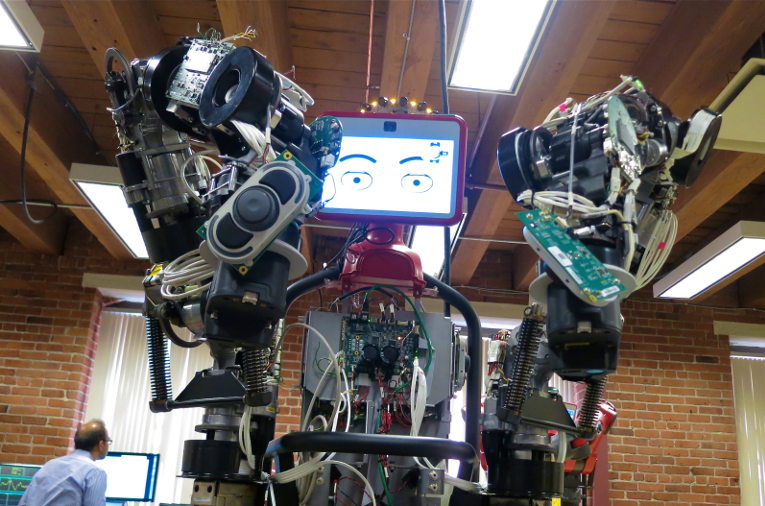
“Roughed up by Robocop” – disassembled robot. (2013) by Steve Jurvetson. via Wikimedia Commons https://commons.wikimedia.org/wiki/File:Roughed_up_by_Robocop_(9687272347).jpg





Comments
We changed commenting systems on September 10, 2026 as part of a site-wide functionality and security upgrade. Your past comments have not disappeared, and you can still log in with your old Disqus account credentials if you wish. Contact us with any questions.
Thanks Kurt. This is valuable stuff. Few of the devotees of Google, Facebook et al seem to understand or care that their algorithms processing vast amounts of information of our lives are severely psychopathic of nature and must destroy mankind if not replaced with more civilized (compassionate) algorithms.
It is inevitable humans will turn to tech and growth. The digital age is just the last step. Algorithms based decisions are just humans getting further from proper scale. There is no solution to this as in an engineering fix. Systematically the various planetary systems will adapt humans back to a proper scale. The natural degradation that occurs with late-stage ecosystems is now full swing with humans. This ecosystem succession principal is in our own ecosystem of human networking. Increasingly the dysfunctional and irrational is resulting. The dependency of more knowledge and tech is a trap but a systematic and self-organizing one. This is why humans are going urban and why technocrats look to controlled urbanism as the final solution. This is in fact a hijacking by the elites and their technocratic support network. The elites take civilizations down with moral hazard creep. Today this moral hazard is transhumanism of the delocalization of what is natural.
I often say atheism is dead. I have nothing against atheism. I don’t consider it right or wrong. When I say it is dead this is because as a degrowth doomer I see a point where the luxury of atheism that comes from the affluence of knowledge and tech will be ending. A similar situation will occur with traditional religions and their corruptions. They too have been hijacked by a human decline from moral hazard. I ask atheist to embrace spirituality not tech and knowledge. There is a worship of tech and knowledge today specifically with scientism and transhumanism. This is an atheistic spirituality. We see the results in environmentalism with green policy of more tech and more centralization of human activity in controlled urban settings. The rural areas will be dominated and controlled by these concentrated human places too and littered with all those green devises. More brown spaces will be the result.
I am calling on atheist because many scientists and engineers involved with this tech, knowledge, and efficiency effort are atheist. Even those who have a religious persuasion are corrupted by these tendencies of the anti-human push of transhumanism. I am calling on our brightest minds who worship science as our only hope to call into question science itself. With affluence comes luxury and with luxury comes moral hazard. I am calling on them to turn to a natural spirituality. Science and spirituality are two separate aspects of the unique human condition of the separateness of the ego but also of the connectedness of community. The sacred is found through community and when the ego lets go. This is where our true nature dwells but we must first find a wisdom to manage our human overshoot that transhumanism is. Spirituality is the key now and specifically a spirituality of acceptance of decline and overshoot. The feeling of power through knowledge and tech is success. This is always growth based but growth is now tipped over by a finite planet and systematic decline of human agency. This is nonnegotiable yet we continue to bargain for more success.
This spirituality is a wisdom of insecurity that comes from letting go. It is a humility of accepting failure of what human’s think is our highest power to grow knowledge and tech. Transhumanism is an immense power that humans dependently turn to. This has now gone to the merging of biology and machine. This mechanization is going further with not trusting human decision making with automation. The end result of this is a dehumanization and a mechanization that can only end in failure because trust can only come in nature not against nature. The planet will stop this because there are no limits to this human drive if left unchecked. A finite planet will stop it humans will not. Asteroids and space travel are transhuman fantasy. The earth must be left once destroyed is the meme. This new spirituality is of limits and acceptance of the consequences of choices. It is also acceptance of this human impulse to transhumanism will not end either. The acceptance is twofold with one being humans will continue turning to growth whether called growth or not. The acceptance is that our finite planet will stop it. Nature rules not man. This spirituality is one of decline, decay, and forced dematerialization but with spiritual growth of finding real humanism.
What this spirituality is then is leap frogging the part of belief and faith and going straight to connectivity. Acceptance of the process itself is a letting go and a new spirituality results. This is simple but the hardest things humans will ever do. Nature and only nature will adapt. This wisdom of insecurity then turns out to be an orientation of what wisdom we can muster to counter this path dependency of carbon and tech growth. This spiritual process turns to the humility and sobriety of less of these things. This is transformative not a transcendence. Mortality is baked in but with meaning. This spirituality calls on man to find grace in naturalness. It means less algorithms and more trust in a new humanism of humility with sobriety. Transhumanism is delocalization and arrogance and a luxury of affluence. Affluence is ending and so will transhumanism and its delocalizations. Realgreenadaptation.blog
The
author of the story on which “MInority Report” is based is P.K. Dick –
my favorite science fiction writer! “Bladerunner” and “Total Recall” are
also based on his works.
Yep, overblown and amazingly simplistic, but hyped to the moon by salesmen. No surprise, our authorities are stupid and fearful enough to buy completely into it. That’s not to say it won’t make many deadly and horrible mistakes, but if you feed these systems more data points, you merely make meaningless correlations easier to find. Nevertheless, there is a simple action here for everyone doing serious anti-capitalist work: stop feeding the biggest surveillance systems, Facebook, Google etc, your data.