Last year, Americans spent an estimated $5,000,000,000 shopping during the 24 hours that made up “Black Friday.” That’s over $208 million an hour or about $3.5 million a minute. I don’t have hard evidence for this claim, but my educated guess is that a good portion of this spending is on stuff that’s made by people in far corners of the planet who couldn’t afford to buy it themselves, for people who don’t really need it. And I also think it’s safe to say that much of this stuff is made from depleting, nonrenewable resources through processes that cause pollution, help warm the planet, and will wind up in a landfill someday soon if not already. Aside from the warm-and-fuzzies generated by holiday gift giving, this “Black Friday” tradition leaves a lot to be desired.
The good news is that we can all have those warm-and-fuzzy experiences without spending a dime.
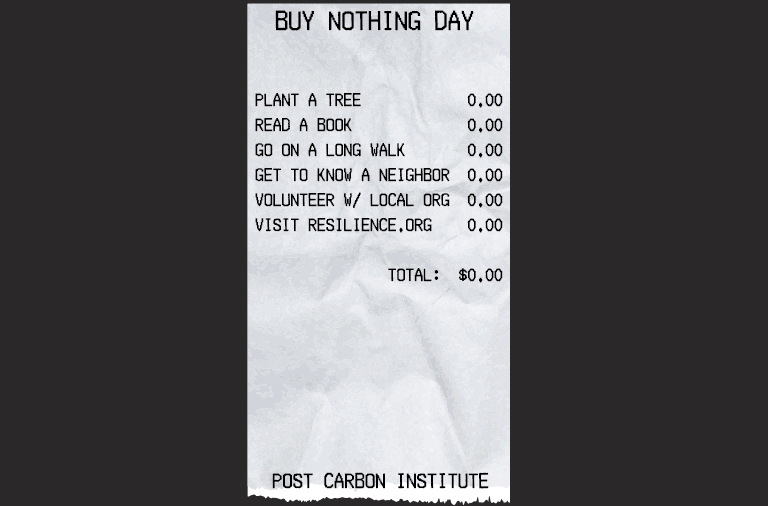
This Black Friday we’re inviting everyone to join us and our friends at Adbusters in celebrating “Buy Nothing Day.” We’re not asking you to become a Grinch, or completely abstain from Christmas or Hanukkah or whatever form of gift giving ritual you and yours celebrate. But maybe take a pass on this most egregious day of consumeristic binging.
Related Articles
'SELECT SQL_CALC_FOUND_ROWS wp_posts.ID
FROM wp_posts LEFT JOIN wp_term_relationships ON (wp_posts.ID = wp_term_relationships.object_id)
WHERE 1=1 AND wp_posts.ID NOT IN (3474430) AND (
wp_term_relationships.term_taxonomy_id IN (2,8988,8992)
) AND wp_posts.post_type = \'post\' AND ((wp_posts.post_status = \'publish\'))
GROUP BY wp_posts.ID
ORDER BY wp_posts.post_date DESC
LIMIT 0, 3'
By Jan Spencer, Resilience.org
Benicia, California, is set to lose its largest single employer and source of tax revenue, a sprawling oil refinery. A Guardian article about this issue catalyzed this essay that describes what a thoughtful process might look like, if a community – any community – chose to pursue sustainability instead of economic growth.
April 2, 2026
By Miho Soon, Post-Growth Institute
It’s curious that money trauma hasn’t gone into the mainstream yet. It’s one of the most fundamental forces shaping how we move around in our lives, and yet it remains incredibly taboo.
March 31, 2026
By Jeremy Lent, Resilience.org
The gap between the beckoning future of an ecocivilization and today’s grim reality is only too clear. But to the extent that meaningful hope does arise, it emerges from the very ruptures of our present breakdown. As the weave of our dominant system unravels, possibilities emerge to reweave our societal fabric into a new design.
March 31, 2026