

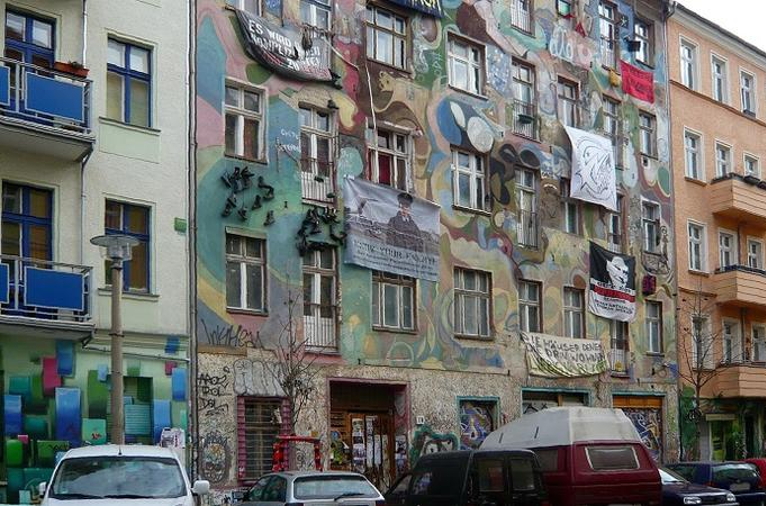
Here’s the problem: The founders of “Mietshäuser Syndikat” (tenements syndicate), a network of cohousing projects in Germany, observed many self-organized cohousing projects struggle and fail. Some couldn’t overcome the challenges in the critical early phases, in terms of dealing with legal issues, finances, and group dynamics, while others created commercially exploited housing projects against their original intentions. At the same time, many cohousing projects did not have the capacity to support each other.
Here’s how one organization is working on the problem: The Mietshäuser Syndikat was launched to support self-organized, social housing projects. It connects successful, established projects with emerging ones to provide help, while at the same time reducing re-commercialization by ensuring all inhabitants co-own all real estate assets of all cohousing projects.
A legal construct stipulates that each cohousing project is considered an autonomous enterprise that owns its real estate, with the legal status of a limited liability company (LLC or “GmbH” in German). This GmbH consists of two partners: the cohousing association itself and the Mietshäuser Syndikat GmbH. The form of limited liability companies allows the property assets to be interconnected, since decisions cannot be made unilaterally. Finally, the single associate of the network’s GmbH is the MHS Association, which all inhabitants are part of.
For a cohousing initiative to join MHS, some requirements must be met: The cohousing project needs to be self-organized by its residents, and a house and a financing plan must be on hand. Once the cohousing project establishes a secure financial basis, it needs to support new projects that are in the critical, cost-intensive early phases, the same way it received help when it began. The MHS Association represents all inhabitants of all cohousing projects and has a veto right when it comes to reprivatization and commercial exploitation of individual projects. Regarding any other issue concerning the residents, loans, rents, and renovation, the co-residents themselves make decisions on behalf of their own cohousing association.
Results:
- Since 1983, the network has grown to consist of 111 cohousing projects with a total of about 3,000 residents.
- Twenty-one initiatives throughout the country are in the process of joining the network.
- Spin-offs like “habiTat” in Linz, Austria, have been established in other countries.
Learn more from:
• Mietshäuser Syndikat
• Habitat (German)
This case study is adapted from our latest book, “Sharing Cities: Activating the Urban Commons.” Get a copy today.
This article is cross posted with permission from Shareable.net.




Comments
We changed commenting systems on September 10, 2026 as part of a site-wide functionality and security upgrade. Your past comments have not disappeared, and you can still log in with your old Disqus account credentials if you wish. Contact us with any questions.