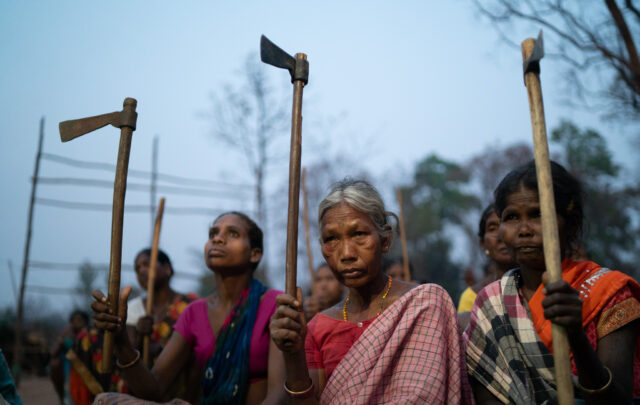
The full length interview with Helena Norberg-Hodge from the upcoming documentary A Simpler Way: Crisis as Opportunity.
Support the full film at: http://igg.me/at/asimplerway/x/7867973.

By Samuel Alexander, originally published by The Simpler Way
September 2, 2015
The full length interview with Helena Norberg-Hodge from the upcoming documentary A Simpler Way: Crisis as Opportunity.
Support the full film at: http://igg.me/at/asimplerway/x/7867973.
Dr. Samuel Alexander, co-director of the Simplicity Institute, is a lecturer at the Office for Environmental Programs, University of Melbourne, Australia, teaching a course called ‘Consumerism and the Growth Economy: Critical Interdisciplinary Perspectives’ into the Master of Environment. He is also a Research Fellow with the Melbourne Sustainable Society Institute. He is author of eighteen books, including Degrowth in the Suburbs: A Radical Urban Imaginary (2018), Art Against Empire: Toward an Aesthetics of Degrowth (2017), Just Enough is Plenty: Thoreau’s Alternative Economics (2016), Prosperous Descent: Crisis as Opportunity in an Age of Limits (2015), Sufficiency Economy: Enough, for Everyone, Forever (2015), and Entropia: Life Beyond Industrial Civilisation (2013), and he is editor of Voluntary Simplicity: The Poetic Alternative to Consumer Culture (2009) and co-editor of Simple Living in History: Pioneers of the Deep Future (2014). A full publication list is available here.
As well as his academic work, in recent years Sam has been working on a ‘simpler way’ demonstration project which became the subject of a documentary, ‘A Simpler Way: Crisis as Opportunity‘. He is also founder of the Simplicity Collective, a website and social network dedicated to exploring the relationships between voluntary simplicity, energy descent, and post-growth / degrowth economics. Dr. Alexander’s PhD thesis, conducted through Melbourne Law School, is entitled “Property beyond Growth: Toward a Politics of Voluntary Simplicity”.
Tags: economics of happiness, new economy, The Simpler Way
By Richard Heinberg, Independent Media Institute
We must develop a realistic plan for energy descent, rather than clinging to naive fantasies of endless consumer abundance powered by alternatives to fossil fuels.
May 15, 2026
By Sandra Ericson, The Observatory
Nordic countries used an education system rooted in human ecology and civic formation to build high‑trust, more equal democracies. Could similar changes in U.S. schools help confront inequality, polarization and the climate crisis?
May 14, 2026
By Pamela Boyce Simms, Pamela Boyce Simms Substack
Elections and protest movements may shift public attention, but systemic change depends on building resilient economies capable of replacing the structures now driving inequality and social fragmentation. The solidarity economy, an evolving network of post-capitalist worker-driven coalitions, is what we need.
May 14, 2026