



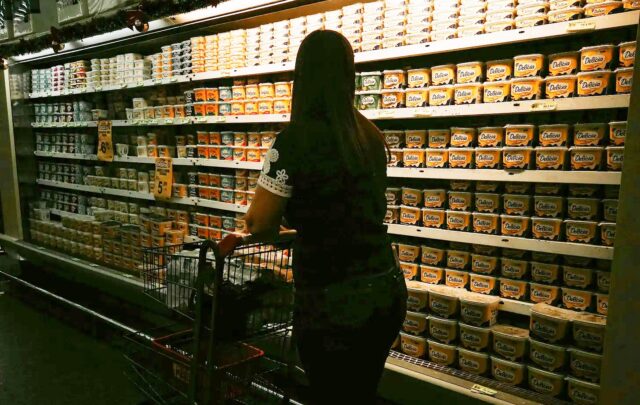
Food Waste Recycling Law allowed the Japanese food industry to reduce, reuse, and recycle an average of 82 percent of its food waste in 2010. (shutterstock)
Japan discarded approximately 18 million tonnes of food annually—five to eight million tonnes of that food was considered edible when it was discarded.
This amount was virtually equivalent to the amount of the country’s annual rice production (8.39 million tonnes). Three to four million tonnes came from the food industry and another two to four million from individual households; this is comparable to the total amount of food aid distributed worldwide (about four million tonnes).
Growing consumerism in Japan has resulted in a huge amount of waste generated daily, and exacerbated of the shortage of space available for landfills. In the 1990s, the intention was to shift from a linear production-consumption-waste process to a circulatory system, minimizing the consumption of natural resources and turning waste into valuable resources to be exploited.
Japan’s Food Recycling Law was enacted in 2001 and revised in 2007 in order to promote the reutilization of food resources. It encourages food-related businesses to reduce the generation of food waste during production in order to implement recycling methods (e.g. animal feed, fertilizer, methane), and to promote heat recovery and weight reduction (i.e. dehydration). The most successful implementation is represented by eco-towns and “recycling loops,” recycling facilities working in symbiotic relationship between industrial and urban areas and improved recycling systems circulating resources respectively.
When the issue of food waste entered the political agenda, it represented one of the many aspects of the national environmental policy aimed at solving the garbage problem. The success of the Food Waste Recycling Law allowed the Japanese food industry to reduce, reuse, and recycle an average of 82 percent of its food waste in 2010. Methane, oil and fat products, carbonized fuels, and ethanol accounted for seven percent, fertilizer for 17 percent, and animal feed for 76 percent—the latter being the primary recycling final product by far.
A key driver behind the government’s promotion of food waste recycling has been the country’s high dependency on natural resource imports. Japan’s self-sufficiency of feed for livestock was as low as 26 percent in 2011, implying that the vast majority of it was actually imported from abroad. With the Basic Plan for Food, Agriculture, and Rural Areas, the Japanese government set the objective of rising feed self-sufficiency to 38 percent by 2020 through the production of eco-feed via the implementation of recycling loops. The global rising in the prices for fuel, corn and soy meal made imported agricultural products destined to livestock as much as 50 percent more expensive, which enhanced the popularity of locally recycled feed. Moreover, since domestically raised livestock fed on imported feed do not count as domestic in origin, the high imports of feed also caused a decline in the self-sufficiency rate for livestock products. This in turn was being subtracted from the domestic food supply capacity, resulting in a decreased national self-sufficiency for food. In fact, higher self-sufficiency rates for both feed and for livestock products would naturally result in less need for imports, and therefore in a general enhancement of the country’s food self-sufficiency rate on a calorie supply basis. Therefore, while reducing the environmental burden, the new business models, infrastructures, technologies and policies in support of food waste recycling also had the direct objective of improving domestic production and stable food supply.
Federica Marra is an expert on food waste, the 2012 winner of the Barilla Center for Food & Nutrition YES! Competition, and a member of the Food Tank Advisory Group.


Comments