Click on the headline (link) for the full text.
Many more articles are available through the Energy Bulletin homepage
Growing Cities Movie
Dan Susman and Andrew Monbouquette, Growing Cities website
Growing Cities is a feature-length documentary film about urban farming across America. It follows two friends in their road trip across country as they meet with leaders in the urban farming movement and learn how cities are being revitalized one vegetable, bee, and chicken at a time.
Some would says times are bleak in our country today—one third of our children will develop diabetes, nearly 9% of the population is unemployed, and environmental disasters such as the Gulf oil spill and Katrina have become almost commonplace.
In our hometown, Omaha, NE, signs tell us how we are one of the fastest growing cities in the country. Yet, there are other signs that say we are also one of the least healthy. The idea for Growing Cities came out of this conundrum. If growing bigger isn’t making our cities healthier and more vibrant places to live, then what kind of growth will? That’s when we started thinking about a different kind of growing … one that involves rooftop gardens, backyard chickens, and vegetables literally sprouting out of concrete.
Growing Cities follows me, Dan, and my friend Andrew on our road trip across country learning about Urban Agriculture from city-dwellers who’ve made it their lives. Visiting urban centers from Los Angeles to New Orleans we discover a diverse, grass-roots movement that is building across our country—people growing food in cities to make a living, to learn and to teach, to provide safe and nutritious food for their children, and to build stronger and more vibrant communities.
The film will also track the development of city farming throughout our country’s history and examine the biggest challenges urban farmers face today.
Through our journey we’ll re-imagine what is possible in urban settings and inspire Omahans and all Americans to create growing cities of their own—places that are healthier, more sustainable, and socially just.
(2011)
Something’s Growing at Riverpark
Sisha, Riverparkfarm blog
Thanks for visiting the Riverparkfarm.com, the official website of the Riverpark Farm at Alexandria Center. I’m the chef and a partner at Riverpark restaurant and one of the founders of the Riverpark farm.
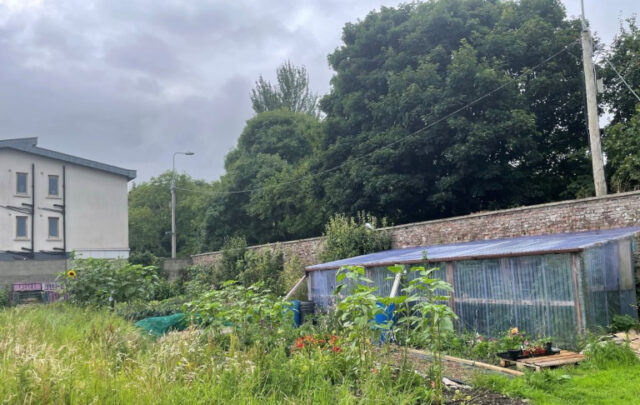
On these pages you can learn about the 15,000 square foot urban farm we built in a stalled construction site on East 29th Street in New York City. We sometimes refer to our farm as the “most urban farm” because it’s right in the heart of the largest city in the United States. We’re not located in a park or preserve either, we’re at street level at 430 East 29th Street.
I invite you to visit this website often to get to know some of the people working at our farm, pick up some urban farming tips, recipes and cooking tips for fresh produce. We also hope to inspire people to try their hand at growing some of their own food. We’re doing it now in the most improbable of places – an urban construction site – using thousands of soil-filled milk crates as our farmer’s field. There’s nothing quite like eating just-picked, “hyper-fresh” produce, both in terms of flavor and nutrition. If we can do it, so can you.
(3 Aug 2011)
Picturing World Agriculture
Sharon Astyk, Scientific American guest blog
When most of us write about food and agriculture, we include references to the larger world food picture. This is understandable, but it can lead to problems of context and comprehension. We tend to tie our discussions about agriculture to the plight of the world’s teeming hungry poor – but these discussions are often loaded down with a set of underlying assumptions prevalent among citizens of the developed world. We think that the solution to hunger is more food production; and indeed, sometimes it is. But where and how our agricultural technologies are distributed has a greater effect than the technologies themselves, and until we understand what farms look like worldwide, it all too is easy for us to tout the latest breakthrough’s hypothetical ability to feed so many millions of hungry people. Unfortunately, the path to reaching those people is more complicated than that.
In order to understand where the future may take us, we need an accurate picture of world agriculture to work with. We must understand what limiting factors affect us now, and how they may change in the future. When we discuss organic or conventional agriculture in the developed world, we may have in our minds the usual misleading conventional Western iconography: we speak of farmers “feeding the world”, and imagine a man on a tractor in a large field in the best agricultural regions of our own country, growing grain. That’s a part of the picture, of course, but not the largest part. So let’s take a look at the world’s average farm.
The first thing you’d notice about a typical world farm, say in Asia or Africa, is that it is small – about 2 hectares, or less than five acres. 85% of all the farms in the world are smaller than five hectares. Those small farms produce more than half the world’s total calories, and almost half the world’s grains. Most of us imagine that grain must be grown on a huge scale, with combines and tractors, but in fact, nearly half of all grain is grown in small fields, using mostly hand labor. The vast majority of the world’s rice, for example, is grown on small-scale farms in Asia. Half or more than half of the corn, beans and potatoes that feed Latin America are produced on farms that are tiny by the standards of the Global North [1].
Historically speaking, most of the gains of agricultural technologies have gone into the bellies, into the livestock, and now with the biofuel boom, into the cars of people in the developed world who have never been hungry. We know that livestock, for example, have eaten more Green Revolution grains than people have.
The second thing you’ll notice when you take a look at that average world farm, is that the farmer isn’t a man, and almost certainly doesn’t own a tractor. More than half of all farmers are women, although women own only 1% of the land on the planet [3]. Women produce about half of the world’s food, and they do the vast majority of the world’s food processing and preservation. In some regions, like sub-Saharan Africa, women constitute 80% or more of all farmers. The majority of farming African women use very simple agricultural tools – the same digging sticks and handmade implements that have been used for centuries [4]. And planet-wide, most farmers do their farm work around other domestic responsibilities including food preservation and preparation, childcare, and fetching water and firewood…
(11 Aug 2011)
National Farmers Market Week: Why the Feds Should Support Family Farms
Elliott Negin, Civil Eats
In case you missed the announcement, this week is National Farmers Market Week. No matter. If you shop regularly at one of the more than 7,000 markets across the country, every week is farmers market week. That’s true in my neighborhood, where FreshFarm Markets started the first producer-only farmers market in Washington, D.C., 14 years ago.
When I relocated to D.C. from New York, I had no idea I was moving to a food desert. Although Dupont Circle wasn’t poor by any means, we had limited access to healthy, fresh food. There was one small supermarket we called the “Soviet” Safeway because there were usually long lines and nothing on the shelves. The produce there was pitiful: The tomatoes, picked green and reddened with ethylene gas, could break your teeth.
FreshFarm came to the rescue in 1997 with 15 small, family farms hawking fruit, vegetables and flowers on Sundays from early July to mid-November. That first season attracted 21,000 customers. Today, the market boasts 42 stands selling fruit, vegetables, meat, cheese, eggs, seafood, baked goods, flowers and plants every Sunday all year round. Last year it drew some 162,000 shoppers.
But that’s not all. Over the last decade, FreshFarm, a nonprofit spun off from American Farmland Trust in 2002, set up 10 other one-day-a-week markets in the region, which collectively attracted more than 350,000 customers last year.
These markets have not only been a boon for area residents hungry for tasty, locally produced food, they provide a lifeline for regional farmers–and create jobs in rural areas. Some 150 family farms in Delaware, Maryland, Pennsylvania, Virginia and West Virginia now sell their goods at one or more of the FreshFarm Markets, and there are now some 40 other farmers markets run by other organizations within 10 miles of Dupont Circle…
(12 Aug 2011)
Creating a sustainable world: An interview with Barton Seaver
Jadda Miller, Nourishing the Planet
National Geographic fellow, author and chef, Barton Seaver has dedicated his career to restoring the relationship we have with our ocean. It is his belief that the choices we are making for dinner are directly impacting the ocean and its fragile ecosystems. He promotes sustainability, wellness, and community as they relate to food.
He sits on the board of the hunger-fighting organization D.C. Central Kitchen. He also has collaborations with the School Nutrition Association, the Center for Health and the Global Environment at Harvard Medical School. They help promote a wider understanding of the human health consequences of global environmental change.
Seaver became a National Geographic fellow in 2010, working with the global partnership initiative Mission Blue. He developed a list of ocean friendly substitutes for popular yet depleted seafood species, and co-created the Seafood Decision Guide for consumers which evaluates seafood based on health and environmental factors.
His first book, For Cod and Country: Simple, Delicious, Sustainable Cooking is a cookbook of seasonal, environmentally responsible seafood and vegetable recipes.
Why do you feel it is important to use underutilized and more sustainable fish species in your cooking?
Because, we have commoditized our seafood preferences and ecosystems don’t work that way. We demand our preferences instead of asking a fish monger or local fisherman, what is freshest? What is local? In Europe people go to the docks to buy their seafood, they have a totally different idea of the meaning, “grocery shopping”.
It didn’t matter to my customers what variety of fish it was, even if they had never tasted it before because they always knew that it would be great. People got excited about trying a new fish species and continually would come back for another culinary adventure…
(12 Aug 2011)
Read more about the book here.
“And The Echo Follows” Brings the Food Sovereignty Movement to Life
Christina Schiavoni, why
From the administration’s recent approval of GM alfalfa to the First Lady’s embrace of Wal-Mart as the latest healthy food hero, the food movement in the US is beginning to get riled up—and for good reason. Just as communities are making some headway on building local food systems, structures from above seem to be working extra hard to dismantle them. Words like “democracy,” “power,” and even “revolution” are showing up more frequently on food and farm listservs, undoubtedly inspired by the popular uprisings sweeping across northern Africa and the Middle East, many of which were sparked by the food price spikes of the globalized food system. This confluence of factors makes And the Echo Follows by Nic Paget-Clarke a timely arrival for those who are yearning to tackle food issues in their broader political context.
And the Echo Follows brings the concept of food sovereignty to life by sharing the stories, insights, and images of the people who are putting it into practice every day. We hear from Maori activists in New Zealand who are resisting further colonization in the form of biopiracy of their native flora and fauna, indigenous knowledge, and even their own DNA. We hear from peasant leaders of Mali who are making up for the failure of the government to regulate agricultural prices by creating their own system of locally controlled reserves. We hear from community leaders of Venezuela and Bolivia, where for the first time, peasants and indigenous peoples are at the helm of a process of social transformation based on participatory democracy. These stories, together with vivid images and historical context, form a fascinating web of interconnections and commonalities that Nic Paget-Clarke has masterfully woven together in this work…
(12 Aug 2011)
And read more about this book here.