


Click on the headline (link) for the full text.
Many more articles are available through the Energy Bulletin homepage
How Bad Will It Get?
Mike Whitney, Information Clearing House
The U.S. economy is at the beginning of a protracted period of adjustment. The sharp decline in business activity, which began in the summer of 2007, has moderated slightly, but there are few indications that growth will return to pre-crisis levels. Stocks have performed well in the last six months, beating most analysts expectations, but weakness in the underlying economy will continue to crimp demand reducing any chance of a strong rebound. Bankruptcies, delinquencies and defaults are all on the rise, which is pushing down asset prices and increasing unemployment. As joblessness soars, debts pile up, consumer spending slows, and businesses are forced to cut back even further. This is the deflationary spiral Fed chairman Ben Bernanke was hoping to avoid. Surging equities and an impressive “green shoots” public relations campaign have helped to improve consumer confidence, but the hard data conflicts with the optimistic narrative reiterated in the financial media. For the millions of Americans who don’t qualify for government bailouts, things have never been worse.
Kevin Harrington, managing director at Clarium Capital Management LLC, summed up the present economic situation in an interview with Bloomberg News: “If we have a recovery at all, it isn’t sustainable. This is more likely a ski-jump recession, with short-term stimulus creating a bump that will ultimately lead to a more precipitous decline later.”
Reflecting on the Fed’s unwillingness to force banks to report their losses on hard-to-value illiquid assets, Harrington added, “We haven’t fixed the problem. We’ve just slowed down the official recognition of it.”…
(3 Sept 2009)
Building the Ownership Society
John Medaille, Front Porch Republic
Discussions of what to do about the current crisis commonly take the form of an argument between “socialism” and “capitalism.” However, such a discussion is flawed in both of its terms. Real socialism collapsed in 1989, and few would want to return to that horrific system. What is less well understood is that pure capitalism itself collapsed in 1929, never to rise again anywhere in the world. There are few citizens with any living memory of real capitalism, and the memories they have are generally unfavorable. Capitalism collapsed for the same reason as communism, a victim of its own internal contradictions that caused chronic instability. Workers found the system unacceptable, to be sure, but so did the capitalists themselves, and few were very sorry to see it go. Pure capitalism had proved itself toxic to both capital and labor, just as Belloc predicted it would in 1913.
The first task in reforming the system to understand the system that we have, the system that is in full failure, and understand apart from the ideological terms commonly used to describe it. The system that replaced capitalism was first a hyper-active Keynesianism, brought about by World War II and which lasted until the late 70’s; Keynesianism itself was then replaced by a pure mercantilism, the system which combines private privilege with public power and which so incited the wrath of Adam Smith. It is this mercantilism which finds itself in the midst of a full-blown collapse. Both the Keynesianism which replaced capitalism, and the mercantilism which replaced Keynesianism, depend on massive government controls and subsidies which are no longer practicable or sustainable. Nor can we go back to the capitalism of the 1920’s without reliving the instability of that turbulent period.
If capitalism is not a viable alternative, if it represents a system that no living man has seen, why then do the arguments in its favor carry such weight? I believe the reasons are mostly ideological. Capitalists are quite willing to trot out libertarian arguments when dealing with some regulation or tax that they find odious, but they are just as willing to put such arguments aside when they seek some privilege or subsidy from the government. In this way, the most well-meaning of the libertarians serve as the fellow-travelers and useful idiots of the mercantilists. And although I have a great deal of respect for the libertarian arguments in general, in practice these arguments do not function apart from well divided property, as the older, pre-Austrian libertarians realized…
(3 Sept 2009)
China and the buzz of a pending bank default
The Fundamental View blog
Let’s put the pieces together here. Just this past weekend China announced that State Owned Enterprises (SOEs) will be allowed to default on commodity derivative contracts. Think of that. China has given the green light and authorized the defaulting on commodity derivative contracts.
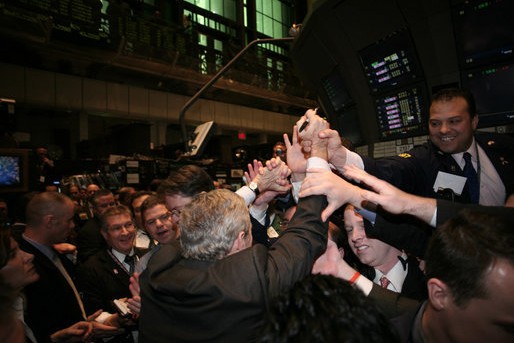
This story broke over the weekend but has not gotten much mainstream media attention on this side of the pond. (North America). The only inference to it was the talk or “buzz” on the Wall Street floor that another bank was rumored to be close to defaulting. As Art Cashin of UBS Securities indicated in the video clip I posted earlier, normally when a market sells off on a rumor and the rumor turns out to be false, the market will tend to correct itself. IT DIDN’T.
The Reuters report cited 6 foreign banks that received letters indicating that the Chinese State Owned Enterprises would be given the green light to default on their derivatives.
A look at what a derivative actually is may be useful here. A Derivative is a financial instrument that is derived from some other underlying asset, index, event, value or condition. Rather than trade or exchange the underlying itself, derivative traders enter into an agreement to exchange cash or assets over time based on the underlying. A simple example is a futures contract: an agreement to exchange the underlying asset at a future date. Commercial and investment banks make up the foundation of the over the counter (OTC) derivatives market. Investors use derivatives to protect against risks, such as sudden changes in price or value of the underlying asset. Others tap derivatives to take on extra risk, in the hope of extra gains…
(3 Sept 2009)
States of shock
Ilargi, The automatic earth
An article at the excellent MyBudget360 site says Californians may soon be able to claim 92 weeks of unemployment benefits. The beyond bankrupt state already pays out $80 million in unemployment insurance per day!.
“So far this year California has dished out some $11 billion in unemployment insurance. This is the biggest amount on record, dwarfing the previous record set last year at $8.1 billion.”
While that may sound like a lot of money, in actual fact 365 days of $80 million really adds up to almost $30 billion. California has a $60 billion hole in its budget this year. Looks like that hole is about to get a whole lot bigger.
…As I was reading these things, I figured it might be a good idea to take a look around for more news on state budget problems. Part of me wishes I’d never had that brilliant thought. Within minutes I had some 40 articles lined up, just from one day. I stopped looking, but there’s no doubt I could have gathered dozens more where that came from…
Recession moves migration patterns
Andrew Walker, BBC news
The global recession has had a marked effect on international migration according to a special report commissioned by the BBC World Service.
Fewer people are moving abroad for work but those who are already abroad are, for the most part, staying put.
And in general, money sent by migrants to their families in their home country, has declined…
(8 Sept 2009)



Comments
We changed commenting systems on September 10, 2026 as part of a site-wide functionality and security upgrade. Your past comments have not disappeared, and you can still log in with your old Disqus account credentials if you wish. Contact us with any questions.