

Richard Heinberg, author of Powerdown, makes plain the dire situation we’re in as declining oil supplies fail to meet demand. He notes there are no easy “supply side” solutions (like substitute fuels): we must reduce demand, initially through conservation and efficiency. Julian Darley, president of Post Carbon Institute observes that while personal action is very important, individuals can only do so much. A deeper response must come at the municipal level — to change infrastructures on how we heat, transport, and power our society. Sharing, he notes, can bring enormous energy reductions almost immediately: after all, two people rather than one in a car cuts energy use per person in half. Bottom line: Americans love rising to a challenge. And this IS a challenge! (www.postcarbon.org, www.richardheinberg.com) Produced September 27, 2008. Episode 129.

Related Articles
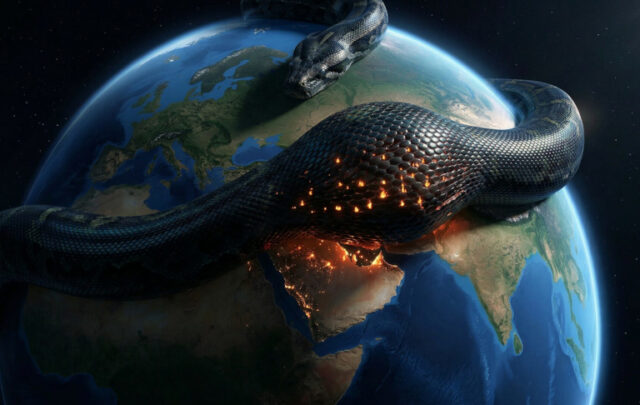
Iran, U.S., and the Rest: The Unavoidable Pig in the Python
In this episode, Nate offers a personal reflection on the unfolding geopolitical tensions surrounding the Strait of Hormuz, beginning with an examination of how disruptions to fossil fuel flows propagate through the global economy, but with a time lag.
March 30, 2026
Iran to Trump: If you destroy us, you destroy yourself
So, there you have it. Trump and his team have stumbled into a war they cannot win. If the war does not end soon, it will likely destroy the world economy for lack of energy supplies and plunge it into a deep, years-long depression, one from which it will be difficult to emerge.
March 29, 2026

Entropia and the Disintegration of Empire
As the current situation (March 2026) around the Strait of Hormuz continues to destabilise the global economy, it is timely to return to Alexander’s analysis outlining ‘the Disintegration of Empire’ (being Chapter Two of Entropia).
March 23, 2026

