


Click on the headline (link) for the full text.
Many more articles are available through the Energy Bulletin homepage
Spam drops (dramatically!) after Internet providers disconnect a California hosting firm
Brian Krebs, Washington Post
Host of Internet Spam Groups Is Cut Off
—
The volume of junk e-mail sent worldwide dropped drastically today after a Web hosting firm identified by the computer security community as a major host of organizations allegedy engaged in spam activity was taken offline, according to security firms that monitor spam distribution online.
While its gleaming, state-of-the-art, 30-story office tower in downtown San Jose, Calif., hardly looks like the staging ground for what could be called a full-scale cyber crime offensive, security experts have found that a relatively small firm at that location is home to servers that serve as a gateway for a significant portion of the world’s junk e-mail.
… Immediately after McColo was unplugged, security companies charted a precipitous drop in spam volumes worldwide. E-mail security firm IronPort said spam levels fell by roughly 66 percent as of Tuesday evening.
Spamcop.net, another spam watch dog, found a similar decline, from about 40 spam e-mails per second to around 10 per second
(12 November 2008)
Is this for real? A 66% drop? Can anyone calculate how much energy this represents (e.g. in electricity and infrastructure)? -BA
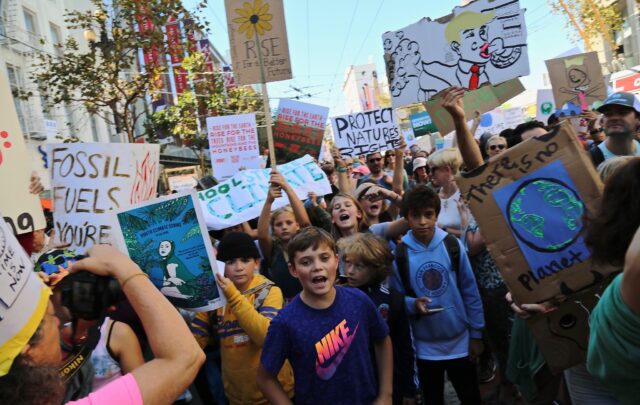
Is ‘ecoterrorism’ really a threat?
Bibi van der Zee, Guardian
Police suggestions that the public should be wary of a growing tide of activism amounts to nothing more than hysteria aimed at a movement that has often been radical but rarely violent
—
… ecoterrorism is itself one of the most pernicious examples of governmental rule-by-fear of this age.
To begin with, ecoterrorism is a far broader category than you would expect: it’s defined by the FBI as “the use or intended use of violence of a criminal nature against innocent victims or property by an environmentally oriented, subnational group for environmental-political reasons, or aimed at an audience beyond the target, often of a symbolic nature”.
Damage to property? Well, sabotage is a tactic used relatively often by activists. One of the most traditional forms of direct action, it dates back centuries, as the Luddites, who wrecked the factory machines which were destroying their livelihoods, would testify.
… And although ecoterrorism is regarded as one of the most serious domestic security threats in the US, to my knowledge not one of the dozen or so people serving time for acts of ecoterrorism in that country has caused any bodily harm at all. Their crimes consist of setting fire to cars and buildings, or of planning to do so, and their sentences are frequently out of all proportion to the crime. Eric McDavid, for example, is currently serving 19 years for planning damage to mobile phone masts and pylons.
Currently none of the activists in this country that I’ve spoken to are much inclined towards violence against people: in fact most of them are deeply committed to non-violence.
(10 November 2008)
Peak Oil Warfare: Identifying the Risks
PeakEngineer, PeakOilDesign.com
In speaking of Peak Oil, may people frequently highlight the need for security and self-defense against random aggressors. While it is clear that the security environment in a post-Peak Oil world will be far more volatile, few have given a thorough look at the nature of the threats we will face. Will it be bands of crazed suburbanites, oppressive government regimes, or legions of foreign troops that pose the greatest threat? This writing is intended to provide a thorough and objective look at the future of personal and community defense so as to guide us on the most effective ways to prepare strategies.
… So if biker gangs, martial law, and foreign occupiers aren’t our greatest security threats, what is our greatest risk? In short, crime.
This is not a trivial threat. Consider the number of neighbors or relatives you know who have made preparations or even listened to concerns about Peak Oil and the host of other crises on the horizon. Chances are they can be counted on one hand, at best. This presents a huge security risk literally in our own backyards as our hungry friends and neighbors grow desperate in their needs for food, warmth, and water. Crime will present itself more and more frequently as time goes by and is by orders of magnitude the security risk about which we should be most concerned.
The catch, however, is that we need friends and neighbors in order to assure our long-term survival. Despite many survivalist claims to the contrary, it is a much greater risk for an individual or family to attempt to survive the wilderness alone than the threat of attack by those closest to you.
The strategy for security preparations against local crime is by no means a purely military one. Remember the adage “war is continuation of politics by other means”. The wisest strategy for security is one that focuses on developing a strong political situation which dictates the smallest possible military backup. Strategies for ensuring physical security must focus on ensuring food, energy, and water security for the local community, which gives the residents something to defend rather that erode.
Even the best prepared among us will be forced to make tough choices in the time ahead, such as who to help and who to guard against. However, we must err toward assisting the needy, even if we keep a wary eye on what we have painstakingly prepared for ensuring our own survival. We cannot hope to keep what we have prepared if we are not prepared to keep our community.
(13 November 2008)
Family homelessness rising in the United States
Ross Colvin, Reuters
President-elect Barack Obama has vowed to help middle-class U.S. homeowners facing foreclosure, but he has said little about how he will help low-income families made homeless by a worsening economy.
Obama has spoken broadly about boosting affordable housing and restoring public housing subsidies. But with economists forecasting a deep recession in 2009, he may find it hard to find the money to fulfill those promises soon.
At the same time, advocacy groups and the country’s czar for combating homelessness say immediate action is needed to halt the foreclosures of tens of thousands of homes and rehouse thousands of families amid the worst financial crisis since the Great Depression of the 1930s.
(12 November 2008)



Comments