


Click on the headline (link) for the full text.
Many more articles are available through the Energy Bulletin homepage
Soil research has dried up
Graham Harvey, Guardian
Unless we address the problem of declining soil quality, we, and most other life forms on the planet, are in big trouble
—
If you had to choose the region of Britain under greatest pressure from the global demand for food it would have to be eastern England. Ever since the second world war this landscape of big skies and broad, featureless farmlands has been the epicentre of high-input industrial agriculture.
So it’s no surprise that the region is starting to show signs of strain. A new report from the Royal Agricultural Society of England (RASE) warns that deteriorating soil quality could render some parts of the country unfit for productive farming. Eastern England, with its intensive cropping for fruit and vegetables, is highlighted as a likely candidate.
The team of leading soil scientists who wrote the report are calling for more government-backed research on food production and less on environmental protection. A good starting point might be a new national centre for soil and water management, says the report. It should look urgently at how our soils are going to adapt to climate change. Without this research, we’re likely to face increased flooding and static or falling crop yields.
As one who studied soil science along with agriculture in the 1960s, I find myself in total sympathy with this clarion call. Back in the 60s, when food shortages in western industrial countries were still imaginable, the study of soils was seen as a vital branch of science. In today’s world of genetic manipulation and molecular biology, it sounds almost Victorian. The very phrase soil science conjures up pictures of brass microscopes and mahogany work-benches littered with reagent bottles.
So it’s no surprise to learn that scientists are deserting the discipline in their droves. Around the country soil science departments have closed, and key research scientists have emigrated or retired. Postgraduate research has virtually dried up.
There’s probably no better illustration of society’s metropolitan attitude to the countryside than the neglect of this vital discipline and the elevation of environmental studies to pole position. If we’re not careful it will be our undoing. Those in touch with the real world know that our dependence on the soil remains total.
Terrestrial life on this planet depends, as it always has, on the chemical and biological processes that take place in the top few centimetres of earth. If the soil breaks down we and most other life forms on the planet are in big trouble.
(25 October 2008)
Related:
Soil health ‘threatens farming’ (BBC)
Soil food web – opening the lid of the black box (Energy Bulletin)
Europe’s secret plan to boost GM crop production
Geoffrey Lean, The Independent
Gordon Brown and other European leaders are secretly preparing an unprecedented campaign to spread GM crops and foods in Britain and throughout the continent, confidential documents obtained by The Independent on Sunday reveal.
The documents – minutes of a series of private meetings of representatives of 27 governments – disclose plans to “speed up” the introduction of the modified crops and foods and to “deal with” public resistance to them.
And they show that the leaders want “agricultural representatives” and “industry” – presumably including giant biotech firms such as Monsanto – to be more vocal to counteract the “vested interests” of environmentalists.
News of the secret plans is bound to create a storm of protest at a time when popular concern about GM technology is increasing, even in countries that have so far accepted it…
(26 October 2008)
Farm-Credit Squeeze May Cut Crops, Spur Food Crisis
Carlos Caminada, Shruti Singh and Jeff Wilson; Bloomberg
The credit crunch is compounding a profit squeeze for farmers that may curb global harvests and worsen a food crisis for developing countries.
Global production of wheat, the most-consumed food crop, may drop 4.4 percent next year, said Dan Basse, president of AgResource Co. in Chicago, who has advised farmers, food companies and investors for 29 years. Harvests of corn and soybeans also are likely to fall, Basse said.
Smaller crops risk reviving prices of farm commodities that sank from records in 2008 after a six-year rally that spurred inflation and sparked riots from Asia to the Caribbean. Futures contracts on the Chicago Board of Trade show wheat will jump 16 percent by the end of 2009, corn will rise 15 percent and soybeans will gain 3 percent.
“The credit situation is worrying even the biggest and best farmers,” said Brian Willot, 36, a former University of Missouri commodity analyst who now grows soybeans on 2,000 acres in Brazil. “For the financially weak, credit has dried up completely. For the strong, credit has been delayed and interest rates are higher.”
The number of hungry around the world is at risk of increasing as the financial crisis cuts investment in agriculture and crops, said Abdolreza Abbassian, secretary of the Intergovernmental Group on Grains at the United Nations Food and Agriculture Organization in Rome. The total increased by 75 million last year to 923 million, the UN estimates.
(27 October 2008)
Is manure more valuable than hogs?
Steve Block, Albert Lea Tribune
Liquid gold keeping farmers financially afloat or a vile, foul-smelling gunk that is a threat to the environment. What is hog manure?
The downward trend in hog prices and the dramatic rise in fertilizer costs have turned conventional wisdom on it’s head. Hog manure, long considered only a nasty byproduct of the pork-production industry, has suddenly become a financial lifeline. Whenever plans for a new swine confinement barn are announced, neighbors complain about what the smell of concentrated hog manure will do to the quality of their live
(27 October 2008)
At Asian food market, a sign of lost confidence
Sasha Issenberg, Boston Globe
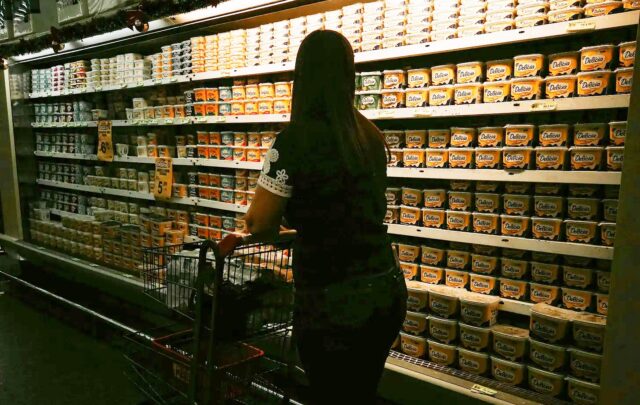
… Empty rice shelves encase a fear that has transcended American culture, as consumers have learned that things they saw as entitlements – food staples, fuel for a commute, toys, and toothpaste free of poison – could no longer be taken for granted.
“I was like, ‘What is going on?’ ” said Peter Park, a 28-year-old Willamette University law student who moved to Seattle from South Korea when he was 15. “This is the last country that I thought would run out of food.”
In the Pacific Northwest, such unease threatens a notion of middleclassness that has been central to the collective identity of an Asian-American community.
“The rich were getting richer, the poor were getting poorer, but if you were in the middle it didn’t affect you. In the middle, you felt safe,” said Sho Dozono, the president of Azumano Travel, a Portland-based agency that operates in three Northwestern states. “More people are concerned about the economy now.”
(27 October 2008)


Comments
We changed commenting systems on September 10, 2026 as part of a site-wide functionality and security upgrade. Your past comments have not disappeared, and you can still log in with your old Disqus account credentials if you wish. Contact us with any questions.