


Click on the headline (link) for the full text.
Many more articles are available through the Energy Bulletin homepage
Our diet of destruction
Felicity Lawrence, The Guardian
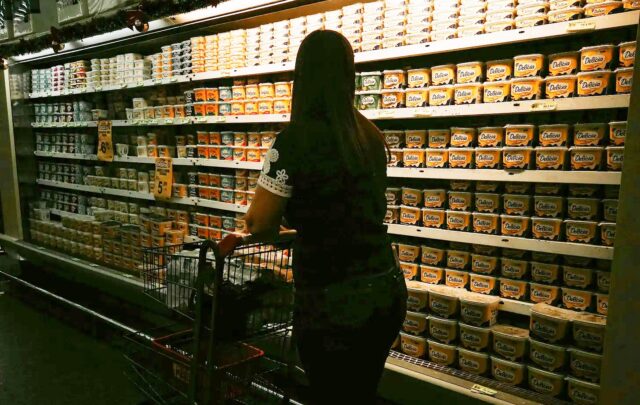
Look at a few packets in a typical kitchen cupboard, and you will notice a disconcerting overlap between the labels of apparently completely different foods. A handful of ingredients, some of them barely used as food in the west before the second world war, crop up in everything from baby food to cat food to processed meals. The same half-dozen heavily subsidised commodities – soya, rapeseed, palm oil, corn, sugar and rice – are broken down into their individual parts and endlessly reconstituted. They are sold back to us as processed food or turned into animal feed to produce the factory meats that have conquered our diets in the past half-century. How did such a transformation come about?
When you look back at the origins of much of today’s industrialised food system, what you see is the ebb and flow of empire. First there were the British imperial ambitions that turned slave-produced sugar from the colonies into the engine of emerging capitalism during the industrial revolution. Later the prewar European powers developed and controlled new fats such as margarines. Today we are living with the postwar American model, a privatised form of empire that reached into every corner of world food supply in the second half of the 20th century.
The result has been a kind of food Fordism. We are fed a production-line diet that is homogenised and bolted together from standard commodity parts. The parts, many of them created out of American agricultural surpluses, are largely controlled by an oligopoly of US-based trading and processing companies – Cargill, ADM, Bunge – that are little known in the UK. All three companies are now expanding in China and heavily involved in spreading the western industrialised diet, with its unsustainable dependence on fossil fuels and extravagant use of grains. As the Chinese move up this processed-food chain, the diet-related diseases that have afflicted us in the west are growing there too.
Adapted from Eat Your Heart Out: Why the Food Business Is Bad for the Planet and Your Health, by Felicity Lawrence,
(16 June 2008)
The peaceful revolution in farmers’ markets
Lynn Perrin, Vancouver Sun
A peaceful revolution is taking place across North America. While it is neither underground nor covert, it may soon be quashed by local and provincial policy-makers. They potentially could assert that the revolution is too risky and that laws must be enacted in the public interest.
The revolutionaries in this case are ordinary consumers and farmers wishing to trade directly in local food products via farmers’ markets. Despite the growing popularity of these markets, they have had to overcome and still face ongoing legal and regulatory barriers that inhibit their expansion. These barriers have been justified in the name of food safety and public order.
… My research involving interviews and surveys with both suppliers and managers at farmers’ markets confirms that barriers from laws and regulations are retarding growth of this sector of the food industry despite growing consumer demands. These barriers are compounded by other issues such as the loss of farmland through exemptions from the Agricultural Land Reserve, the rising price of farmland and the lack of adequate support for the sector from public officials.
Yet not everything is bleak, and governments in B.C. are slowly coming to see the virtues of the farm-to-fork revolution.
(16 June 2008)
Food Revolution That Starts With Rice
William J. Broad, New York Times
Many a professor dreams of revolution. But Norman T. Uphoff, working in a leafy corner of the Cornell University campus, is leading an inconspicuous one centered on solving the global food crisis. The secret, he says, is a new way of growing rice.
Rejecting old customs as well as the modern reliance on genetic engineering, Dr. Uphoff, 67, an emeritus professor of government and international agriculture with a trim white beard and a tidy office, advocates a management revolt.
Harvests typically double, he says, if farmers plant early, give seedlings more room to grow and stop flooding fields. That cuts water and seed costs while promoting root and leaf growth.
The method, called the System of Rice Intensification, or S.R.I., emphasizes the quality of individual plants over the quantity. It applies a less-is-more ethic to rice cultivation.
In a decade, it has gone from obscure theory to global trend – and encountered fierce resistance from established rice scientists. Yet a million rice farmers have adopted the system, Dr. Uphoff says.
(17 June 2008)
Liz Bryant writes:
Here’s one for the food department that I found quite hopeful.
Ethiopia pleads for £167m aid after crops fail
Xan Rice, Guardian
Ethiopia has appealed for $325m (£167m) in aid after drought and crop failure more than doubled the number of people needing emergency assistance to 4.6 million.
Poor rains have affected much of southern and south-eastern Ethiopia since last year, significantly cutting harvests. The shortage of local cereals has sent prices soaring, while the cost of imported food has also risen sharply because of the global food crisis and increased fuel prices.
Aid agencies say that hundreds of thousands of the country’s poorest families can no longer afford to buy enough food to sustain themselves. According to the UN, which issued the appeal to donors yesterday together with Ethiopia’s Disaster Prevention and Preparedness Agency, 75,000 children are suffering from acute malnutrition and illness.
(14 June 2008)
Farming with Far Fewer Fossil Fuels (video)
Tillers International via YouTube
Tillers International is a nonprofit learning center located in Scotts, Michigan. Learn how you can help Tillers International preserve these important paths to sustainability by visiting us on the web at: tillersinternational.org
(17 June 2008)
From Energy Bulletin contributor Brandon Marshall. Also posted at YouTube are several short videos taken from the recent Farming with Draft Animals class.



Comments
We changed commenting systems on September 10, 2026 as part of a site-wide functionality and security upgrade. Your past comments have not disappeared, and you can still log in with your old Disqus account credentials if you wish. Contact us with any questions.