Click on the headline (link) for the full text.
Many more articles are available through the Energy Bulletin homepage
It’s the meat-eating, stupid
Bill Berry, The Capital Times (Madison, Wisconsin)
How’s this for a timely quote: “(It) was the year I decided to find out why people were hungry in the world. The experts were telling us that the population problem was the cause of scarcity. The truth was, we were feeding a third of the world’s grain to livestock, and with little return.”
That was Frances Moore Lappe, author of “Diet for a Small Planet.” The year was 1968.
Since then, meat consumption around the world has risen exponentially. As with our thirst for oil, Americans lead the way when it comes to chomping animal flesh, and by a long shot. As the public dialogue reels over the question of food vs. fuel, it’s a good time to look in the mirror, like it or not.
Depending on who’s doing the estimating, Americans hammer down something between one-half and three-quarters of a pound of meat per person per day. Some of those big boys eating ribs heaped on their plates at the local buffet probably raise the average for the rest of us.
Groups like People for the Ethical Treatment of Animals are quick to preach about this. PETA often seems to be a PR train wreck of its own making, but Bruce Friedrich, the group’s vice president for campaigns, makes some points that really ought to enter the public discussion if we’re going to seriously consider food vs. fuel.
(27 May 2008)
Sowing the seeds of a global revolution
Kate Kelland, Sydney Morning Herald
Guerilla gardeners across the world say they are fighting a win-win war
—
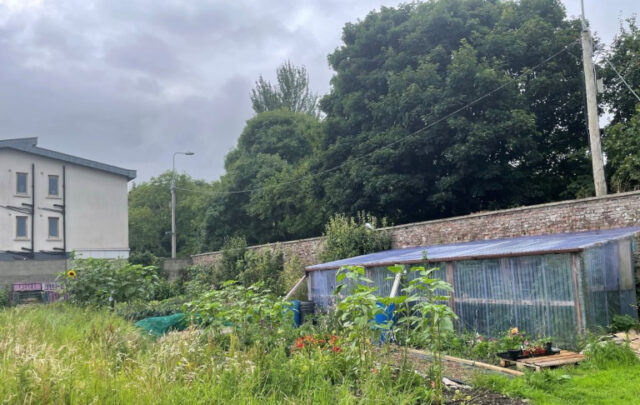
THEY work under the cover of night, armed with seed bombs, chemical weapons and pitchforks. Their tactics are anarchistic, their attitude revolutionary. Their aim: to beautify.
An army of self-styled guerilla gardeners is growing across the world, fighting to transform urban wastelands into horticultural havens. To document and encourage their victories, one of the movement’s top generals has written a handbook.
On Guerrilla Gardening, by Richard Reynolds, defines the activity as “the illicit cultivation of someone else’s land”.
“Our main enemies are neglect and scarcity of land,” says Reynolds, a 30-year-old former advertising employee who wrote the book after his website, guerrillagardening.org, became a global focal point for would-be green-fingered activists.
(28 May 2008)
Sustainable Communities
Ruth Ann Smalley, Daily Gazette (Shenectady, New York)
I came home one day just in time to catch my neighbor planting flowers in my front garden. I had admired several of his plants, and asked him if they would do well in shade and among tenacious tree roots. Little did I know he’d be so obliging!
The neighborly exchange of plants, recipes and tools is as old as human history, but to many modern city dwellers seems as remote as the horse and buggy. Even in areas where neighbors do have reciprocal relationships, they are often limited. In his book, “Deep Economy: The Wealth of Communities and the Durable Future,” Bill McKibben notes “studies have shown that as urban neighborhoods became more heavily used by cars instead of pedestrians, the average person saw the number of friends and acquaintances she had in her neighborhood drop from nine to four.”
This truly is a loss. McKibben identifies the problem as a kind of “hyper-individualism,” resulting largely from the same industrialized lifestyles that have contributed so strongly to climate change. Loss of community also takes a personal toll. “The body reacts to community in measurable ways. Staggering ways,” McKibben notes. “According to Robert Putnam, if you do not belong to any group at present, joining a club or society of some kind halves the risk that you will die in the next year.” Pretty impressive numbers, eh?
We chose our neighborhood because of its reputation for being an old-fashioned neighborhood, where kids run in and out of each other’s houses.
… Chinese medicine places a premium on these interpersonal networks, calling them “personal circulation vessels,” to indicate how essential they are. People who have not developed them are sometimes referred to as “dead doors that lead to nowhere” (Yanhua Zang, “Transforming Emotions with Chinese Medicine”). A disturbing, but apt, metaphor
(27 May 2008)
New local environmental group based on idea from United Kingdom
Fiaona Isaacson, Peterborough Examiner (Ontario, Canada)
Fred Irwin wants to change the way Peterborough residents live in the city.
Irwin envisions plug-ins for electric cars downtown, more solar-powered homes and naturalizing lawns.
The model follows an idea described in a book published in the United Kingdom, The Transition Handbook, by Bob Hopkins.
The model focuses on creating a sustainable environment that uses less energy, relies more on local sources and creates a movement started by volunteers.
Irwin, who has founded Transition Town Peterborough, said it’s a grassroots, not a political movement.
It’s also not an awareness program, but a plan ready for implementation, he said.
Irwin and Hopkins argue the world needs to react not only to climate change but also “peak oil” – the point where half of the world’s oil has been consumed.
(27 May 2008)