Click on the headline (link) for the full text.
Many more articles are available through the Energy Bulletin homepage
Oxygen-poor ocean zones are growing
Kenneth R. Weiss, Los Angeles Times
Oxygen-starved waters are expanding in the Pacific and Atlantic as ocean temperatures increase with global warming, threatening fisheries and other marine life, a study published today concludes.
Most of these zones remain hundreds of feet below the surface, but they are beginning to spill onto the relatively shallow continental shelf off the coast of California and are nearing the surface off Peru, driving away fish from commercially important fishing grounds, researchers have found.
… The study, led by Lothar Stramma at the University of Kiel in Germany, warns that the spread of hypoxic waters that suffocate marine life is consistent with climate models forecasting what would happen as greenhouse gases accumulate in the atmosphere.
The trend, the study points out, eerily echoes a scenario that unfolded about 250 million years ago, when 95% of life on Earth went extinct after heat-trapping carbon dioxide spewing from volcanoes warmed the planet and the oceans became stripped of oxygen.
“If you warm waters, they hold much less oxygen,” said coauthor Gregory C. Johnson, an oceanographer with the federal Pacific Marine Environmental Laboratory in Seattle. “That’s the same as a bottle of soda water. If you open it warm, it’ll fizz all over the place. If you open it cold, it will slowly fizz out as it warms.”
(2 May 2008)
Nature article on ‘cooling’ confuses media, deniers
Next decade may see rapid warming, not cooling
Joseph Romm, Gristmill
The Nature article ($ub. req’d) that has caused so much angst about the possibility that we are entering a decade of cooling — “Advancing decadal-scale climate prediction in the North Atlantic sector” — has been widely misreported. I base this in part on direct communication with the lead author.
In fact, with the caveat from the authors that the study should be viewed as preliminary, and should not be used for year-by-year predictions, it is more accurate to say the Nature study is consistent with the following statements:
- The “coming decade” (2010 to 2020) is poised to be the warmest on record, globally.
- The coming decade is poised to see faster temperature rise than any decade since the authors’ calculations began in 1960.
- The fast warming would likely begin early in the next decade — similar to the 2007 prediction by the Hadley Center in Science (see “Climate forecast: hot — and then very hot“).
- The mean North American temperature for the decade from 2005 to 2015 is projected to be slightly warmer than the actual average temperature of the decade from 1993 to 2003.
Before explaining where the confusion came from — mostly a misunderstanding of how the Nature authors use the phrase “next decade” — let’s see how the media covered it:
(4 May 2008)
Related from NY Times: In a New Climate Model, Short-Term Cooling in a Warmer World”.
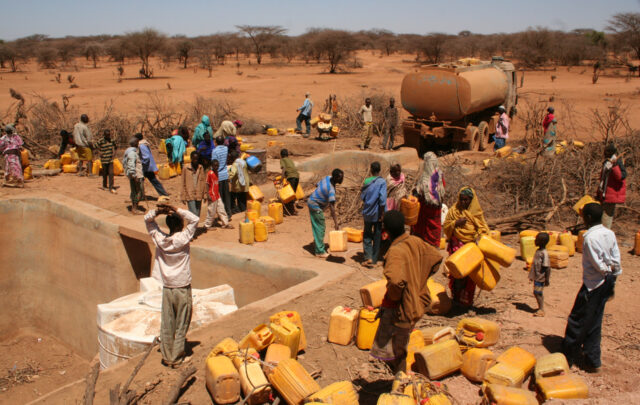
Farmers face climate challenge in quest for more food
David Fogarty, Reuters
– If farmers think they have a tough time producing enough rice, wheat and other grain crops, global warming is going to present a whole new world of challenges in the race to produce more food, scientists say.
In a warmer world beset by greater extremes of droughts and floods, farmers will have to change crop management practices, grow tougher plant varieties and be prepared for constant change in the way they operate, scientists say.
“There certainly are going to be lots of challenges in the future. Temperature is one of them, water is another,” said Lisa Ainsworth, a molecular biologist with the United States Department of Agriculture.
(3 May 2008)