


Click on the headline (link) for the full text.
Many more articles are available through the Energy Bulletin homepage
Load Up the Pantry
Brett Arends, Wall Street Journal via Yahoo!Finance
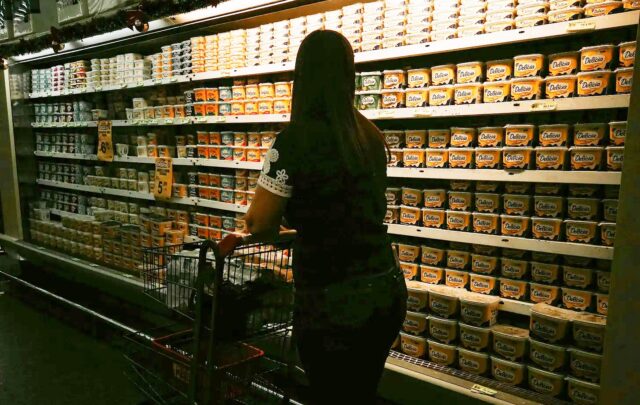
I don’t want to alarm anybody, but maybe it’s time for Americans to start stockpiling food.
No, this is not a drill.
You’ve seen the TV footage of food riots in parts of the developing world. Yes, they’re a long way away from the U.S. But most foodstuffs operate in a global market. When the cost of wheat soars in Asia, it will do the same here.
Reality: Food prices are already rising here much faster than the returns you are likely to get from keeping your money in a bank or money-market fund. And there are very good reasons to believe prices on the shelves are about to start rising a lot faster.
(23 April 2008)
How much your groceries will cost in 10 years
Anna Shepard, UK Times
However much you hope that the food crisis will go away, it’s difficult to ignore this week’s headlines warning us that the era of cheap food is over. But which of the staples in our shopping basket will be worst hit?
The general picture is that most items will go up, some more significantly than others. With oil at $117 a barrel and rising, so are the costs rising of the three Fs of farming: feed, fuel and fertiliser. “We’re in a unique situation in which numerous problems are coming together,” says Tim Lang, Professor of Food Policy at City University. We’re not just facing rising oil prices and water shortages, but the changing dietary habits of the developing world as it becomes richer, combined with land being used to provide crops for fuel rather than food, and climate change bringing drought to countries such as Australia.
There’s no doubt that we’re going to have to spend more on food. And yet, compared to other parts of the world, we’re lucky. We spend 13 per cent of our household budget on food, down from 30 per cent, 50 years ago. For a family in the developing world, food is likely to be between 50 and 75 per cent of the total, according to the World Bank.
(25 April 2008)
A wise course of action?
Fred Pearce (and John Vidal?), Guardian
A quest to find out where the prawns in his London curry came from took Fred Pearce all the way to Bangladesh – but is was not so much the food miles that bothered him as the social dilemma he unearthed
—
It was a bit quixotic, I know. But I wanted to find out where the prawns in my Saturday night curry came from. That is how I ended up standing beside a pond in the blazing sun in south-west Bangladesh with Amal as he pulled one of the first prawns of the new season from his pond – and told me about a prawn mafia that lies between this patch of former mangrove swamp and my plate.
My journey to meet Amal was just one of dozens that I took to trace my global footprint by finding out where the cotton in my shirt comes from, the coffee in my mug, the computer on my desk. To discover who grows or mines or makes my stuff. And where my waste and recycling really ends up.
For the prawn leg, my investigation began in Manchester with Iqbal Ahmed, known among Britain’s Bangladeshi community as Mr Prawn.
(23 April 2008)
Long, in-depth report.
How to End the Global Food Shortage
Jeffrey D. Sachs, TIME Magazine
The world economy has run into a brick wall. Despite countless warnings in recent years about the need to address a looming hunger crisis in poor countries and a looming energy crisis worldwide, world leaders failed to think ahead. The result is a global food crisis. Wheat, corn and rice prices have more than doubled in the past two years, and oil prices have more than tripled since the start of 2004. These food-price increases combined with soaring energy costs will slow if not stop economic growth in many parts of the world and will even undermine political stability, as evidenced by the protest riots that have erupted in places like Haiti, Bangladesh and Burkina Faso. Practical solutions to these growing woes do exist, but we’ll have to start thinking ahead and acting globally.
The crisis has its roots in four interlinked trends. The first is the chronically low productivity of farmers in the poorest countries, caused by their inability to pay for seeds, fertilizers and irrigation. The second is the misguided policy in the U.S. and Europe of subsidizing the diversion of food crops to produce biofuels like corn-based ethanol. The third is climate change; take the recent droughts in Australia and Europe, which cut the global production of grain in 2005 and ’06. The fourth is the growing global demand for food and feed grains brought on by swelling populations and incomes. In short, rising demand has hit a limited supply, with the poor taking the hardest blow.
So, what should be done? Here are three steps to ease the current crisis and avert the potential for a global disaster.
(24 April 2008)
A limitation in Sach’s vision is his unfamiliarity with sustainable agriculture. As he mentioned in a talk at Google, agriculture is not his speciality. Consequently, he emphasizes technical solutions (external inputs) and ignores other approaches. -BA


Comments
We changed commenting systems on September 10, 2026 as part of a site-wide functionality and security upgrade. Your past comments have not disappeared, and you can still log in with your old Disqus account credentials if you wish. Contact us with any questions.