Click on the headline (link) for the full text.
Many more articles are available through the Energy Bulletin homepage
Struggling country where bread means life
Ian Black, Guardian
Fear of unrest grows as soaring wheat prices strain Egypt’s creaking economy
—
… It looked as if this simmering crisis could trigger wider unrest. Last week, four people were killed and scores more injured and arrested in rioting in Mahalla, an industrial town in the Nile Delta, while a general strike left the normally teeming centre of Cairo eerily quiet. “The strike is against poverty and starvation,” demonstrators shouted.
Egypt’s problems are part of a global phenomenon, in that the price of the wheat it imports – half the country’s needs – has tripled since the summer. But price rises have also cruelly exposed the shortcomings of a stagnant, creaking economy and regime. Prices of cooking oil, rice, pasta and sugar have soared, forcing more to rely on state-subsidised bread – at 5 piastres a loaf (about 0.5p) the main source of calories for the 40% of the population who live on or below the poverty line of £1 a day (about 10 Egyptian pounds).
(12 April 2008)
Food Inflation, Riots Spark Worries for World Leaders
Bob Davis and Douglas Belkin, Wall Street Journal
Finance ministers gathered this weekend to grapple with the global financial crisis also struggled with a problem that has plagued the world periodically since before the time of the Pharaohs: food shortages.
Surging commodity prices have pushed up global food prices 83% in the past three years, according to the World Bank — putting huge stress on some of the world’s poorest nations. Even as the ministers met, Haiti’s Prime Minister Jacques Edouard Alexis was resigning after a week in which that tiny country’s capital was racked by rioting over higher prices for staples like rice and beans.
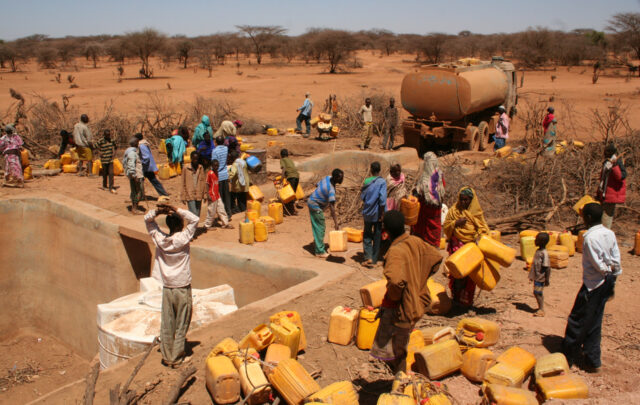
Rioting in response to soaring food prices recently has broken out in Egypt, Cameroon, Ivory Coast, Senegal and Ethiopia. In Pakistan and Thailand, army troops have been deployed to deter food theft from fields and warehouses. World Bank President Robert Zoellick warned in a recent speech that 33 countries are at risk of social upheaval because of rising food prices. Those could include Indonesia, Yemen, Ghana, Uzbekistan and the Philippines. In countries where buying food requires half to three-quarters of a poor person’s income, “there is no margin for survival,” he said.
(14 April 2008)
Credit crunch? The real crisis is global hunger. And if you care, eat less meat
George Monbiot, Guardian,
A food recession is under way. Biofuels are a crime against humanity, but – take it from a flesh eater – flesh eating is worse
—
Never mind the economic crisis. Focus for a moment on a more urgent threat: the great food recession that is sweeping the world faster than the credit crunch. You have probably seen the figures by now: the price of rice has risen by three-quarters over the past year, that of wheat by 130%. There are food crises in 37 countries. One hundred million people, according to the World Bank, could be pushed into deeper poverty by the high prices.
But I bet that you have missed the most telling statistic. At 2.1bn tonnes, the global grain harvest broke all records last year – it beat the previous year’s by almost 5%. The crisis, in other words, has begun before world food supplies are hit by climate change. If hunger can strike now, what will happen if harvests decline?
There is plenty of food. It is just not reaching human stomachs. Of the 2.13bn tonnes likely to be consumed this year, only 1.01bn, according to the United Nation’s Food and Agriculture Organisation, will feed people.
I am sorely tempted to write another column about biofuels. … But I have been saying this for four years, and I am boring myself. Of course we must demand that our governments scrap the rules that turn grain into the fastest food of all. But there is a bigger reason for global hunger, which is attracting less attention only because it has been there for longer. While 100m tonnes of food will be diverted this year to feed cars, 760m tonnes will be snatched from the mouths of humans to feed animals – which could cover the global food deficit 14 times. If you care about hunger, eat less meat.
… But I cannot advocate a diet that I am incapable of following. I tried it for about 18 months, lost two stone, went as white as bone and felt that I was losing my mind. I know a few healthy-looking vegans, and I admire them immensely. But after almost every talk that I give, I am pestered by swarms of vegans demanding that I adopt their lifestyle. I cannot help noticing that in most cases their skin has turned a fascinating pearl grey.
What level of meat-eating would be sustainable?
(15 April 2008)
Brewing Trouble: How to Drink Beer and Save the World
Benjamin Dangl, AlterNet
Can corporate “globeerization” be fought through “beeroregionalism”?
—
How to Drink Beer and Save the World By Christopher O’Brien, New Society Publishers (November 2006), 275 pages
Beer, like so many other products, is largely in the hands of giant corporations. Therefore, drinking beer can often enrich the same systems of power we as activists are fighting against. Fermenting Revolution: How To Drink Beer and Save the World by Christopher O’Brien is a book about how the people can take back the brew and join together in saying, “If I can’t drink good beer, it’s not my revolution.”
It is satisfying and rebellious in this increasingly corporate world to make your own beer. In Vermont, homebrewing and microbrewing is a state-wide past time; a 2005 census shows that there is one microbrewery for every 32,792 people in the state, which is the highest number of microbreweries per capita in the country. As many people know, beer drinkers can be activists in how they choose and make their own beer. Interested in changing the world through drinking? Fermenting Revolution can serve as a kind of bible for the beer activist that’s bubbling inside each and every one of us.
(1 April 2008)