


Click on the headline (link) for the full text.
Many more articles are available through the Energy Bulletin homepage
Let the East Bloom Again
Richard T. McNider and John R. Christy, New York Times
THE United States faces two major security challenges this century. Both involve water… Some agricultural experts fear that the country does not have enough water and land to both replace the declining agricultural production in the arid West and expand the production of biofuels.
There is, however, a sustainable solution: a return to using the land and water of the East, which dominated agriculture in the United States into the 20th century.
Until the middle of the 1900s, much of our country’s food and fiber was produced east of the Mississippi River. Maine led the nation in potato production in 1940, and New York wasn’t far behind. The South, including Alabama, Georgia and Mississippi, dominated cotton. Large amounts of corn were grown in almost every state for consumption by the local livestock and poultry. Regional vegetable markets, especially in the mid-Atlantic states, served the population centers of the East.
By 1980, Western irrigation and improvements in transportation had largely destroyed this Eastern system of agriculture. Irrigated cotton in Arizona, California and Texas displaced the cotton economy of the Deep South. Idaho and Washington became the nation’s major potato producers. Corn production became more concentrated in the Midwest.
Through irrigation, Western farmers were spared the occasional droughts that had plagued Eastern farmers, but the specialized Western system came with a price. Water projects dried up the area’s rivers. Salmon runs disappeared. Soils were poisoned from the salt in irrigated water that is left behind after evaporation.
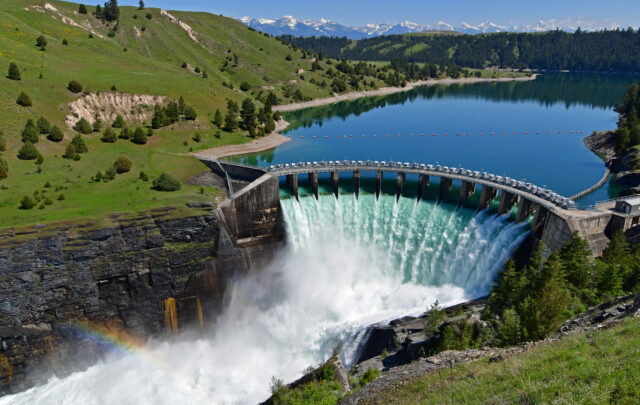
Returning agricultural production to the Eastern United States under irrigation would be efficient and environmentally sound. In the West, at least three to four feet of water per acre is needed every year to produce a good crop. In the East, only a few inches of irrigated water per acre are needed, because of the region’s heavier rainfall. Even in a dry year for the East, about a foot of water per acre will suffice…
Richard T. McNider and John R. Christy are professors of atmospheric science at the University of Alabama in Huntsville.
(22 September 2007)
Contributor Carl Etnier writes:
Any policy aimed at moving more agriculture to the eastern US would also help relocalize food production, as the population centers in the eastern US are dependent on food from the prairie and the far west. Left to themselves, policy makers are likely to relocalize regionally, rather than build the truly local food networks that many contributors to Energybulletin.net envision and are creating. We should look for opportunities to direct policies encouraging eastern US agriculture to supporting small farms.
Also, how much would permaculture-esque swales on small farms reduce the need for the storage ponds that McNider and Christy call for government funding to build?
As Prices Soar, U.S. Food Aid Buys Less
Celia W. Dugger, New York Times
Soaring food prices, driven in part by demand for ethanol made from corn, have helped slash the amount of food aid the government buys to its lowest level in a decade, possibly resulting in more hungry people around the world this year.
The United States, the world’s dominant donor, has purchased less than half the amount of food aid this year that it did in 2000, according to new data from the Department of Agriculture.
“The people who are starving and have to rely on food aid, they will suffer,” Jean Ziegler, who reports to the United Nations on hunger and food issues, said in an interview this week.
Corn prices have fallen in recent months, but are still far higher than they were a year ago. Demand for ethanol has also indirectly driven the rising price of soybeans, as land that had been planted with soybeans shifted to corn. And wheat prices have skyrocketed, in large part because drought hurt production in Australia, a major producer, economists say.
The higher food prices have not only reduced the amount of American food aid for the hungry, but are also making it harder for the poorest people to buy food for themselves, economists and advocates for the hungry say.
(29 September 2007)
Where is your food really from?
Alex Pulaski, The Oregonian
Labeling – After stalling in Congress, country-of-origin stickers appear to be headed to grocery stores
—
The kinds of labels that tell Americans where their shirts and toys come from are finally, after years of delay, expected to identify the sources of many foods.
In 2002, Congress budged from decades of opposition and promised that retailers would provide country-of-origin labeling. But lobbying pressure from grocers and meatpackers, who call labeling costly and unwieldy, has helped postpone the law’s effective date.
Over the next few weeks, Congress is again expected to approve such rules, but with the reduced penalties and streamlined record-keeping requirements sought by industry. And this time — amid a consumer revolt over health threats discovered in toys, seafood, toothpaste and pet-food ingredients from China — it appears that labeling will stick.
(30 September 2007)
The Everyman Who Exposed Tainted Toothpaste
Walt Bogdanich, New York Times
PANAMA – Eduardo Arias hardly fits the profile of someone capable of humbling one of the world’s most formidable economic powers.
A 51-year-old Kuna Indian, Mr. Arias grew up on a reservation paddling dugout canoes near his home on one of the San Blas islands off Panama’s Caribbean coast. He now lives in a small apartment above a food stand in Panama, the nation’s capital, also known as Panama City.
But one Saturday morning in May, Eduardo Arias did something that would reverberate across six continents. He read the label on a 59-cent tube of toothpaste. On it were two words that had been overlooked by government inspectors and health authorities in dozens of countries: diethylene glycol, the same sweet-tasting, poisonous ingredient in antifreeze that had been mixed into cold syrup here, killing or disabling at least 138 Panamanians last year.
Mr. Arias reported his discovery, setting off a worldwide hunt for tainted toothpaste that turned out to be manufactured in China. Health alerts have now been issued in 34 countries, from Vietnam to Kenya, from Tonga in the Pacific to Turks and Caicos in the Caribbean. Canada found 24 contaminated brands and New Zealand found 16. Japan had 20 million tubes. Officials in the United States unwittingly gave the toothpaste to prisoners, the mentally disabled and troubled youths. Hospitals gave it to the sick, while high-end hotels gave it to the wealthy.
People around the world had been putting an ingredient of antifreeze in their mouths, and until Panama blew the whistle, no one seemed to know it.
The toothpaste scare helped galvanize global concerns about the quality of China’s exports in general, prompting the government there to promise to reform how food, medicine and consumer products are regulated. And other countries are re-examining how well they monitor imported products.
(1 October 2007)
Buy-local food trend nears fad status
Judy Schultz, CanWest News Service (Vancouver Sun)
From chefs growing their own veggies to the boom in farmers’ markets, consumers show footprint awareness
—
EDMONTON – There’s an audible buzz in food circles about the smaller footprint, sustainable food systems and local growers. The 100-mile diet, tricky as it is, has become so trendy it is reaching fad status.
After decades of eating too high on the food chain, we seem intent on mending our wasteful ways. From chefs who grow their own vegetables to the current boom in farmers’ markets and organizations such as Slow Food, consumers have suddenly begun to care.
Maureen Osadchuk is the editor of Food For Thought, an Alberta magazine dedicated to keeping consumers informed about the role of primary agriculture in what we eat.
(29 September 2007)



Comments
We changed commenting systems on September 10, 2026 as part of a site-wide functionality and security upgrade. Your past comments have not disappeared, and you can still log in with your old Disqus account credentials if you wish. Contact us with any questions.