


Click on the headline (link) for the full text.
Many more articles are available through the Energy Bulletin homepage
Rethinking biochar
Rebecca Renner, Environmental Science & Technology
Imagine a simple agricultural soil amendment with the ability to double or triple plant yields while at the same time reducing the need for fertilizer and therefore decreasing nitrogen- and phosphorus-laden runoff. As if that’s not enough, what if this amazing ingredient also had the potential to cut greenhouse gases on a vast scale? This revolutionary substance exists, and it isn’t high-tech, or even novel-the history of its use can be traced back to pre-Columbian South America.
The ingredient is charcoal, in this context called biochar or agrichar, and if a growing number of scientists, entrepreneurs, farmers, and policy makers prevail, this persistent form of carbon will be finding its way into soils around the world. “Biochar has enormous potential,” says John Mathews, a professor of strategic management at Macquarie University in Australia. “When scaled up, it can take out gigatons of carbon from the atmosphere,” he adds.
Agrichar’s benefits flow from two properties, says Cornell University soil scientist Johannes Lehmann. It makes plants grow well and is extremely stable, persisting for hundreds if not thousands of years.
(1 August 2007)
Interesting discussion about biochar at TOD Drumbeat starting here. I liked the summary by sgage:
Charcoal is a form of carbon. It does not supply “fertility”, i.e., the full range of plant nutrients. Finely ground and mixed with the soil, it does add “exchange capacity”, the ability of a soil to hold on to nutrient ions that might otherwise be leached away. Certain kinds of clay particles in the soil do the same thing, as well as regular old “organic matter”.
In the moist tropics, organic matter tends to break down very quickly due to heat and moisture, whereas charcoal is remarkably persistent. Also, the clay minerals in tropical soils are not always the “good” kind. So it makes sense that charcoal might be useful in tropical soils, and could be important in developing agricultural sustainability in some climates.
I don’t see it as any kind of miracle fertilizer, which some folks are touting it as. It is charcoal. You still need the usual plant nutrients, it’s just that the charcoal might help retain those nutrients on site somewhat better in those climates that don’t have the ability to develop good levels of organic matter.
In more temperate zones, I don’t suspect that charcoal would be any better than regular organic practices.
Meet the New Yard: Tropical Plants, Invasive Species and Drunken Trees
Alex Steffen, World Changing
When we look at ecosystem disruption and climate change, we have a great tendancy to focus on the really sexy aspects (by media standards) — the melting of Greenland, the spread of the Sahara, the predicted extinction of rhinos, tigers and all sorts of other large critters. But some of the effects will land a lot closer to home.
Take, for instance, the change in gardening climates and the dramatic spread of invansive species. As the global climate changes, the impacts can be seen in what plants will thrive in our gardens, and already the mix of plants that will do well in any particular place is changing rapidly.
So rapidly that the (U.S.) National Arbor Day Foundation felt it necessary to update the Plant Hardiness Zones Map. That’s the map that gardeners and farmers use to figure out what seeds to plant where they live. Their findings? That across huge swathes of the United States, climate zones have already shifted: according to James Hansen, such zones may already be marching northwards at a rate of tens of kilometers a year.
And, of course, climate change has only just begun.
(31 July 2007)
Harvesting New Ideas: Ambitious Maverick Farms promotes local food – and the future of farming
Michael Hastings, Winston-Salem Journal (North Carolina)
VALLE CRUCIS – When is a farm more than a farm?
When it sets out to harvest farmers as much as crops.
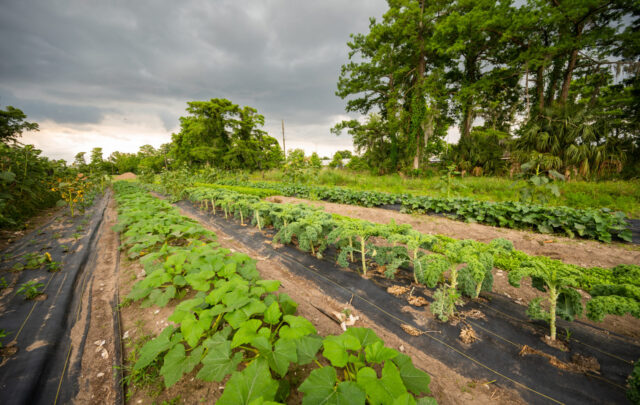
Maverick Farms in Watauga County is just such a farm. Its founders are ostensibly in the vegetable business, but their broader vision encompasses tourism, environmentalism, education and economic development.
In 2004, Hillary Wilson, Alice Brooke Wilson, Sara Safransky, Leo Gaev and Tom Philpott started Maverick Farms.
…From the beginning, they knew they wanted a different kind of farm, a desire reflected in the name Maverick. “We thought about it as a kind of laboratory,” Philpott said. “We had an idea that we would be an educational group, as part of a broader community that educates people about where food comes from.”
The Wilson sisters grew up on the farm, and the others had spent time working on organic farms in Italy, but they were hardly seasoned pros.
“The truth is when we started, we knew more about cooking than we did about farming,” Philpott said.
“We were all into sustainable food and questioning the industrial food system. We naively showed up and started doing stuff.”
The partners planted their first crops in March 2004. They started having farm dinners to show off the glory of fresh local food. They began selling food at the Watauga County Farmers Market in Boone. They started a Community Supported Agriculture, or CSA, program in which people contract for weekly portions of the farm’s harvest.
They offer cooking classes to teach the pleasures of the table, and they have lodging for people who want to vacation at a working farm. And they’ve started an internship program to train would-be farmers who feel as passionately about local food as they do.
…”We would like to see people rediscover the pleasures of cooking,” Philpott said. “That’s why we do the cooking classes and farm dinners.”
Though Gaev has since left the group, the other four are still going strong with their vision – even though all of them have to struggle to balance school, outside work or both with the seemingly never-ending work on the farm.
“I’m 41 now,” said Philpott, who was a financial journalist before co-founding Maverick Farms. “I do a food column for Grist (an electronic magazine at grist.org devoted to environmental issues). I have another nonfood-related regular freelance writing gig. I have no weekends. (The farm work) hurts my back. And the amount of work wears you down.
“But I’m encouraged by the reception we’ve received, and the interest in local food. I find it inspiring to be part of something that is bigger than just running a small business.”
(25 July 2007)
Mentioned by David Roberts at Gristmill, where Tom Philpotts writes on sustainable agriculture. -BA



Comments
We changed commenting systems on September 10, 2026 as part of a site-wide functionality and security upgrade. Your past comments have not disappeared, and you can still log in with your old Disqus account credentials if you wish. Contact us with any questions.