Click on the headline (link) for the full text.
Many more articles are available through the Energy Bulletin homepage
Drivers cut back – a 1st in 26 years
Paul Overberg and Larry Copeland, USA Today
The average American motorist is driving substantially fewer miles for the first time in 26 years because of high gas prices and demographic shifts, according to a USA TODAY analysis of federal highway data.
The growth in miles driven has leveled off dramatically in the past 18 months after 25 years of steady climbs despite the addition of more than 1 million drivers to the nation’s streets and highways since 2005. Miles driven in February declined 1.9% from February 2006 before rebounding slightly for a 0.3% year-over-year gain in March, data from the Federal Highway Administration show. That’s in sharp contrast to the average annual growth rate of 2.7% recorded from 1980 through 2005.
“You have demographic shifts, traffic congestion and increased gas prices,” says Ed McMahon, senior research fellow at the Urban Land Institute, a non-profit group that promotes innovative development. “For the first time in recent history, the rate of vehicle miles traveled is not increasing at the rate it was for 25 years. It’s having an effect and is changing in subtle ways the way people think about their driving.”
The nation has not seen such stagnant growth in driving since 1981, when the USA staggered through an oil shortage and a recession.
(18 May 2007)
Sidebar: CUTTING BACK: Drivers begin to look ‘outside the box’.
What “Bike Friendly” Looks Like
Alan Durning, Sightline
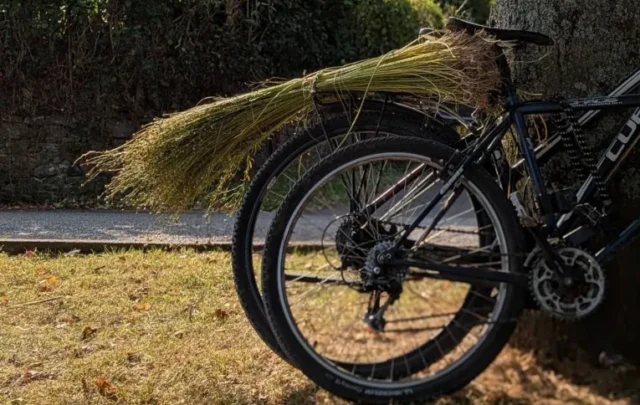
…what would Cascadia’s cities* look like if we provided the infrastructure for safe cycling? What does “bike friendly” actually look like?
Bike signal–green Durning 60wGood bicycling infrastructure is something few on this continent have seen. It doesn’t mean a “bike route” sign and a white stripe along the arterial. It doesn’t mean a meandering trail shared with joggers, strollers, and skaters.
Bike friendly means a complete, continuous, interconnected network of named bicycle roads or “tracks,” each marked and lit, each governed by traffic signs and signals of its own. It means a parallel network interlaced with the other urban grids: the transit grid on road or rail; the street grid for cars, trucks, and taxis; and the sidewalk grid for pedestrians. It means separation from those grids: to be useful for everyone from eight year olds to eighty year olds, bikeways on large roads must be physically curbed, fenced, or graded away from both traffic and walkers. (On smaller, neighborhood streets, where bikes and cars do mingle, bike friendly means calming traffic with speed humps, circles, and curb bubbles.)
Picture a street more than half of which is reserved for people on foot, bikes, buses, or rail; on which traffic signals and signs, street design, and landscaping all conspire to treat bicycles as the equals of automobiles. This is what bike friendly-what Bicycle Respect-looks like.
(17 May 2007)
* Cascadia = the bioregion of the Pacific Northwest of U.S. and Canada
Strange but True: Helmets Attract Cars to Cyclists
Nikhil Swaminathan, Scientific American
Although you might not want to leave your protective gear at home, just know that if you do, drivers will be a lot more scared of hitting you.
—-
…there’s a raging debate about whether or not you should forget your helmet when you hop on your two-wheeler.
Last September a plucky psychologist at the University of Bath in England announced the results of a study in which he played both researcher and guinea pig. An avid cyclist, Ian Walker had heard several complaints from fellow riders that wearing a helmet seemed to result in bike riders receiving far less room to maneuver-effectively increasing the chances of an accident. So, Walker attached ultrasonic sensors to his bike and rode around Bath, allowing 2,300 vehicles to overtake him while he was either helmeted or naked-headed. In the process, he was actually contacted by a truck and a bus, both while helmeted-though, miraculously, he did not fall off his bike either time.
His findings, published in the March 2007 issue of Accident Analysis & Prevention, state that when Walker wore a helmet drivers typically drove an average of 3.35 inches closer to his bike than when his noggin wasn’t covered. But, if he wore a wig of long, brown locks-appearing to be a woman from behind-he was granted 2.2 inches more room to ride.
(10 May 2007)
Much more to the controversy at the original.
Greens angered by 1m flights giveaway
Patrick Collinson and Dan Milmo, Guardian
· Ryanair says it will pay all taxes, fees and charges
· Struggle to fill planes as air duty cuts demand
There have been 1p flight sales before, but until now Ryanair has never paid for people to fly. Yesterday it began a giveaway of 1m flights where the airline pays the taxes, fees and charges, sparking an unprecedented rush of “binge flyers” clambering to book tickets for close to nothing.
The Ryanair website collapsed several times as 4m attempts were made to grab tickets in the first five hours after the offer went live at 10am yesterday. The airline said it had enjoyed its busiest day ever and an “unprecedented level of demand”.
The giveaway comes as Ryanair struggles to fill its planes amid an unexpected drop in demand across the low-cost airline industry during April.
…Ryanair, easyJet and BA have admitted in recent weeks that they are struggling to fill their planes. Industry executives deny that the softer demand is due to a passenger boycott following an onslaught from green organisations, who are urging the government to curb demand for air travel by raising taxes.
(17 May 2007)