

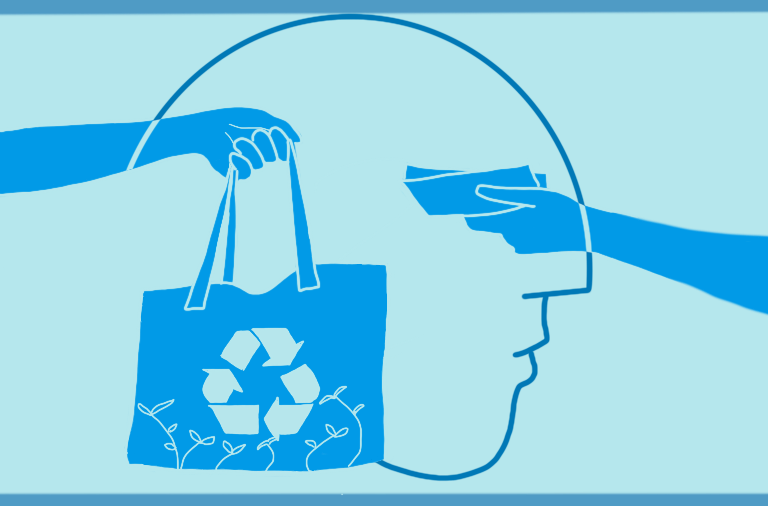
Will 2005 be a prosperous year for Australians? That depends on whether you’re the typical Australian householder carrying the debt load or you’re Peter Costello, shedding the government’s debt.
Most Australians are too busy working to pay off mortgages, HECS fees, medical bills, insurance, credit cards, and personal debt to care about the government’s debt. We will literally be “working until we drop” because our combined household debt has now outstripped our total income. For every $100 we earn, we owe $130.
Debt has become acceptable, even mandatory, in today’s economy. Personal debt is the fuel required to consume goods and services. Shopping to incur more debt and working to pay off the debt is a continuous cycle in the global monopoly game. Our household debt forms the base of the capitalist pyramid, where what we owe makes more money for the system than what we earn. Mortgages and credit have become key financial products with securitisation and credit derivatives being “on-sold” to overseas banks and financial institutions.
Last month Australians re-elected the Government that plunged us into record levels of debt. Between 1996, when Howard first came into power and the end of 2003, household debt has skyrocketed from 85% of disposable income to 140%. Prior to the election, Treasury announced that “consumption growth has run ahead of income growth…this has seen households borrow against their increased wealth”. The “wealth” is actually the increased debt taken on by homebuyers and investors wanting to take advantage of negative gearing. The treasury report was surprisingly honest about this development: “Rising household debt, particularly a rising proportion of highly geared households, increased the vulnerability of the economy to shocks that affect wealth or incomes.”
Australian households are now borrowing more than our financial corporations are borrowing from the rest of the world. In 2003/2004, households borrowed $47 billion while financial corporations borrowed $38 billion. Homes have become ATMs with home equity withdrawals running at 7% of disposable income. We are borrowing against a pre-existing debt to buy a house of cards that can be blown away with a hike in interest rates, increased unemployment, or a pinprick in the housing bubble.
BIS Shrapnel is forecasting interest rates to peak by late 2006, with the Reserve Bank’s cash rates hitting about 8 per cent. That’s an extra 3¼ percentage points, or $550 a month, on a $225,000 home loan. Many Australians, who are paying off a mortgage on variable rates, are likely to increase their credit card debt in order to cope with the increased payments. In October, our total credit card debt was a record $13 billion while our personal debt (excluding housing) now soars at $100 billion. Add to that another $766 billion that we have borrowed to buy our homes, and it’s clear that the Aussie “castle” has become our house of debt.
Unlike our parents’ generation that learned to save for the hard times, the new generation is living for the day. A recent CPA poll found that 70% of Generation Xers (aged 25-45) were postponing saving, more than half favored borrowing for instant gratification, and a whopping two-thirds had already experienced bad debt problems.
Last year’s the Senate Committee found that mobile telephone usage and the signing of contracts had created a serious debt problem for young Australians. They also tabled evidence of fringe credit providers plundering the poor and desperate with exorbitant fees and interest on short-term loans with 200 to 300% per annum. Tragically, the debt trap has also increased our addiction to gambling, with nearly 300,000 Australians classified as “problem gamblers” who each lose an average of $12,000 a year. The Government itself has contributed to the debt problem by “over-paying” welfare recipients. One in three families are overpaid because they “underestimate” their incomes. Three years ago, some 670,000 families collectively incurred Centrelink debts of $584 million.
When Australian voters re-elected Howard, they believed that his Government would continue to look after their long-term interests and that the “prosperous” times would continue. However, according to the World Gold Council, the Reserve Bank and the Government have been shortsighted about our economy. When the RBA flooded the market with 167 tonnes of gold in 1997, the Gold Council issued a press statement, criticizing the central bank’s decision to sell the gold: “The Australian decision has been motivated by narrow financial considerations …the Reserve Bank is taking an essentially short term view of the outlook for gold, whereas central banks are supposed to take the long term view and to safeguard the nation and the currency against long term dangers. They are supposed to look after the interests of future generations. This does not fit with the management style of the Australian central bank which is perceived…to be risky and aggressive.” When the Reserve Bank sold that gold, it depleted the nation’s gold reserves by 67%.
One might wonder what is actually backing the money we earn and the debts we owe. While we trade pieces of paper and computer entries, the value of what we call “money” is based on our faith in the system.
Does the money exist at all? Obviously not if you compare our debt to the listed banking reserves in the Australian yearbook. As at 30th June 2003, the Reserve Bank had $1.66 billion in gold “supporting” more than $12 billion in currency and more than $40 billion in bonds. The total “wealth” of our Australian banks show nearly $40 billion of currency and deposits compared to $606 billion worth of “loans and placements”. The aggregate balance sheet shows that our banks’ liabilities collectively exceed so-called “assets” by nearly one trillion “dollars”. The bulk of the “assets” are computer generated entries where the actual currency does not exist and gold reserves are a fraction of the currency that does exist. In other words, our so-called wealth is an illusion.
Still the mainstream media presents the blowout in Australian household debt as an increase in “wealth”. A few days after the election, the Sydney Morning Herald reported that “the combined wealth of Australians has surpassed $5 trillion, doubling over the past seven years. It’s more thanks to the house price boom than it is to the stock market. Per capita wealth is now equal to $250,000.”
Most Australians would be wondering which bank has ended up with their share of that wealth. The average Australian mortgage now stands at $218,000. With a twenty or thirty year loan, the bank ensures a regular inflow of “real” money in the form of wages to pay off a loan created with a few keystrokes of the computer.
The best part of this deal (for the bank) is that the bank is repaid two to three times the loaned amount over a typical 20 to 30 year loan. Hence, if you borrow $200,000, at a standard variable rate of 7.7% to buy a house, and its value is reflected in the purchase price, you will actually pay $451,000 for the same house over 25 years. If the interest rates move upwards, as they must in economic cycles, you could pay closer to $500,000 for your home.
While you remain indebted to the bank, the deed for your home (in other words the right to ownership) remains with the bank. Bricks and mortar have replaced gold in propping up our economy.
Dr. Peter Brain, Director of the National Institute of Economic and Industry Research, believes that the debt to income ratio is reaching unsustainable levels in Australia. “ I think the Reserve Bank is at last coming around to reality, that the household sector is becoming extended well beyond the levels that are feasible. In other words, it just can’t go on, it’s got to stop when the overall debt-to-income ratio reaches an unsustainable level, and that must be close.” Dr. Brain believes that we are headed for a major economic crisis if households don’t pull back their consumption. He believes that eventually the household debt service ratio will hit 35 to 40% at which time the Australian economy could easily be plummeted into a severe depression if US currency collapses, oil prices rise, or a terrorism act again shakes the confidence out of the global economy.
As Americans line up at the polls for the election of the “apocalypse”, all three scenarios carry a high probability factor. Oil prices have started to rise, the American dollar is weakening daily against other currencies, and Osama has once again threatened serious terrorist attacks.
The Reserve Bank has publicly recognised that household consumption is “more sensitive to economic conditions”. Two years ago, Dr. MacFarlane, Governor of the RBA, estimated that our debt-servicing ratio (interest payments to disposable income) was around 20% once the aggregate rate is adjusted to account for households with no debt. Given the housing boom and increase in home loans in the past two years, it would be fair to assume that households with a mortgage and personal debt are paying 25% of what they earn in interest payments alone.
The normally cautious Reserve Bank Governor was clear about the inherent dangers with this level of debt, even two years ago: “I suspect that a significant number of households have chosen a debt level which makes sense in good times, but does not take into account the fact that bad times inevitably will occur at some time or other.”
Unfortunately, there is no “easy” payment plan for our debt bill. If we choose to “batten down the hatches” and curb our borrowing and expenditure, we will also be braking the “healthy” economy. The domino effect of less spending, less revenue, and less employment will impact on our ability to pay our debts anyway. For most middle class Australians, it will be a race to see who can pay off their home before their income drops.
Clearly the re-elected Howard Government faces a critical economic challenge. Everyone who is paying off a loan from the bank, particularly long term loans that are tied into interest rates, will be vulnerable to economic shocks. Let’s hope that those shocks don’t tumble our house of cards.


Comments
We changed commenting systems on September 10, 2026 as part of a site-wide functionality and security upgrade. Your past comments have not disappeared, and you can still log in with your old Disqus account credentials if you wish. Contact us with any questions.