

It is clear that we are moving into an era of deepening emergency and risk. All the warning lights are blinking at once. Economic stagnation on one hand is colliding with the rising costs of basics like housing, food, energy and care on the other. Ageing populations and declining health are colliding with overstretched infrastructure and public services. As monopolies proliferate, products shrink, prices rise, small businesses fail, high streets close and community spaces disappear. Where new housing is built at all, it is often small, poor quality and expensive, and unsupported by new infrastructure.
Loneliness and depression are on the rise. Social media platforms hijack our attention, amplifying outrage as a business model. Paid disinformation proliferates online, fuelling the rise of far-right politics and populist charlatanism. Visible corruption and government capture are eroding trust in institutions. More and more people find themselves feeling trapped, working jobs they hate to pay rents and bills they can barely afford. Meanwhile, traditional pathways to opportunity like higher education have become unviable due to the debt burden that comes with them.
To many, the economy feels like a rigged game. No one seriously believes that hard work pays anymore. Everyone knows you make money by owning things — or you just get lucky. The foundational belief that life will be better for each generation no longer holds — in fact, most people now hold the opposite view. Simply put, there is a growing consensus that the social contract itself is broken.
It is into this fragile, febrile setting that a new set of shocks will arrive. Supply crises. Cyber-attacks. Outages. Climate events like heatwaves, freezing winters, floods, droughts and wildfires. These will hit food supply chains and economies, triggering resource wars, terrorism and subsequent migration. International cooperation will break down, accelerating global instability. Fascism will rise in many countries, pandemics will become more dangerous, belligerent nations will break international law with increasing impunity, bringing the risk of war closer.
At home, the advent of AI may wipe-out the wage labour economy for many, with few opportunities to reskill. Millions of young people will likely find it hard to start any kind of career at all. Stripped of security, identity and purpose, people will increasingly become desperate and hopeless. That stress, anger and disenfranchisement will trigger repeated outbreaks of violence and public unrest.
This is not a moral critique. It is just what it is. The centralised, bureaucratic, linear systems of the last century are failing, even on their own terms. Business or investment models that relied on growth increasingly no longer function, because there isn’t any. Concentrations of power have now become single points of failure.
Highly efficient, global, just-in-time supply chains have become brittle infrastructures, resulting in empty shelves or rationing. Rentier commercial models have got so good that they increasingly find that they have run themselves into a dead end — there is nothing left to extract. Extreme weather events will render property uninsurable, and therefore unlendable, causing property market price crashes and stranding people in their homes. Families will default on mortgage payments and rents, driving a wave of potential evictions.
No one wants these things. No one agrees with them. And if we’re honest, although our heads tell us that all these bleak assessments are individually probably correct, our gut somehow refuses to believe it will happen until it actually does. Our denial fights a continuous rearguard action. We tell ourselves we’ll be ok, that the state will ultimately step-in to stabilise, bail-out, to rescue, to do “whatever it takes”: the insurer of last resort. And to the extent that it can, it will. But we must remember that the state too has been weakened, captured, stripped of capacity and courage.
Even at its strongest, the 20th century state machine was never designed to deal with the complexity, speed and sheer uncertainty that will become normal over the next few years. Like most large organisations, governments often find themselves structurally incapable of even really understanding what’s going on, let alone deciding what they should do about it, or acting effectively.
Besides, when governments borrow — or issue — money, they are borrowing against the future. That only works if there is a foreseeable future economy to borrow against. The sheer magnitude and breadth of costs that governments will be expected to pick up are hard to fathom: health costs, housing costs, energy costs, security, defence, food production and distribution.
The UK government has launched the ‘Be Ready’ campaign, asking households to hold 3 days worth of supplies for civil emergencies, to give authorities time to marshall a response. But what happens after that – and before? In some ways the campaign feels like a way to pyschologically prepare us, to remind us that we are citizens. But it also inadvertently highlights the extent to which, in longer, slower, wider ways, our civic fabric is profoundly not ready.
Capital holders have noticed all this. Over the last few decades in particular, vast amounts of private capital have accumulated, and those responsible for managing it — whether it’s hedge fund managers, pension funds, philanthropic endowments, owners of businesses, landlords or simply wealthy individuals and homeowners — are worried.
The capital holders’ dilemma
To begin with, it was just a personal anxiety, not a professional one. A feeling of cognitive dissonance. While professionally they know it’s their job to keep the machine going, to keep compounding, to secure their wealth in any way possible, privately they have begun to realise that there is not much point leaving your children a legacy of financial security if that wealth is situated within a broken society and an unliveable world.
For some, especially in the US — this seems to be creating a nihilistic bunker mentality — propelling some to build literal bunkers in remote corners of the world in the hope that they and their children might be able to survive it out for a few extra years. But others — particularly in Europe — are responding differently. They have begun to think quite seriously about the legacy they will leave their children, and the communities and society those children will be a part of. It is creating a genuine personal motivation to find tangible ways they can put their assets or wealth to some use that will help prepare and protect society, and create a resilient, liveable future.
Increasingly, it is becoming not just a personal anxiety, but a professional one too. Fund managers recognise that their investment portfolios are unlikely to survive a collapsing economy and society, especially if the pitchforks come out. Everything comes full circle. If you are a pension fund, the prospect of sustaining an ageing population who are paying exorbitant rent and care bills to private equity firms, whilst large parts of the labour economy are eviscerated by AI, is a mathematical impossibility, even if you are among the rentiers.
A similar argument can be made for insurers, as risks compound. Or government bond markets as the state looks ever more exposed. Wealth that was built within a rules-based system does not survive the collapse of that system. So tackling this is no longer just a matter of personal ethics or ‘doing the right thing’ — it’s strategy.
How do you invest in civil resilience?
This is probably why I’ve had several conversations in recent weeks with capital holders of various kinds who all seem to be asking versions of the same question: What can we invest in that will help increase society’s resilience to these shocks? And not just in a defensive, reactive way. They recognise that this is at some level a problem of system obsolescence.
So the question is not just ‘how do we look after people within the existing system’, but rather how can we get ahead of this? What are the new systems that will be able to build-up our civil resilience into the future? Like preventative health, but much broader.
In simple terms, I think what they are saying is this:
‘We don’t know exactly what’s going to happen in the next 30 years. But we are looking for ways to use some of our capital to increase society’s resilience, so people are better equipped to deal with it, whatever happens next.’
Somehow, we have to make sure there is a reliable way for them to do that.
The next economy
As Immy Kaur puts it, ‘all crises begin and end in place’. In the last mile. In homes, in neighbourhoods. We saw that very clearly during COVID. Mortality rates varied wildly between different postcodes, driven by a range of factors including housing quality, deprivation, occupation, ventilation, tenure. But at the same time, it was also at the scale of neighbourhoods that people mobilised, to make sure that vulnerable people in their communities got food and medicine, or weren’t evicted from their homes.
This is who humans are. We organise to look after each other. It is actually who we’ve always been, when our systems allow us to be. If you’re looking for hope in dark times, always look for the helpers, the volunteers. The first place you see them may not be in the news, but in your local community.

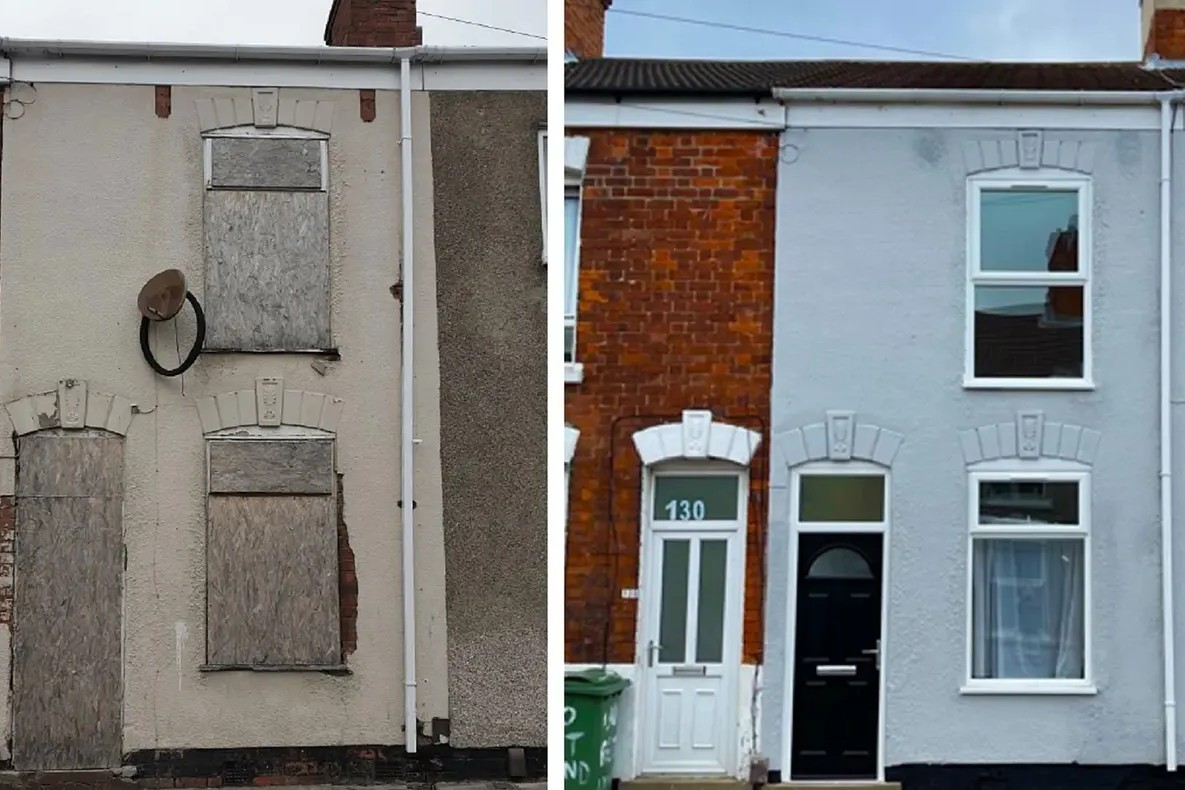
This rule doesn’t just apply in ‘fast’ crises, but also in the slow-motion ones. For example, take the Frome community project that set out to reduce loneliness, and ended up also reducing health costs by 17% while they went up by 21% in the rest of Somerset . Or East Marsh United in Grimsby, a community project who buy-up empty, boarded-up houses, retrofit them and rent them out as warm affordable homes.
Or projects like Hastings Commons, which rescues difficult and derelict buildings, brings them into community ownership and revitalises them. Or We Can Make in Bristol who organised with the community to build zero carbon, affordable homes through suburban densification. Or Community Land Trusts (CLTs) like in Cornwall, which has created over 260 permanently affordable homes. Or De Stripmaker in the Netherlands, a project that allowed 27 families who were able to buy an affordable plot of land and self-build a neighbourhood of zero-carbon, near-zero energy bill homes for themselves. Or Civic Square and Onion Collective who are creating community owned infrastructure and institutions in places as different as Birmingham and Watchet. Or Platform Places, who coordinate multi-actor agreements to bring failing high streets back to life. Or credit unions. Or regenerative farms across Europe who are restoring the soil and natural biodiversity, while actually being 33% more productive on average. Or farm cooperatives that protect food supply chains. Or community care networks like Buurtzorg Nederland that can reduce the cost of care by 50% while producing better outcomes.
Then there are organisations like Create Streets, MySociety (or ourselves, Open Systems Lab) who create open source tools, templates and digital infrastructures to support these new models and placed-based citizen-led projects. There are also network organisations like Locality and the Community Land Trust Network that facilitate knowledge sharing, and representation of these models to policymakers. Or the Mycelial Network, a network of community asset developers cooperating to support each other.

This list could go on, and you’d only start to feel more hopeful. The important thing is that these are not just random, ‘nice community projects’ — a cheerful collection of nice-to-haves. These are what are referred to as ‘third horizon’ demonstrators, signals and proofs of the next economy. They are distributed by design, open source, fair, regenerative and, critically, resilient. They consistently outperform and outlast the ‘zombie’ systems they are filling-in for, often even on their own terms. For example, by reducing costs, or delivering projects when others can’t. Or by exceeding environmental goals that the old economy says are ‘unviable’. They rewire the incentives. They tap-into forms of trust, collaboration and social capital that legacy systems either can’t reach or actively exclude.
From inside big national policy bodies and government institutions, these sorts of initiatives can easily be dismissed as too small, too local. But what that perspective misses is that the local is always there, whether you look at it or not. It is a peculiarity of 20th century institutions that they tend to overlook this ‘middle’ scale of human organisation, between individual households and the state, even though, throughout most of human history, that is where much of life actually happened. But in an era of broken systems and toxic social media, we can’t afford to do that anymore. This may be the only scale at which things actually work — the only scale at which trust can be rebuilt.
The things these initiatives are working to afford are exactly the fundamentals of a good life. The chance to own a secure, warm, affordable home, to be healthier, to care and be cared for, to be part of a community, to learn, to do work you enjoy, to have agency, opportunity, to contribute to something bigger than yourself.
This is not a ‘Left’ thing, or a ‘Right’ thing. It is simply about what works in an era of complexity, uncertainty and rapid change. It is about local, distributed, networked and circular (or ‘regenerative’) as strategies for resilience, as opposed to centralised, linear and extractive. It is about what social fabric we can weave to reduce the risk burden on governments and insurers, and what new systems we can build that will allow us to survive and thrive in the coming decades. In very practical ways these are the building blocks of a new social contract.
The big AI question
Let us take, for example, one of the central questions that is haunting political leaders, businesses and investors today:
If AI destroys wage labour for many, what will people do?
In the old system there are two common answers to this question. The first is to leave it to ‘the market’ to figure it out. It’s not hard to imagine how that would go. The second answer is that governments should tax AI firms, and use the proceeds to pay something like a Universal Basic Income (UBI) to all citizens.
But even if governments could adequately tax tech giants and use the money to pay a Universal Basic Income, it still wouldn’t work — because we’re still locked inside these legacy rentier systems.
To illustrate this, imagine if, next month, the government started paying everyone in your neighbourhood a basic income of £500 per month. What would happen? For a while, everyone would feel richer. But in a year or two you’d just find that the rents and property prices in your neighbourhood would have gone up (or not gone down) by approximately… £500 per month.

But these projects offer better answers. What if everyone had access to a permanently affordable home to rent or own, with ultra-low energy bills? And what if the rent they paid was recycled back into community infrastructure and services instead of being extracted out? That could free up time and money to instead be spent on care, learning and stewardship of their community, entrepreneurship, buildings or the environment. Or just to build up some savings.

A stewardship economy
This hints at the answer to the AI question. Because for every person looking at the tech sector wondering what all the unemployed workers are going to do, there is someone else wondering where we are going to find all the builders, the maintainers, the repairers, the teachers, the learners, the doctors, the carers, the regenerative farmers, the stewards of natural resources and infrastructure, the social entrepreneurs. That’s the kind of work we badly need more of. It’s also the kind of work that gives people a sense of identity, belonging, agency, and purpose.

Scaling the stewardship economy
So the question becomes, how do we create an economy where people have the space, time, knowledge and resources to do these things? Why aren’t initiatives like these already normal everywhere? The answer to that question is complicated. It’s not just a matter of investing in these things as if they were startups. They’re not. It’s about the availability of funding, the policy environment, helping local councils understand how to work with and enable these sorts of initiatives, not put blockers in their way (be more like Lewisham Council and Cornwall Council. Don’t be like Somerset Council).
The land question
But of all these blockers to the stewardship economy, there is one that is greater than all the others put together — one that underpins every single one of these projects. In fact, it underpins almost everything. It is land ownership. Not just who owns land, but rather, how we own it. Land — or rather, property (the tradeable paper legal agreements we form over land) and the incentives it creates — is the boss-level problem.
Understanding that system is the key to unlocking not just the stewardship economy, but the wider commercial economy too.


Comments