

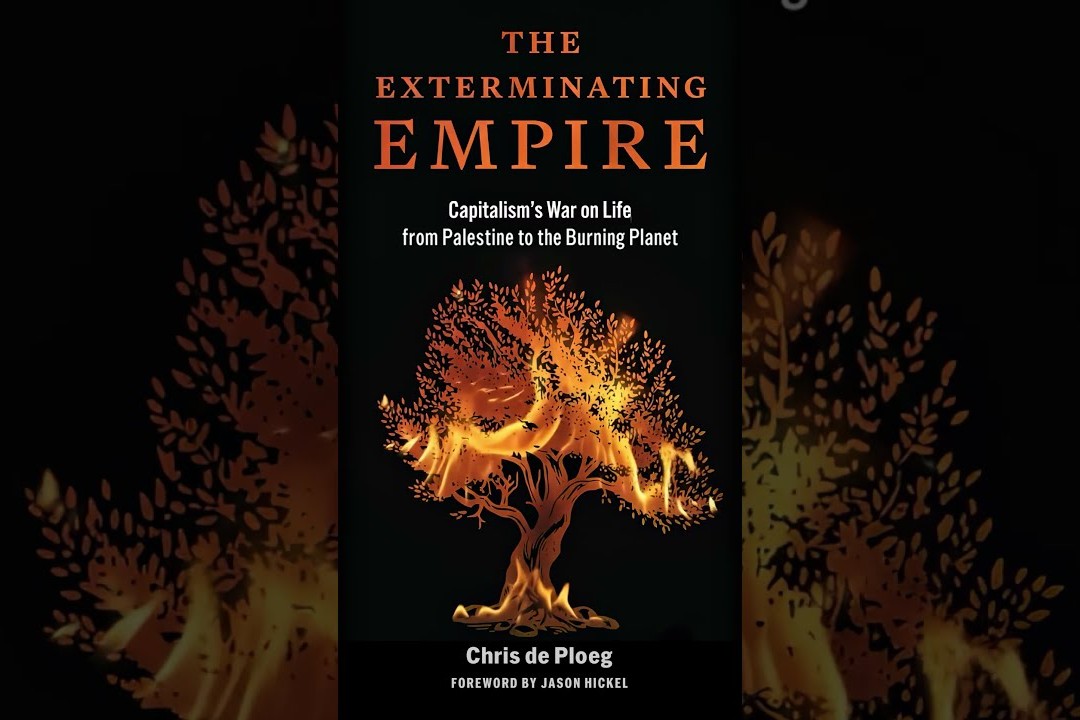
The Exterminating Empire: Capitalism’s War on Life from Palestine to the Burning Planet by Chris de Ploeg. (Monthly Review Press, New York, 2026). Foreword by Jason Hickel.
Chris de Ploeg starts from a scene we have all lived through by now: watching governments invoke human rights and international law while arming and defending a genocide. Jason Hickel makes the same point in his foreword: it isn’t hypocrisy. There’s only one standard, and it’s capital. Governments aren’t failing to live up to their stated values. Capital accumulation has been the actual operating logic all along.
The Exterminating Empire: Capitalism’s War on Life from Palestine to the Burning Planet (2026) traces that logic across five hundred years, starting with the plantations and land seizures of early colonialism and running through to the AI-assisted targeting systems used in Gaza today. The core argument is that genocide and ecological destruction aren’t two separate crises that happen to be occurring together. They’re the same machine, running on the same program. Gaza isn’t an exception to how empire works, it’s actually the clearest demonstration of it.
De Ploeg builds that case from several angles: the mechanics of destruction in Gaza and beyond, U.S. settler colonialism and the war on Indigenous life and land, how capitalism hollows out inner life and meaning, the ideologies (like longtermism and eco-fascism) that justify mass death, how mainstream climate and conservation politics often function to delay real change rather than deliver it, and the history of revolution and counterrevolution going back to Haiti. The book’s final section turns from diagnosis to strategy — what should actually be done. That’s where I’ll spend the most time, because it’s rare, it’s urgent, and because it’s also where I found the clearest places to push back.
I want to hold two things at once here: take the diagnosis seriously, and press on the prescription.
What the book gets right
De Ploeg won’t let Gaza sit as an isolated horror, disconnected from everything else. His argument is that capitalism has always needed to clear away whatever stands in the way of profit, whether that’s people, animals, or entire ways of life, and then build something more profitable in the space that’s left. He traces that pattern from the extermination of the American buffalo alongside Indigenous nations, to the way colonizers reshaped entire ecosystems to serve European agriculture, to the ideologies that make mass death seem acceptable, even necessary, to the people ordering it. Gaza fits the same pattern: land and people cleared, and plans already underway for what gets built in their place. Destruction and construction aren’t opposites under capitalism, in his account. They’re two steps of the same process, whether what gets built next is a plantation, a settler colony, or today, a “green” transition that still runs on extraction.
De Ploeg’s most developed material is on a different kind of annihilation: the destruction of meaning, memory, and culture. He traces a straight line from the U.S. boarding schools that told Indigenous children to “let everything Indian inside you die,” through the CIA-funded art and academic institutions of the Cold War, to the algorithms shaping what people see and feel today. That throughline shows that colonialism never stopped at land and bodies. It goes after the stories people tell about who they are, the ground a people stand on when they know their own history and language, which is exactly what makes them harder to rule. The same logic shows up in some unexpected places, like American car culture and suburban sprawl, which he reads as another form of enclosure: the destruction of walkable, communal city life in favor of a system that isolates people and locks them into debt. It’s a useful frame for organizers thinking about isolation and alienation as political conditions, not just personal ones.
De Ploeg also takes on conservation itself, tracing how the modern environmental movement has roots in colonial hunting grounds and eugenicist population theory, and argues that a lot of mainstream climate and conservation policy still runs on the same logic: land conservation used to displace Indigenous communities, carbon offset markets that fund green-washing more than they fund real emissions cuts, and Global North consumption habits repackaged as “personal responsibility” campaigns. It’s a strong argument: a lot of what passes for climate policy is really a way of avoiding the deeper redistribution the crisis actually calls for.
The same refusal to settle for half-measures shows up in how De Ploeg handles degrowth. His argument is that shrinking consumption in the Global North only works if it’s paired with real sovereignty for the Global South, and only inside a planned economy rather than left to markets. Carbon taxes and EV subsidies that ask ordinary people to absorb the cost of the transition poll badly and lose political support fast, he argues, while a degrowth message tied to economic justice doesn’t. On the Global South side, what he’s calling for is land redistribution, industrial development controlled by the countries doing it, and resource transfers, not extraction managed more gently. It’s a clear answer to a question a lot of climate politics avoids: degrowth for whom, and paid for by whom.
The most useful part of the book for organizers, though, is how concrete it stays in the final chapter. De Ploeg keeps returning to actual leverage points instead of resting on moral outrage: ports, arms factories, supply chains, military recruitment. He points to Palestine Action UK, which has shut down arms factories by combining direct disruption with real relationship-building in the surrounding community beforehand. He quotes a Belgian dockworkers’ union leader who explains that 80 percent of their time goes into local struggles and only 20 percent into international solidarity work, because the local organizing is what makes the international solidarity possible at all. That’s a strong lesson on its own: local organizing is what international solidarity is built from, rather than a separate consideration.
Conversely, De Ploeg doesn’t shy away from saying plainly what hasn’t worked. The protests against the Iraq War and the Black Lives Matter uprisings shifted public discourse without disrupting the systems they were protesting. Mutual aid and community-based projects matter, he argues, but by themselves they leave the war machine untouched. None of this is a new critique inside organizing circles, but de Ploeg states it clearly, and pairs it with a real challenge: political analysis and vision, without strategy, an actual plan for getting from here to there, risks becoming just an intellectual exercise.
Where the strategy narrows
Here’s the tension I want to name directly: de Ploeg insists on strategic seriousness but ends up answering that call with a fairly familiar prescription. His final chapter argues for rebuilding revolutionary parties along traditional lines, and describes today’s leaderless, horizontal, non-hierarchical organizing, the kind many Global North movements have leaned on for the last few decades, as something he calls “cultural and organizational imperialism.” His argument is that this style of organizing, built around flat structures, consensus, and a suspicion of leadership, spread outward from the U.S. and Europe, where failure has historically been survivable in a way it hasn’t been in the Global South.
It’s a fair point. Movements based in wealthier, or less repressive, countries can afford to lose in ways that movements facing direct state violence cannot. But de Ploeg uses this argument to wave away an entire category of organizing, without offering much space between two options: build a disciplined, centralized revolutionary party, or accept that you’re unconsciously replicating imperial habits. Most organizing lives somewhere in between those two poles, and the book doesn’t spend much time there.
De Ploeg is also far more deferential than critical toward certain state and armed actors. He argues movements should have zero reservations about defending China against economic and military pressure, and treats groups like Ansar Allah and Hezbollah mainly as principled defenders of international law. At the same time, he dismisses the idea that China or Iran might play any “sub-imperial” role of their own, extending influence over other countries and peoples in ways that also deserve scrutiny, calling that idea a manufactured distraction meant to divide movements. Yet, he uses the term “sub-imperial” himself elsewhere in the book, to describe the Gulf monarchies and never explains why the concept applies there but not to China or Iran. It’s an inconsistency inside his own framework, not an outside critique.
A chorus of voices
Reading the strategy chapter, I kept hearing the voices of thinkers and organizers who have shaped my own thinking. I’m not claiming to know what any of them would say about this specific book. What follows is closer to a thought experiment: borrowing their lenses to think through what de Ploeg proposes, and where this leaves me with more questions than the book answers.
Roger Hallam, a co-founder of Extinction Rebellion, has built his organizing theory around large-scale, disciplined civil disobedience: the idea that enough people breaking the law together, in a sustained and coordinated way, can force political change. De Ploeg himself brings Hallam into the book, in a different chapter, noting that he was imprisoned for four years in the UK simply for advocating a highway blockade at a meeting. Reading de Ploeg’s claim that mass mobilization mostly shifts discourse and little else, I think of Hallam’s own movements as a test case. XR and Just Stop Oil are disciplined and sustained in exactly the way Hallam’s theory called for, not the loose, spontaneous protest de Ploeg is dismissing, and they have drawn real state repression for it, including the prison sentence de Ploeg himself cites. They haven’t yet forced the systemic change Hallam set out for. But they also don’t fit de Ploeg’s remedy: they are neither a vanguard party nor the kind of unstructured horizontalism he blames for going nowhere. It leads me to ask a harder question: what separates disruption that builds toward lasting power from disruption that stalls, and is the answer really “party or nothing”?
William I. Robinson studies how global capitalism operates beyond the nation-state. His research argues that capital has outgrown the nation-state blocs that a book like this one relies on: elites across the Global South are often woven into the same transnational capitalist class as elites in the North, not standing apart from it as a unified bloc of the colonized. From that angle, de Ploeg’s map of a U.S.-led empire facing off against China and the Global South starts to look less like a settled political position and more like a picture of how power used to move, rather than how it moves now.
Patrick Bond is the scholar who borrowed the term “sub-imperialism” from dependency theorists Ruy Mauro Marini (Brazil) and Samir Amin (Egypt) to describe how BRICS member states can dominate and extract from their regional neighbors, even while resisting Western political domination themselves. For Bond, this doesn’t put them outside the global capitalist system; it ties them more tightly into it, through neoliberal multilateral institutions and global value chains. Thinking of his work, I want a harder look at how BRICS states and Global South elites profit from unequal relationships within the Global South, not just between North and South. And de Ploeg’s own use of “sub-imperial” for the Gulf monarchies makes it hard for me to accept his dismissal of the same concept everywhere else.
Arundhati Roy’s writing on big dams, land seizures, and extraction in India shaped how I think about ecology and empire together, long before this book. Reading her alongside de Ploeg, I feel the pull of his ecology-as-empire framing; it’s close to ground she’s covered for decades. But her work has also made me wary of any single unifying program, revolutionary or otherwise. She has spent much of her career documenting how states, including ones that call themselves left, can run over the people who live on the land they want to develop: India’s Indigenous communities, Dalit communities, women, all in the name of a bigger cause. The book is clear about what empire does to Indigenous people. It follows that we must ask, would the party and the state that de Ploeg calls for be any better at listening to them once it held power?
Winona LaDuke, an Anishinaabe organizer and writer from the White Earth reservation in Minnesota, has spent decades working to recover Indigenous land and stop pipelines, including through Honor the Earth, which she helped found. Her work runs close to what de Ploeg describes, and to his emphasis on leverage: pipelines are exactly the kind of infrastructure chokepoint he advises movements to target. The book credits Indigenous movements with lowering emissions in the United States and Canada, and it treats the destruction of Indigenous life, from the buffalo to the boarding schools, as a foundation of the whole system. But in the strategy chapter, Indigenous-led organizing appears more as an ally to support than as a model to learn from. And when the ecosocialist program calls for public ownership and planning, I find myself asking a question LaDuke’s work makes hard to avoid: public ownership of whose land, and under whose authority?
Ella Baker spent decades organizing, from NAACP branches across the Jim Crow South to the founding of the Student Nonviolent Coordinating Committee, the organization at the center of my earlier review of Alice Echols’s Black Power, White Heat. She’s remembered for group-centered leadership: the belief that a movement’s work is to develop the leadership of ordinary people rather than to rely on a few charismatic figures. When de Ploeg calls leaderless, horizontal organizing an import from wealthier countries where failure is survivable, I think of Baker. The young organizers she mentored were building power in Mississippi under the threat of real violence, and they did it without a vanguard party. Her record points to ground the book skips over, between a centralized party and an unstructured uprising: organizing that is patient, disciplined, and deeply structured, but built to spread leadership rather than concentrate it.
Grace Lee Boggs came to her later work through the Marxist tradition, then spent decades in Detroit asking what revolution means once you’ve watched a city be abandoned by industry. With her husband James and a generation of local activists, she helped build community gardens, youth programs, and neighborhood projects, arguing that movements have to create new ways of living, and change themselves in the process, not only protest what’s wrong. De Ploeg treats mutual aid and local projects as necessary but not enough without a plan to confront the war machine. Reading him alongside Boggs, I wonder where the work of building something new fits inside his strategy, and whether these projects substitute for a serious plan or make one possible.
Readers of Noam Chomsky’s decades of writing on U.S. foreign policy would recognize a lot of this book’s core argument as familiar ground: the imperialism, the material analysis of power. But his work also offers a direct counterpoint to the two areas where this review pushes back hardest: Chomsky has spent just as long favoring decentralized, institution-by-institution organizing over vanguard-party models, and he’s been openly critical of left tendencies that uncritically defend authoritarian states.
These eight voices function as a set of lenses: people whose work grows out of struggles against empire, racism, and capitalism, and who would likely still land in different places on the two questions this book keeps circling back to. How centralized does effective resistance actually need to be? And which states and movements, if any, earn something close to unconditional defense? This is a live fault line inside the anti-imperialist left itself, not a disagreement between the left and its critics. None of these eight would settle it the same way, but bringing them into the room makes for a richer conversation and sharper organizing because of it.
What is to be done
None of this argues against reading the book; quite the opposite. The core diagnosis holds regardless of where anyone lands on the party question: the refusal to treat Gaza as exceptional, the tracing of cultural genocide from boarding schools to algorithms, and the unmasking of conservation and carbon markets as tools of dispossession rather than solutions to climate breakdown. So does the strategic material: the chokepoint analysis, the insistence that local organizing is what makes international solidarity real, and a synthesis of degrowth in the Global North with sovereign development in the Global South that’s among the clearest versions of that argument available in a single book.
The place to engage more critically sits at the edges of that same confidence: which forms of organizing can actually hold power once it’s seriously contested, and which states and movements, if any, deserve support without conditions attached. Neither question has a tidy answer, in this book or in the movements grappling with it right now.
That’s the real use of a book like this in political education: not as a settled program to adopt, but as an argument sharp enough to be worth having. Take the diagnosis seriously. Debate the prescription. Both belong in the conversation about what happens next.




Comments