

Over the past few weeks, I’ve fallen down a Netflix documentary rabbit hole. First, it was Louis Theroux’s documentary on the manosphere, Louis Theroux: Inside the Manosphere. Then the Turning Point series, which walks through the Second World War, Vietnam, and the wars in Afghanistan and Iraq. Right now, I’m watching a documentary on the US Marines. And running alongside all of it, in the actual news, is the aftermath of the deadly Berlin Pride attack that occurred on Berlin’s Christopher Street Day, which left one person dead and 29 injured.
Beyond the usual political statements of shock and condolence, people are searching for an explanation. Why does a 21-year-old, raised in Germany, find the Islamic State compelling enough to kill in its name? You could ask a version of the same question about the renewed pull of right-wing extremism among young people all over Europe.
In almost every case, the people being pulled in are disproportionately young men. Roughly nine in ten people arrested on terrorism charges in the European Union (EU) are male, and are being drawn into extremism at younger ages, owing in part to social media.
Another part of the answer might be sitting in those Netflix documentaries. Young men keep showing up on screen with strikingly similar backstories: absent fathers, parents struggling with addiction, school struggles. They’re looking for grounding, meaning, direction. Above all, they’re looking for belonging. And they find it in structures like the military. Or online. Nearly two-thirds of young men watch masculinity influencers, and young men are three times as likely as young women to view Andrew Tate favourably.
What’s now widely called the male loneliness epidemic is, on closer inspection, less about loneliness itself than about having nowhere to take it. A Pew Research Center survey found American men and women about equally likely to say they feel lonely, but only 38 percent of men said they would be likely to turn to a friend for emotional support, compared with 54 percent of women. That is the vacuum that religious and political preachers of every stripe have been remarkably quick to fill.
What almost all of these groups have in common is a human enemy, a need that society never seems to outgrow. For the military, in the broadest sense, it’s “the bad guys.” For religious fanatics, it’s “the unbelievers.” For the manosphere, it’s women. For political fanatics, it’s whichever end of the spectrum they’re not on, or foreigners, or Jews, or Palestinians, depending on the flavor. A shared enemy, however abstract, creates a sense of belonging. This isn’t a fringe psychological quirk. Social psychologists have shown, going back to classic studies on group conflict, that introducing a shared external threat is one of the most reliable ways to dissolve hostility between rival groups and bind people together instead. The mechanism works. The only real question is what fills the “enemy” slot.
At the same time, young men increasingly feel sidelined. Socially, economically, politically, the focus has moved elsewhere, and they’ve noticed. The subcultures that used to give a generation of boys an identity and an outlet–punk, goth, skating, hip-hop–built around music or a moderately dangerous sport, are fading or migrating entirely online. And there’s the more basic question of physical energy: where is it supposed to go? My own observation, watching this play out locally, is that somewhere around age 14 or 15, boys move from the dusty football pitch under the trees to the gym, where they start lifting. Toward what end, exactly?
So the question I keep coming back to is this: what would it take to give young men back a sense of purpose, direction, and structure, without handing that job to fanatics of every persuasion? And the answer I keep arriving at is a fairly radical one.
Does the Enemy Have to Be Human?
If a shared goal, or a shared enemy, is what creates belonging, and you can see the same mechanism at work in something as mundane as a football match against a rival team, then I don’t see why that enemy has to be human. Why shouldn’t good old CO2 do the job?
When the hole in the ozone layer became public knowledge in the 1980s, the culprit was identified quickly: CFCs were destroying the ozone layer, and something had to be done about it. Granted, that was a comparatively contained problem, with one narrow chemical culprit and a manageable industry to regulate.
Climate change runs through nearly every sector of the economy and every daily habit, which is part of why progress on it has been so much messier. But as a shared, non-human threat capable of uniting people against it, it has exactly the right shape.
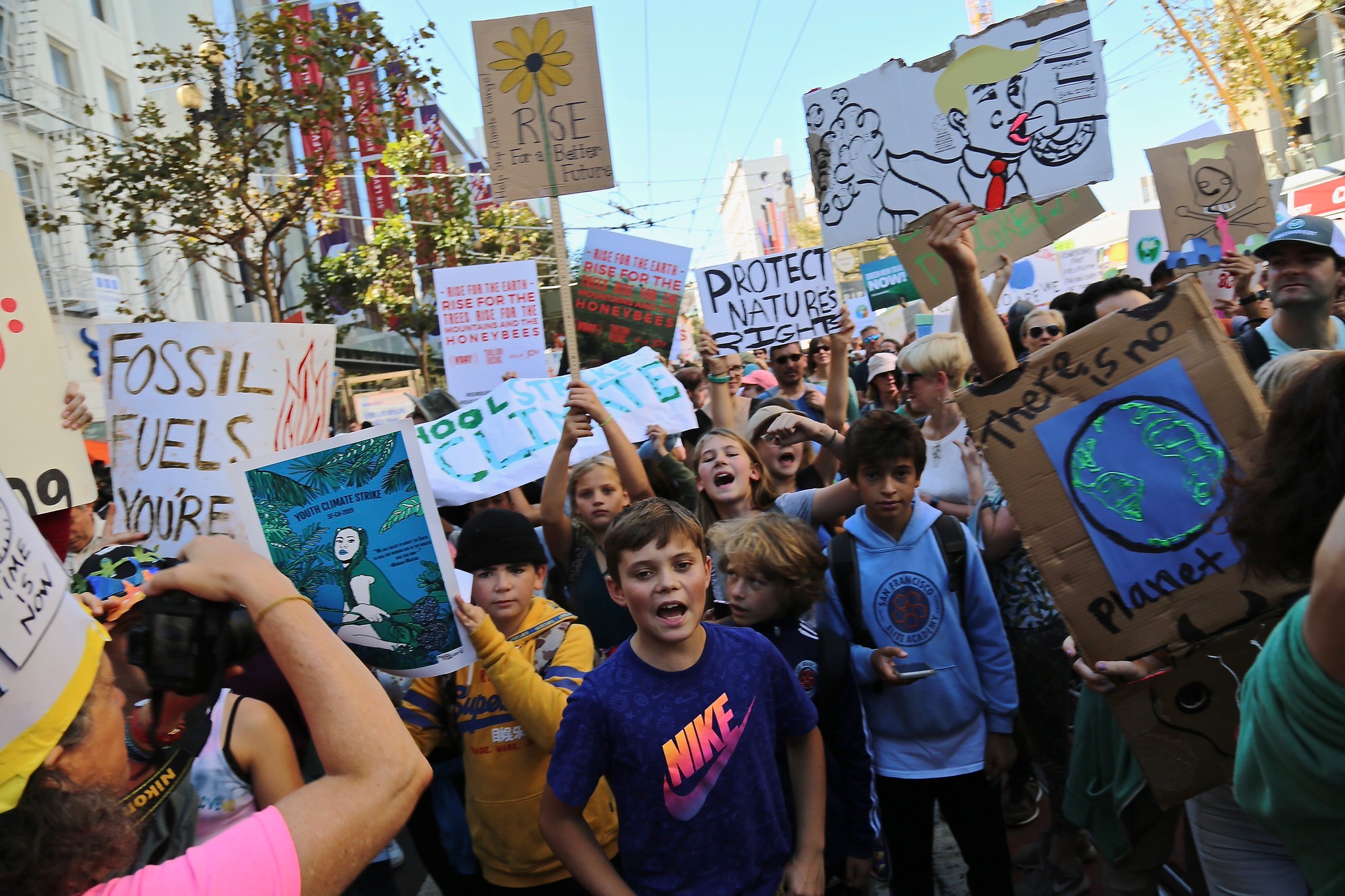
What’s stopping us from building a movement for boys and young men aimed at climate change adaptation, organized along the lines of the historical Civilian Conservation Corps? A corps that demands discipline, effort, and hard physical work, while giving structure and grounding in return. Its purpose: planting trees in towns and cities, maintaining and repairing flood defenses, cutting and maintaining firebreaks in forests so that when a wildfire does start, the damage can be contained faster. The original left its mark on the men who went through it. Even decades later, they earned more and lived longer.
It’s worth being specific about the kind of work this actually means, because not all of it can be mechanized. Large-scale reforestation in open woodland can be done with heavy equipment. Greening a town, planting street trees, restoring a wildflower meadow on an old industrial lot, digging drainage channels through a neighborhood, cannot. That work needs hands, backs, and time on site, and the result is visible immediately, in a way that heavy machinery in a distant forest never quite is to the people who did the work.
This kind of corps wouldn’t need to teach reading and writing as it did in the 1930s. But it would give young people the chance to develop real manual skill, and with it, a kind of pride in the work of their own hands that Europe, in particular, has spent a generation quietly stripping away by treating academic careers as the only kind worth having and skilled trades as something you settle for.
Addressing the Obvious Objection
Before the objection arrives that this would just open another door to militarism and extremism: yes, that risk has to be taken seriously. The movement would need to stay explicitly neutral, politically and religiously, the same way any youth organization does. And the same safeguards that apply to every organization working with young people, against abuse, against capture by any single ideology, would have to apply here too, rigorously. But a visible, public organization is considerably easier to monitor and hold accountable than millions of individual predators operating quietly on TikTok.
None of this is meant to suggest that a corps would fix male disaffection on its own. The causes run deeper than any single program can reach, from jobs and schools to housing and algorithms, and each needs its own answer. A climate corps is one answer among several, aimed at one particular gap: the lack of a place to belong and of something worth doing.
And why specifically for boys, not girls? This is worth looking at plainly, without ideology attached. Boys going through puberty typically experience a sharp rise in testosterone, rapid physical growth, and significant changes in brain development, which may contribute to greater reward sensitivity, status-seeking, and risk-taking.
We are currently at real risk of losing an entire generation of them to people who are only too happy to give that energy a direction. Building an organization around this doesn’t take anything away from girls. If anything, it helps them too, by giving boys role models, goals, and structure that shape them into men who don’t feel the need to dominate or control women, and by pulling them out of the reach of the manosphere and its preachers before that reach becomes permanent.
There’s a piece of the puzzle I’ve glossed over so far, and it’s an important one: status. All extremist movements are remarkably good at offering it. Researchers who study radicalization name the need to matter, to be someone, as its central driver. Rank. Significance. Visibility. A recruit joins as nobody and, within a defined structure, can rise, be seen, be recognized, matter to someone watching. The manosphere in particular sells this almost entirely through hierarchy and dominance: follower counts, body count, a bigger lift than the next guy, being ranked as “high value” by an audience that measures worth in exactly those terms.
What my proposed model offers is work and meaning. Both genuinely valuable, neither one is the same thing as status, and I’d be lying if I said that gap doesn’t matter. Meaning gets you through a hard day. Status is what gets you to show up in the first place, especially at an age when being seen by your peers can matter more than almost anything else.
It is tempting to wish the hierarchy away. The research suggests it forms anyway. Among boys at a summer camp, it took shape within days. In societies with no wealth to speak of, it forms around skill and respect. Even the most egalitarian foraging bands, the anthropologist Christopher Boehm argues, are not free of the urge to dominate.
So the choice, according to some researchers, is not between hierarchy and no hierarchy. It is between two kinds. Researchers distinguish two routes to rank: dominance and prestige. The first is taken through intimidation. The second is freely granted by others for demonstrated skill. Both work. The manosphere sells the first. A climate corps may offer the second. Meaning alone may not be enough to compete with the appeal of extremist recruiters when people also need tangible ways to see their efforts recognized.
Elon Musk puts his fortune and platform behind spreading manosphere content, and that is far too much power in the hands of one man. Countering it takes comparable reach, aimed at something worth spreading instead. Better still would be to spread that weight across many shoulders, in a grassroots movement carried by thousands of local groups and rallied by one or more figures with the standing of a Jane Goodall. It would need influencers willing to lead by example, proudly showing off the tree they just planted instead of their latest supplement or their newest 100-kilogram lift.
Above all, it would need an environmental movement willing to move aggressively into this gap and crowd out the extremist movements competing for the same young people, without becoming just another version of the same trap: a movement that finds its cohesion by inventing a new human enemy of its own.





Comments
We changed commenting systems on September 10, 2026 as part of a site-wide functionality and security upgrade. Your past comments have not disappeared, and you can still log in with your old Disqus account credentials if you wish. Contact us with any questions.