


From the archive: Originally published in July 2024.
Climate change is a huge, complicated problem. Therefore, many people have an understandable tendency to mentally simplify it by focusing on just one cause (carbon emissions) and just one solution (alternative energy). Sustainability scholar Jan Konietzko has called this “carbon tunnel vision.” Oversimplifying the problem this way leads to techno-fixes that actually fix nothing. Despite trillions of dollars already spent on low-carbon technologies, carbon emissions are still increasing, and the climate is being destabilized faster than ever.
Understanding climate change requires us to embrace complexity: not only are greenhouse gases trapping heat, but we are undermining natural systems that cool the planet’s surface and sequester atmospheric carbon—systems of ice, soil, forest, and ocean. Grasping this complexity leads to new ways of thinking about climate change and viable responses to it.
Almost everything we’re doing to cause climate change involves technology—from cars to cement kilns to chainsaws. We humans love technology: it yields profits, jobs, comfort, and convenience (for some, anyway; it also tends to worsen overall economic inequality). So, predictably, we’re looking to alternative technologies to solve what is arguably the biggest dilemma humanity has ever created for itself. But what if that’s the wrong approach? What if more technology will actually worsen the problem in the long run?
In this article, we will see why there is no viable techno-fix to climate change, and why trees, soil, and biodiversity are our real lifelines.
Machines Won’t Save Us
Before discussing natural solutions, let’s explore whether technology has a role to play. What machines are touted as our main climate solutions, and what are their strengths and drawbacks? There are four broad categories.
The first climate-tech category consists of low-carbon energy generating machines, including solar panels, wind turbines, and nuclear power plants. These energy sources produce electrical power with minimal carbon emissions. However, they are not problem-free or risk-free. Wind and solar power are intermittent, requiring energy storage (e.g., batteries) and a major grid overhaul. Building these energy sources at sufficient scale to replace our current energy usage from fossil fuels would require enormous amounts of materials, some of them rare, and mining those materials destroys habitat and pollutes the environment. Recycling could eventually minimize materials requirements, but recycling has limits. Nuclear power likewise suffers from the dilemma of scale (to make a significant difference, we’d need to build an enormous number of nuclear plants, and quickly), but adds problems associated with fuel scarcity, waste containment and disposal, and the risks of accidents and nuclear weapons proliferation.

The second tech category includes energy-using technologies for running the modern industrial world—machines for manufacturing, heating, mining, farming, shipping, and transportation. In many cases, low-emissions versions of these machines are not yet marketed, and many may not work as cheaply as current technologies (cement making and aviation are two industries that will be hard to decarbonize). And again, there is the dilemma of scale, and the requirement for more materials. We have built our current industrial infrastructure over a period of decades; replacing huge portions of it quickly in order to minimize climate change will require an unprecedented burst of resource extraction and energy usage.
A third category of technologies for fighting climate change consists of machines for capturing carbon from the atmosphere so it can be safely stored for long periods. “Direct air capture” (or DAC) technologies have been developed, and are starting to be installed. However, a recent meta-study concluded that these machines suffer from problems of scale, cost, materials requirements, and high energy usage. The study’s authors say that policy makers’ prioritization of mechanical carbon capture has so far yielded a “track record of failure.”
If none of our other mechanical methods for tackling climate change work, there is one last resort: technologies for cooling the planet via solar radiation management. This “solar geoengineering” solution would entail dispersing large quantities of tiny reflective particles in Earth’s atmosphere (this is known as stratospheric aerosol injection), or building a space parasol to shade the planet. Critics point out that these technologies might have unintended consequences as bad as, or worse than the problem they are trying to solve.
It’s hard to argue against implementing at least some of these technologies at a modest scale. Humanity has become systemically dependent on energy from coal, oil, and gas to meet basic needs—including housing, food, and health care. Eliminating fossil fuels quickly and entirely, without having deployed alternative sources of energy, would result in immiseration for millions or billions of people. A similar argument could be made regarding low-carbon manufacturing, agricultural, and transport machines: we need alternative ways to make things, produce food, and get around. But our need for such machines does not erase their inherent environmental costs, including resource depletion, pollution, and habitat loss.
A review of available techno-fixes leads to two unavoidable conclusions. First, our problem is not just carbon emissions per se; it’s also how we humans inhabit our planet (too many of us using too much stuff too fast). And second, we need non-technological ways of addressing the climate crisis.
Cooling Nature’s Way
Throughout hundreds of millions of years, nature has developed cooling cycles that keep the planet’s surface temperature within certain bounds (though Earth’s climate does oscillate significantly). Chief among these is the water cycle, which operates on both a large and a small scale. On the large scale, ocean currents move enormous amounts of water around the planet, shifting more water onto land via precipitation than evaporates from it. On the small scale, water falls as rain or other forms of precipitation, is absorbed by soil, is drawn up into plants, and transpires or evaporates back into the atmosphere. This dual water cycle has a net cooling effect.
We industrial humans have been destabilizing the planetary water cycle. Industrial agriculture degrades soil, so that it holds less water. Expanding cities cover soil and channel rainwater via storm drains out to sea, rather than keeping water on the land. Pavement and buildings create the well-known urban “heat island” effect, which can raise temperatures by many degrees compared to natural landscapes. Industrial agriculture, urbanization, and destructive forestry practices reduce overall vegetation, and therefore also reduce evapotranspiration. Result: even if we weren’t loading the atmosphere with excess carbon dioxide, we’d still be warming the planet. Combine a diminished water cycle with land heating from urban sprawl, a couple of hundred billion square meters of pavement, and degraded soil; then add those ingredients to the main dish of overabundant emissions, and you have a recipe for hell on Earth.
The Big Fix: Lessons from Two Large-Scale Restoration Projects
What happens when bold regenerative ideas meet human-caused environmental destruction? In this event with Sammy Gensaw (Yurok leader) and Andrew Millison (permaculture practitioner), we’ll see how a deep-rooted sense of place, strong leadership, and thinking big can spark profoundly positive changes on the landscape and in our communities.

The obvious solution: restore nature’s cooling cycles. Re-vegetate the planet, thereby increasing evapotranspiration. Restore soils so they hold more water. And get rid of pavement wherever possible.
There are depaving advocates in nearly every community. Unfortunately, their voices are drowned out by powerful road-building and construction interests, and by motorists who want to drive in comfort anywhere and everywhere. Permeable pavement options exist; but most municipalities, when faced with complaints from motorists about crumbling roads, opt simply to cover old streets with a fresh coat of black asphalt (made from oil) that heats the environment, prevents water from reaching the soil underneath, and gives off toxic fumes. If humanity is serious about halting climate change, then it should put the depavers in charge.
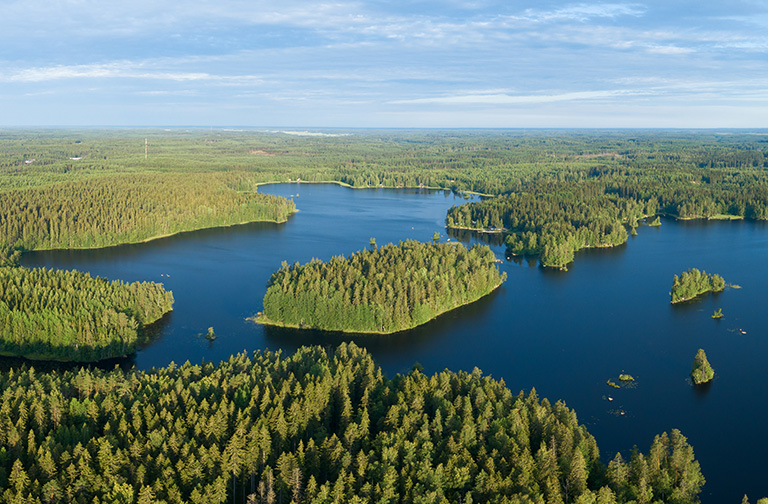
Re-vegetating the planet is a huge project that can only be undertaken in bite-sized chunks at the local scale. The biggest contributors to the small water cycle are intact forests; therefore, our first order of business should be to protect existing old-growth forests (you can plant a tree in a few minutes, but an old-growth forest requires centuries to mature). At the same time, we can plant millions more trees—but they must be the right kinds of trees in the right places. We must anticipate climate change and assist forests to migrate to suitable climate zones.
Soil can be restored by covering it with leaf litter, mulch, and vegetation, by keeping living roots in it as long as possible (mainly by planting more perennial crops and fewer annuals), and by adding compost and biochar to aerate soil and boost biological activity. First, however, we have to stop doing all the things we’re currently doing that harm soils—including annual tillage and application of herbicides and pesticides. Permaculture practitioners and organic farmers have been fighting this battle for decades, and they’ve developed many effective techniques for maximizing food production while building healthy soil.
Climate change reduces biodiversity by making environments inhospitable to some of the species that inhabit them. Moreover, everything we’re doing to cause climate change (industrial agriculture, urbanization, cattle ranching, and road building) is also directly contributing to biodiversity loss. But restoring biodiversity can mitigate climate change. For example, restoring soils requires making them more biologically diverse (in terms of fungi, bacteria, nematodes, and worms). And restored soils support other organisms (more vegetation and hence more wildlife, all the way up to buffalo and elephants) that also help maintain nature’s cooling cycles. In effect, virtually all nature conservation efforts are also climate change mitigation efforts.
Energy and Materials from Nature
If solar, wind, and nuclear electricity generators won’t solve the climate problem, and fossil fuels have to be quickly phased out, where will we get our energy? That’s a tough question, and addressing it requires, first and foremost, a discussion of demand.
The scale of energy usage in industrialized countries today is simply unsustainable. Regardless which energy sources we choose (including fanciful ones such as fusion power), using this much energy results in environmental harms such as resource depletion and toxic pollution. If we want our species to be around for the long haul, we must reduce energy demand. The best ways to do that are to encourage a smaller population and to establish economies that aim for increased human happiness rather than growth of resource extraction, manufacturing, and transport.
As energy demand recedes, humanity will have better supply options. Before we started using fossil fuels in enormous quantities, we got much of our energy from burning wood. We can’t do that now, at a time when we use far more energy and also need to increase the planet’s tree cover. Instead, we can use energy from sunlight, wind, and flowing water, not just in high-tech ways—via photovoltaics, wind turbines, and hydroelectric dams—but in low-tech ways that entail less usage of mined materials. Low-Tech Magazine explores these options, including human-powered air compressors, sailing ships, practical household bike generators, and low-tech solar panels, among many others.
If we need to conserve energy, the same is true of materials (which require energy for mining, smelting, and manufacturing). Currently many of the materials we use are toxic plastics made from fossil fuels.
Can we get all of the materials we need from nature, without depleting and polluting? In an absolute sense, the answer is probably no, unless we eventually return to hunting and gathering as a way of life. But we can dramatically reduce depletion and toxicity, first by applying the familiar ecologists’ mantra of “reduce, reuse, and recycle,” and then by substituting plant-based materials for plastics and metals wherever possible.
By partially combusting plant wastes, it is possible to produce versatile materials for buildings, roads, and manufactured goods. Thousands of small, regional pyrolysis plants, using a range of feedstocks, most now considered waste, could make both biochar (to increase soil fertility) and “parolysates” (carbon-based materials that could be incorporated into products). In many instances added carbon would improve the performance of materials, making this shift in manufacturing methods profitable.
Helping Nature Capture Carbon
Suppose we do all these things. Still, we’ve already emitted an enormous surplus of carbon into the atmosphere—about 1,000 billion tons of it. As a result, even with nature’s cooling cycles restored, there will continue to be a dangerous warming effect. To minimize that, we will have to remove and sequester a lot of atmospheric carbon, and fast. As we’ve seen, DAC machines aren’t working. What will?
Nature already removes and sequesters about half the carbon emitted by humanity’s burning of fossil fuels. You can see that effect in graphs of the annual atmospheric greenhouse gas concentration: during summer months in the northern hemisphere, when plants are flourishing on Earth’s largest land masses, the atmospheric CO2 concentration declines significantly. Then, in the winter, it rebounds and rises even further due to continually increasing emissions. Oceans absorb far more CO2 than land. We need to assist nature in absorbing a lot more than it already is (while, of course, reducing emissions dramatically and fast, rather than continuing to increase them)
Globally, soils contain about 1,500 billion metric tons of carbon; they’re the the second largest active store of carbon after the oceans (40,000 billion tons). Currently, humanity is forcing soils to give up their carbon to the atmosphere through annual tillage, erosion, and salinization. However, by adopting different practices, we could restore soils and thereby significantly increase their carbon content. The practices that would help most go by the names regenerative agriculture and carbon farming. Estimating how much carbon soil could capture if we adopted these practices at scale is difficult, but some experts suggest the quantity could exceed 20 billion tons by 2050 (of course, that assumes dramatic, coordinated efforts supported by governments and farmers).
The widespread use of biochar and parolysate materials could also capture significant amounts of carbon. In their book Burn: Igniting a New Carbon Drawdown Economy to End the Climate Crisis, authors Albert Bates and Kathleen Draper suggest that the amount of carbon that could theoretically be sequestered in buildings, roads, and consumer products is in the range of hundreds of billions of tons.
Trees and other types of vegetation already store a great deal of carbon, but current agricultural and forestry practices are reducing that amount annually. By some estimates, forests alone could capture and store over 200 billion tons of atmospheric carbon if we started adding trees in an ecologically sensitive way, rather than subtracting trees on a net basis.
The sheer scale of the ocean and its existing carbon content means that the theoretical potential for ocean-based carbon capture exceeds that of other options. However, tapping that potential at scale (for example, by microalgal cultivation or ocean alkalinity enhancement) would require massive technological interventions. Some researchers suggest that encouraging the growth of kelp, a straightforward intervention, could capture and store up to 200 million tons of carbon per year. Wetlands such as marshes and swamps cover only 3 per cent of the world’s land, but contain twice as much carbon as all forests; if restored, they could capture and store a significant amount of carbon (though estimates vary widely). Overfishing, shipping, fertilizer runoff, destruction of coastal wetlands, and plastics pollution are currently devastating ocean ecosystems, causing them to lose much of their carbon capturing capacity. Mining the ocean floor for minerals to build large-scale renewable energy systems would only worsen an already grim situation. It seems that, in the case of the ocean, the most important thing we could do is just to stop the ongoing damage.
If we did these things, could we eliminate all the excess carbon in the atmosphere and thereby stop climate change? Halting global warming altogether is likely not possible, because there is already more heating on the way due to the momentum of feedbacks that have already been set in motion—including the melting of glaciers and sea ice. Further, actually doing all of these things rapidly (say, in the next two or three decades) would require an unprecedented level of international coordination and effort. Nevertheless, the numbers add up: it is possible to draw down excess atmospheric carbon on a scale commensurate with the problem using nature-restoring methods rather than machines. Which is hopeful, because doing it with machines simply isn’t working.
Change Everything
Unlike technology, nature constantly repairs itself. It tends to clean up pollution, rather than spreading toxins. It creates resources rather than depleting them. But to meet all human needs and solve problems using nature’s way, we will have to think entirely differently. It’s not just a matter of gradually setting aside harmful, overly complex technologies, but of shifting subtle societal incentives and disincentives that cause us to turn first to machines, even when unintended consequences are easy to spot.
A more nature-based society will feature fewer people living closer to the land, with a throughput of energy and materials far smaller than is the case in industrialized nations today. We will be less urbanized, more rural. We will rely less on money, and more on community-based cooperation.
This is how Indigenous people have lived for millennia, and so it should be no surprise that some of the most successful nature-based climate mitigation efforts are being led by Indigenous communities.
Fortunately, it is possible for individuals and households to make a difference by promoting biodiversity in their homes, gardens and communities, and to reduce energy and materials usage through their daily choices of what to purchase (or not purchase), what to eat, and how (and how much) to travel.
Unfortunately, circumstances require us to make a decisive shift in how we think and live at a time when as we also face an enormous threat. Since more warming is now inevitable, it is almost certain that the remainder of this century will see mass migrations and political instability. These social challenges will make it harder for nations and communities to mount large-scale, coherent efforts to restore ecosystems.
Nevertheless, whatever we do to try slowing or halting climate change will be most effective if it is aimed at helping nature do more of what it already does. Restoring nature isn’t just our best climate solution, it’s our only solution.
Thanks to Bio4Climate and Christopher Haines for inspiration and help with this article.
Please join us on September 30 for an online panel discussion on large-scale environmental restoration, featuring Sammy Gensaw, Yurok leader and director of Ancestral Guard, and Andrew Millison, a permaculture practitioner and documentarian.
The Big Fix: Lessons from Two Large-Scale Restoration Projects
What happens when bold regenerative ideas meet human-caused environmental destruction? In this event with Sammy Gensaw (Yurok leader) and Andrew Millison (permaculture practitioner), we’ll see how a deep-rooted sense of place, strong leadership, and thinking big can spark profoundly positive changes on the landscape and in our communities.





Comments
Welcome to the new Resillience commenting system!
We have moved from the former Disqus commenting system to a new system as of September 10, 2026.
We made this change because of privacy concerns regarding Disqus. It's also part of a set of changes to bring more services to the Resilience community under a single login: commenting, (coming September 2026), and online courses (coming 2027). Unfortunately, your old Disqus comments may not reliably link to your account in this new system. Please contact us if you have any questions or concerns.
I miss you Richard!