

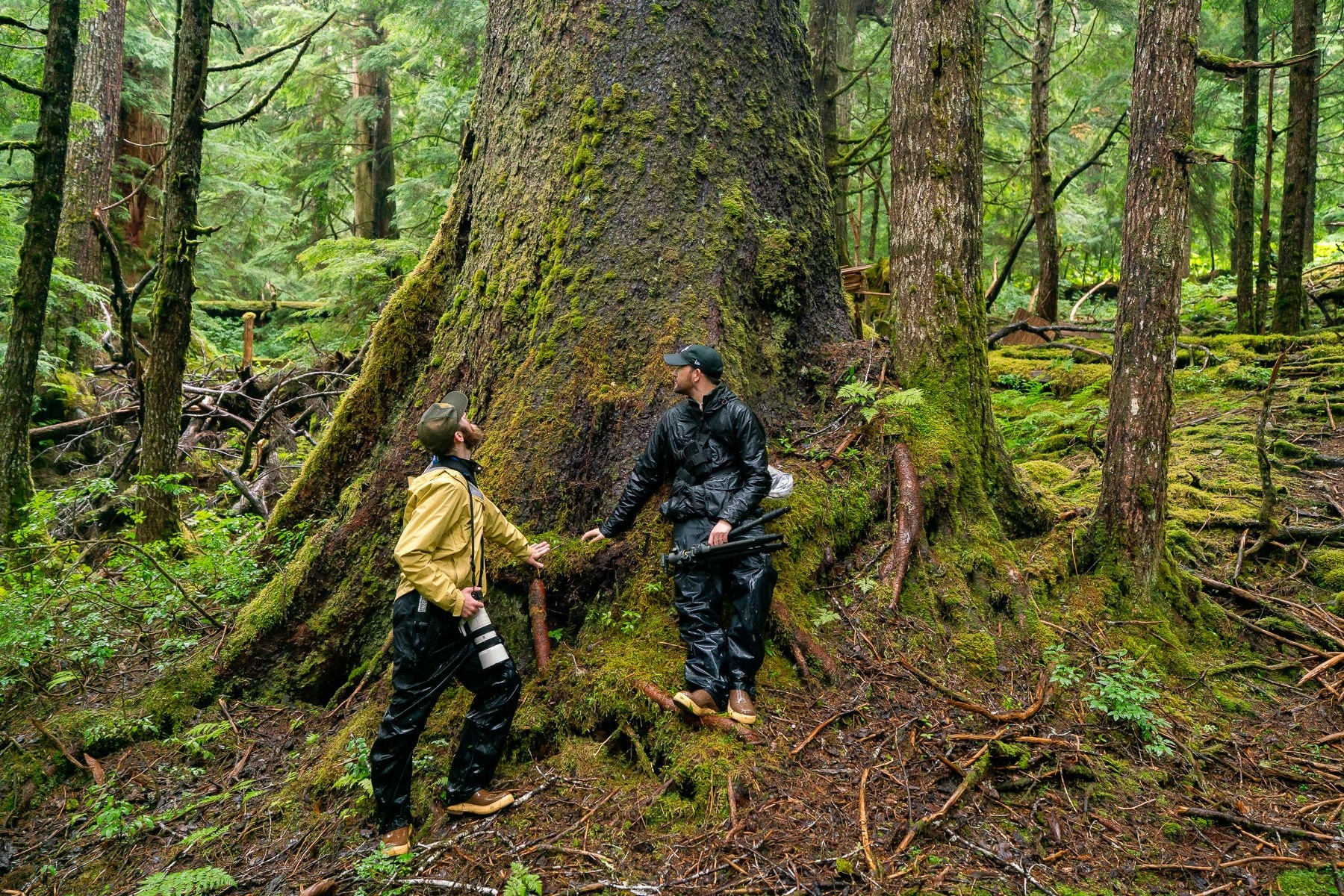
We’re back from the Tongass, the nearly 17-million-acre national forest in Southeast Alaska that now sits at the center of some of the most consequential conservation fights in America. The future of the Roadless Rule, the administration’s timber blitz, and whether we are really prepared to keep cutting what remains of our last great intact old-growth forests.
Of those 16.7 million acres, I want to start with just 16.2.
Sixteen point two acres.
On paper, that can sound almost trivial. Especially now, when millions of acres of public land are at stake across the country.
But these 16.2 acres are on Prince of Wales Island, America’s fourth-largest island and one of the most heavily logged landscapes in the Tongass. Since 1954, an estimated 94 percent of northern Prince of Wales Island’s contiguous high-volume old-growth forest has been logged.
These 16.2 acres contain the best of what’s left. One of the most spectacular pieces of old growth we’ve ever witnessed, and we’ve made it our job to see a lot. Complete with bear dens and all the habitat that wildlife has depended on for generations.
Every surviving intact acre here is critically important. Every remaining stand is impossible to replace. Every old tree that falls takes centuries or millennia with it.
Imagine hearing that 16 acres of giant sequoias in Sequoia National Park had been marked for clearcutting. Or 16 acres of ancient redwoods in Redwood National Park.
No one would dismiss the loss because it was “only” 16 acres.
That’s what they want to do here. Again.
We traveled thousands of miles to investigate it ourselves. Here’s what we found.
Unit 346
The 16-acre stand is known by the Forest Service and prospective logging companies looking to “harvest” this timber “crop” as Unit 346 in the latest Draft Environmental Impact Statement (DEIS). A seemingly innocuous 16.2 acres out of the 1,655 acres proposed for cutting across northern Prince of Wales Island.
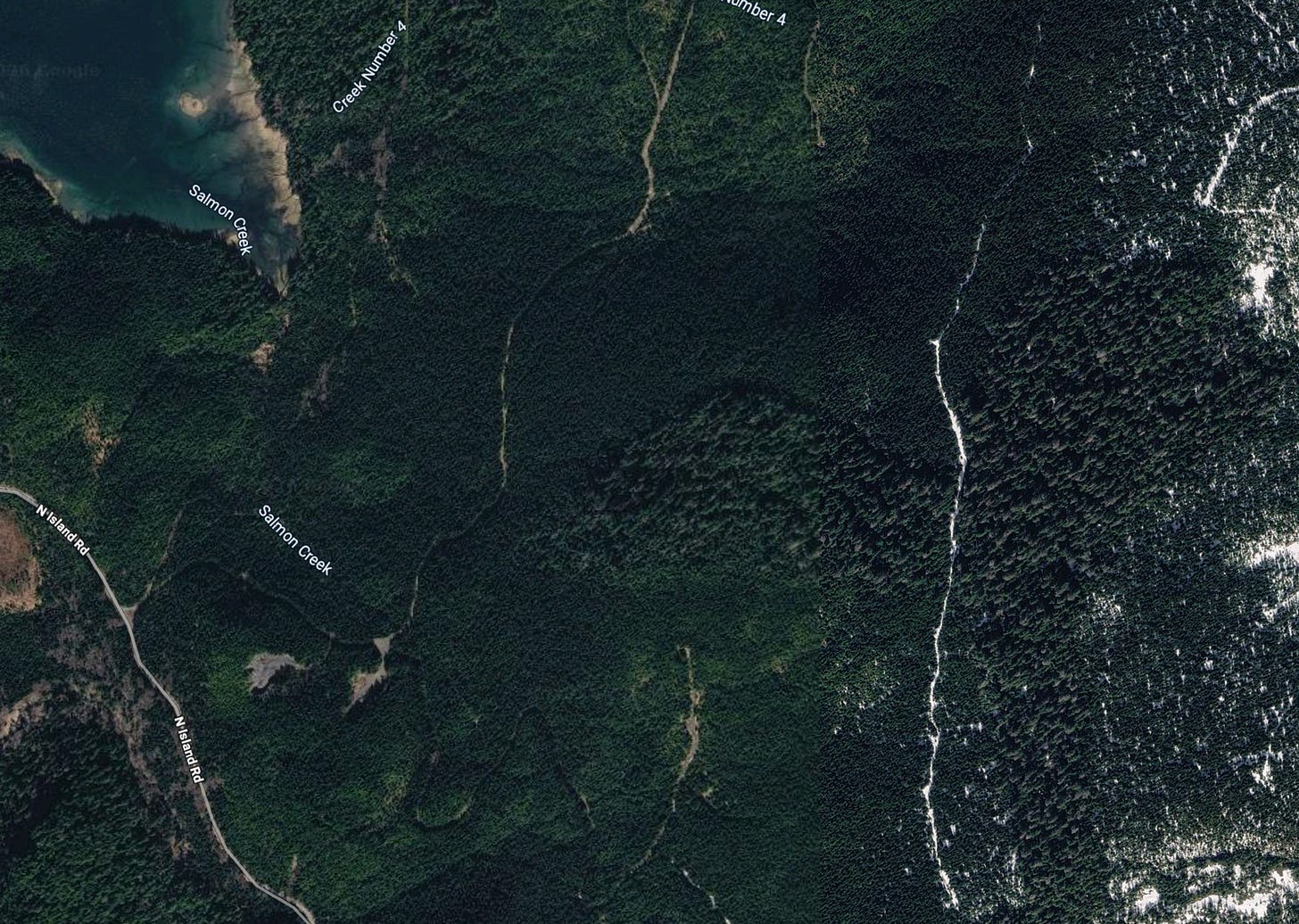
We had seen Unit 346 on the maps and satellite imagery before coming to Alaska. It looked like a pocket of intact old growth surrounded by a lot of land that had already been logged, and we wanted to know what was actually there.
The route to Unit 346 was tough.
We drove an old Forest Service road uphill until our 4WD Chevy couldn’t go any farther and then continued on foot for few miles bushwacking our way up through dense second growth that had enveloped most of the old road. Spruce tips were constantly jabbing us and devil’s club was everywhere.
At some point we looked off to the side of the “road” and noticed a giant stump. It had to be somewhere around 10 or 12 feet across, maybe more. A beautiful and tragic glimpse into the past, sitting there surrounded by the much smaller forest that had grown up in its place.
We kept going.
There had been occasional bear scat along the way but it became more prevalent the closer we got to the pocket of old growth we’d been looking at on satellite imagery.
Eventually the road ended and we were faced with the brush itself.
It was thick enough that we actually stopped and talked about whether we should go in. It was raining pretty good, getting later in the day, there was clearly a lot of bear activity around us and you couldn’t see very far in any direction.
But we had come all this way to see Unit 346.
So we went in.

Early on, we came across what appeared to be an active denning structure in the root system of an ancient cedar. There was the classic hollow opening underneath it, large enough for a bear, with these incredibly bright orange mushrooms growing along one side. It looked like something out of FernGully.
We pushed farther.
For a while it was still extremely dense. Lots of devil’s club and brush and very slow going. The terrain in 346 and much of the Tongass is known as karst, where limestone dissolved and formed invisible sinkholes and underground drainages covered by moss that could be feet thick. Every step in this dense and wet forest needed to be a careful one if you wanted to make it back down the steep slope.
Eventually though, it started to open up and we noticed flagging denoting the timber sale boundary.
And then we glimpsed our first true giant.
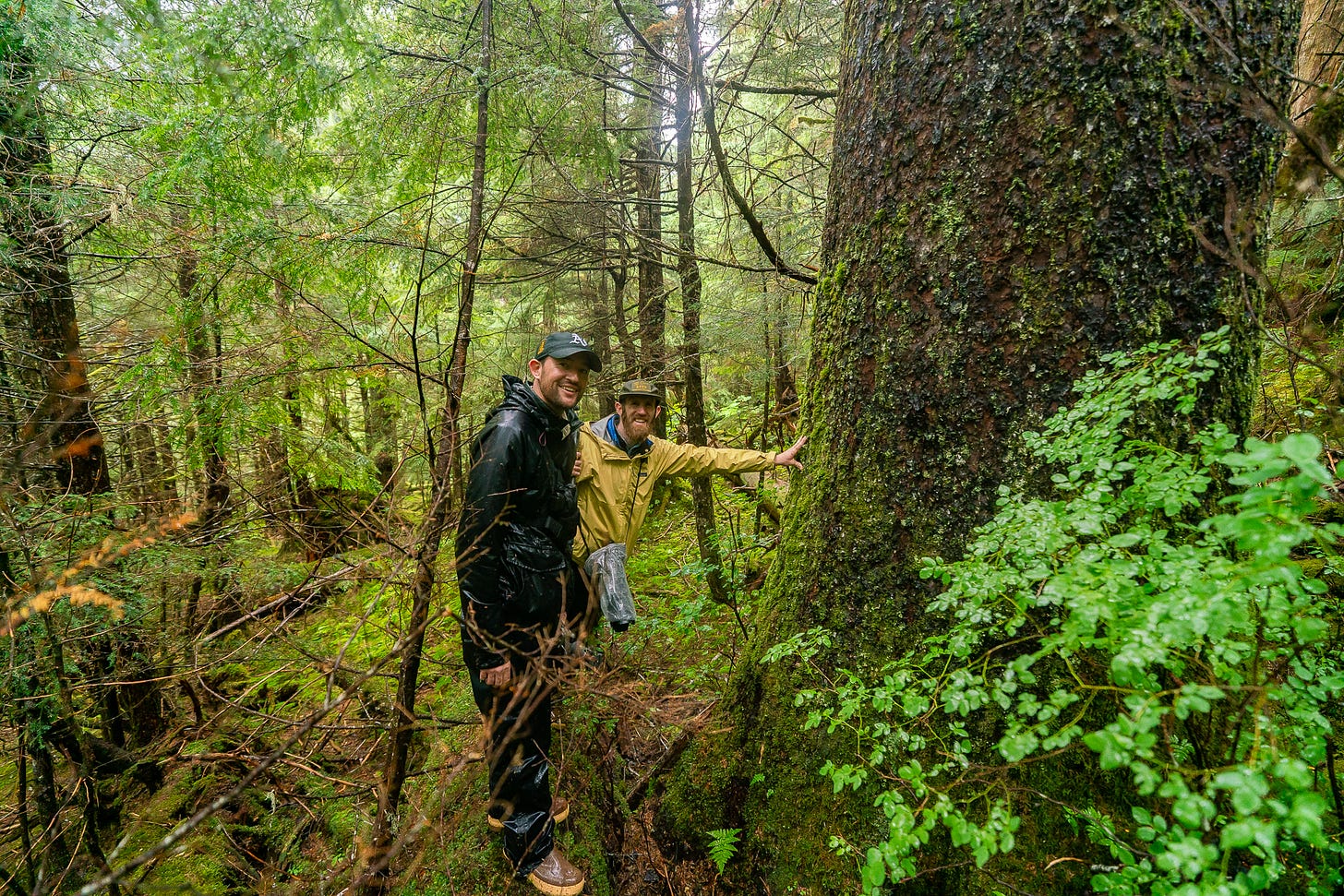
We stopped to photograph it while the rain continued to come down steadily and our cameras were beginning to have functional issues. Then we kept moving and another giant appeared. And another.
The understory thinned dramatically and suddenly we found ourselves in this absolutely spectacular grove dominated by ancient trees.
It was otherworldly.

The scale of it was hard to comprehend. It was on par with some of what we’ve seen in Redwood and Sequoia national parks. Huge trees rising all around us, some of them so large that you really needed a person in the frame to understand what you were looking at.
And towering. So tall that most of the tops disappeared out of the canopy altogether.
It was completely different from any living piece of forest we had experienced on the Tongass up to that point. Primeval. Jim Pattiz likened it to the Hoh Rainforest meets Redwood National Park.
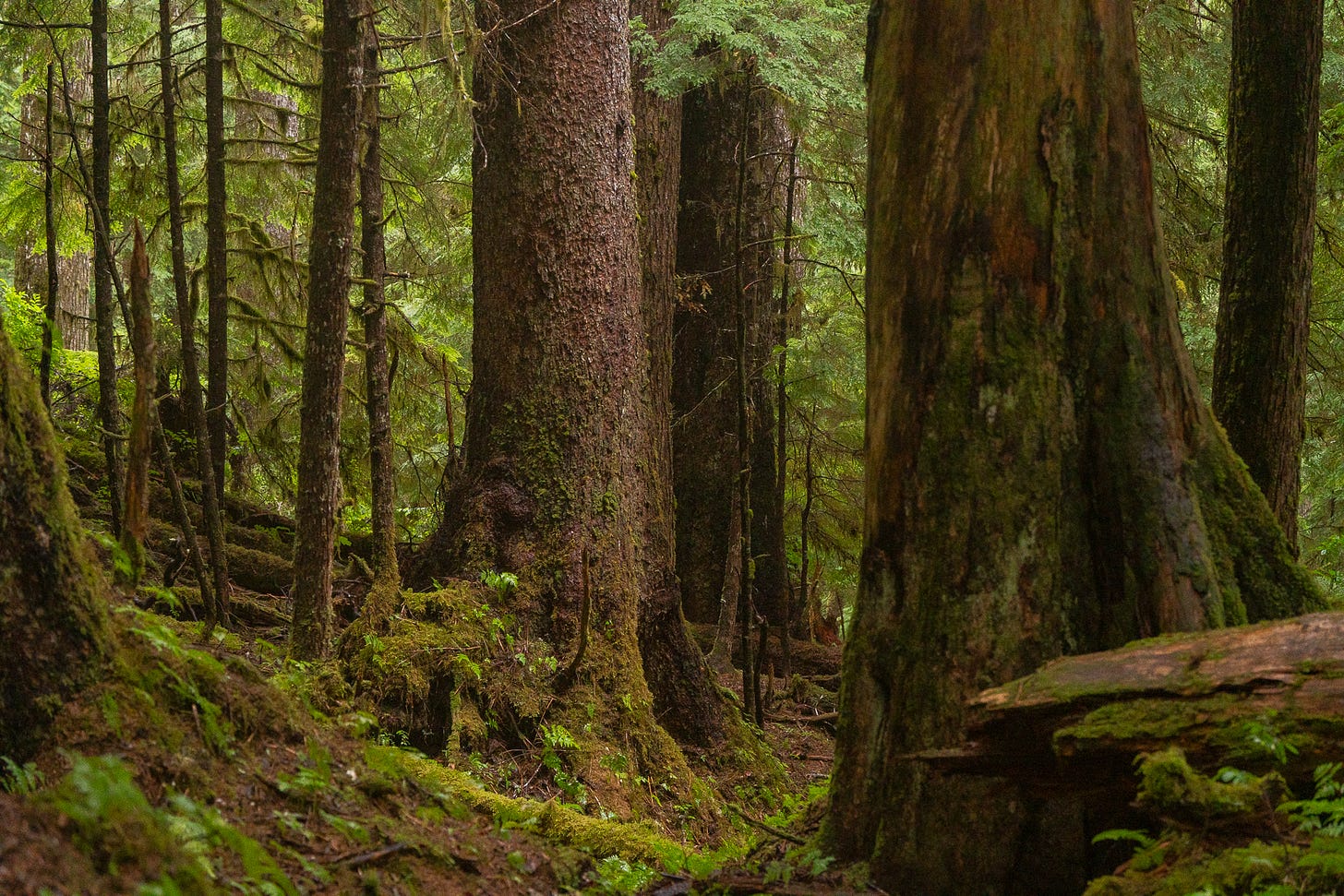
Moss dripping all over with endless shades of green and massive trunks.
And the denning structures kept appearing. One after another.
Some looked old, others looked like they were still being used. Generations of bear habitation and perhaps wolves too.
One tree in particular stood out, a massive living spruce with a denning hollow at its base large enough for an adult bear to fit inside and ample bear scat near it. The height of the opening nearly 4 feet on a healthy ancient spruce.
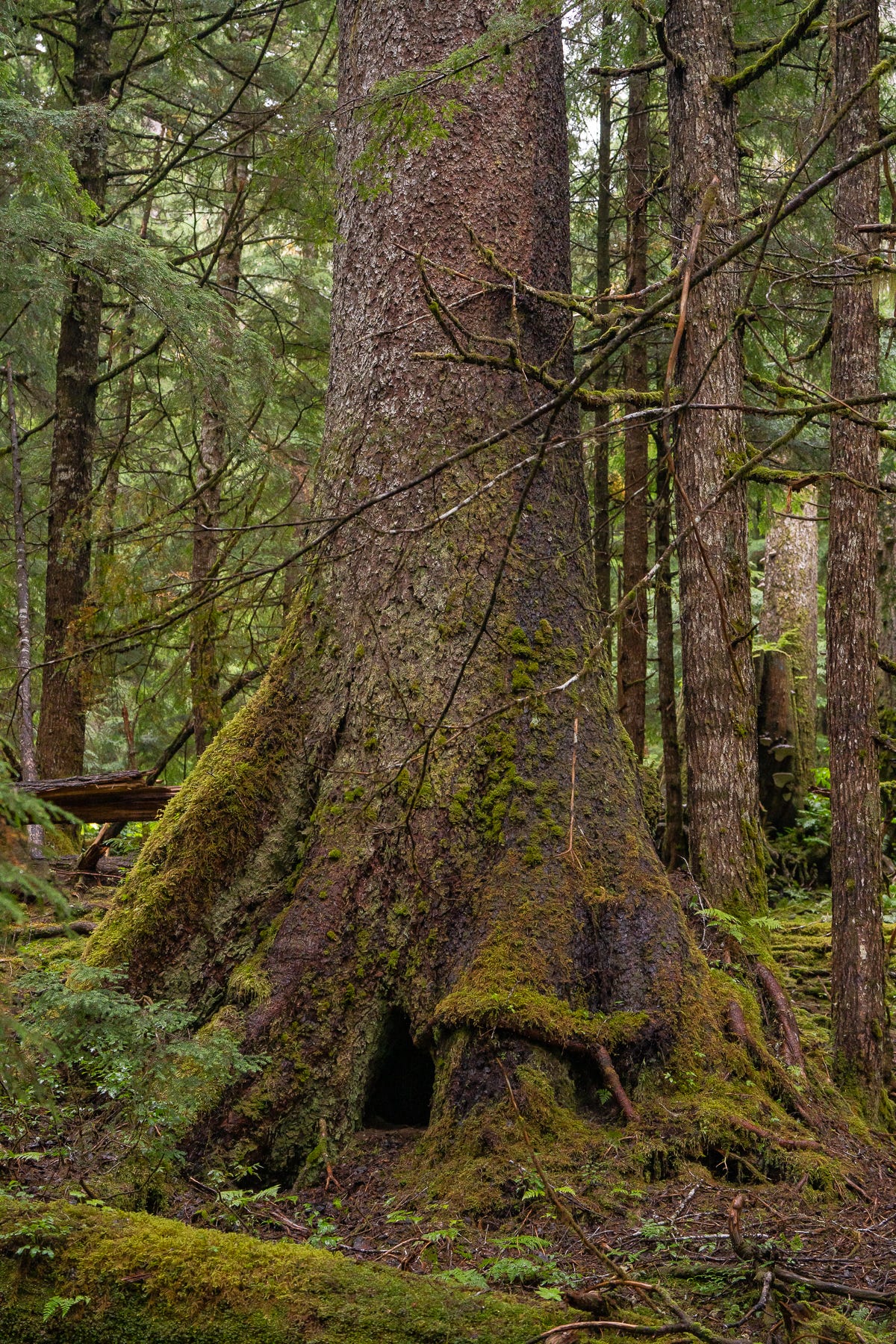
All of this was inside Unit 346.
Eventually the growing darkness and the difficult hike we knew we had ahead of us forced us to start descending back toward the road. The idea of hiking through that area in the dark with the level of bear activity didn’t seem wise.
We decided to exit a different way that would take us mostly through old growth based on what we could see on the satellite imagery.
As we went, the scale and beauty of the stand only continued. And somewhere near the edge of the sale boundary the loss at stake here really started to hit us.

We had spent the better part of a week hunting for places like this across Prince of Wales. Driving roads, hiking into old growth, checking places we’d identified in advance. And this was the only grove we had found that looked anything like this. Nothing else was remotely close to its grandeur.
I started thinking about how many places like this must have existed across the island at one time. How commonplace a stand like Unit 346 was before the roads and the logging. How many had already been taken from us over the years and how little of this kind of forest was left.
And then I thought about what had to happen for Unit 346 to appear on that map.
At some point the people responsible for stewarding this public land had walked into one of the most beautiful forests I had ever seen and begun putting in motion its destruction.
Someone had looked at these same ancient trees and measured their value as board feet at the mill.
And unless something changes, someone else will eventually come up here some morning with a chainsaw and heavy equipment, start it up and cut through thousands of years of accumulated life and natural history and wildlife habitat.
As we came back out of those woods we committed ourselves to doing whatever we could to make sure that doesn’t happen here.
And we started thinking about how to make sure it doesn’t happen elsewhere.
Here’s what you can do now to save this grove
The bad news is that the DEIS commenting period is over. Snuck through in the midst of so many other battles.
The good news is that we are submitting these findings to the Forest Service this week which means they enter the official project record before the final environmental impact statement gets written.
We’re also handing everything to our friends at SEACC and Earthjustice who have the standing needed to argue this in court.
Here’s who to call and email
UPDATE: Since posting this, the voicemail for the first number we included has filled up, and the first email is OOO. Redirecting to the following:
- Call Valeria Cancino Hernandez, Twin Mountain II Project Lead: (907) 228-6338 and then the Thorne Bay Ranger District that oversees the sale: (907) 828-3304
- Email Barbara Miranda, Deputy Forest Supervisor, Tongass National Forest: [email protected] and CC [email protected]
We’re aiming for hundreds of calls to her office. Please be one of them.
Here’s what to ask:
- Why is the Forest Service cutting one of the last large-tree, high-volume old-growth stands on Prince of Wales when 94 percent has already been logged?
- What does the wildlife analysis cover for Unit 346? Just goshawks? How about amphibians like the rough skinned newt or bears or wolves?
- Did the Forest Service survey Unit 346 for bear or wolf denning structures at any point, and if not, why not?
- What are the recorded tree diameters are for Unit 346? She has that data. The public should see it.
- Who benefits from this. Why is your forest, a place with thousand year old trees that would be tourist site on par with the Hoh Rainforest if it were in the lower 48, being logged like a farmer removes a plot of corn for harvest?
- And ask her point blank, will she take Unit 346 out of Twin Mountain II?
In the coming weeks we’ll be launching an interactive investigation into this and keeping you apprised of what’s happening here with more photos from our trip. We hit the limit here for what substack will allow in an email or else we would have included more. The Tongass is your forest, it belongs to you. Act like the owner and tell the people managing it for you that you want the old growth left alone so your kids and their kids can see it and experience it.
We have a lot of exciting updates coming your way in the coming days/weeks as we roll out some more tools in our arsenal and actions to save our public lands.
You’ll be hearing more reporting from us on the Tongass (and from the Ambler corridor). What we found here was beautiful and tragic and worth fighting for.
The fourth wave of conservation is here and it’s growing. This community is a big part of it.


Comments
Welcome to the new Resillience commenting system!
We have moved from the former Disqus commenting system to a new system as of September 10, 2026.
We made this change because of privacy concerns regarding Disqus. It's also part of a set of changes to bring more services to the Resilience community under a single login: commenting, (coming September 2026), and online courses (coming 2027). Unfortunately, your old Disqus comments may not reliably link to your account in this new system. Please contact us if you have any questions or concerns.