

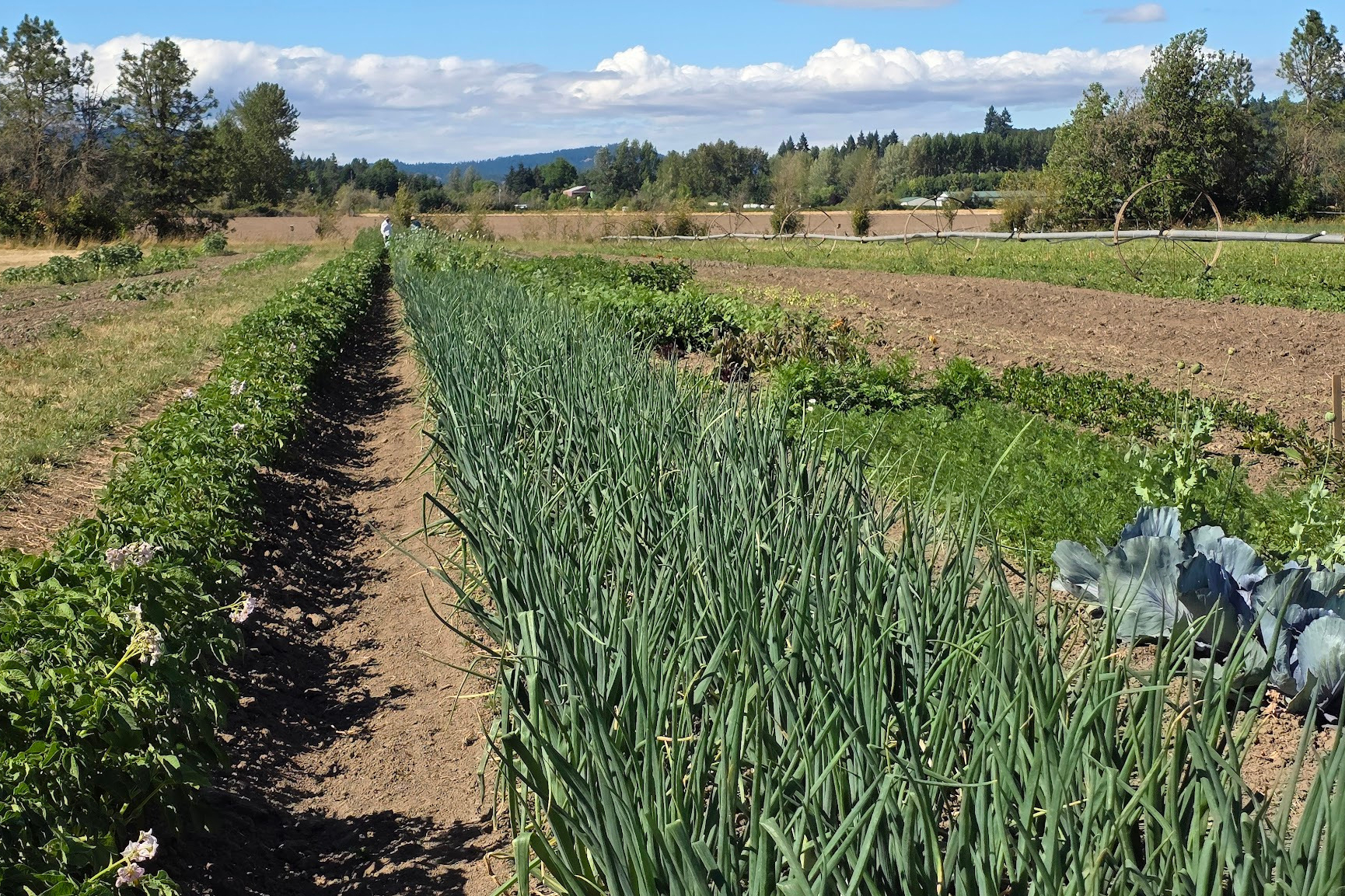
Confluence Farming Club crops in the summer of 2025.
I’d like to catalyze a movement in this country that rebuilds a nation of farmers. Not another generation of John Deere-driving commodity growers, but millions of Earth-caring, soil-is-my-life, stewards-of-place, neoagrarians who’d make Wendell Berry swoon. After an injury and with the help of a handful of friends, I’ve stumbled onto a way that might happen: through local farming clubs.
In January 2024, a severe ice storm struck Oregon’s Willamette Valley. On my family’s farm, tree limbs had snapped and were lying across fencing, so I got to work with a pole saw. My friend Thomas was helping me clear out branches as I cut when I felt a sharp pain in my left shoulder. It took a few months of doctor’s appointments and imaging studies to find that a dislocation while wrestling in college gave me arthritis, followed by years of wear and tear, resulting in a useless joint nearly 40 years later.
As spring approached, I was unsure of what to do. I was a small farmer who worked mostly on my own to grow a modest number of cash crops. There was garlic to sell in August, and I had contracts to fulfill for lettuce and flower seeds. I loved the work, but breaking my body for a few thousand dollars in annual profit made no sense, and the pain now made sleep fitful.
A couple of my friends, Ann and Jen, would come over and work beside me sometimes, drawn, I think, by the fresh air and the exercise. They, in part, inspired my realization that I wasn’t capable of doing it alone anymore, and I probably didn’t have to. So I asked around and several others wanted to farm too, the deal being we’d grow food together, and they’d help me with those crops I had to grow and sell. That was over two years ago; my shoulder has been surgically repaired, but my friends won’t go away!
I’m not suggesting farmers become debilitated and play on sympathy to get help. The sad truth is that small farms can rarely compete financially in a market dominated by massive equipment and consolidated, globalized markets by selling food alone. Often, they survive by having other income streams, whether that’s a partner with a steady job and health insurance, part-time gigs off the farm, agritourism, or education. The farming club offers another means to make it by providing an experience and education while creating a community that can share the work, reduce costs, and perhaps run the farm better than ever.
Confluence Farming Club
We call ourselves the Confluence Farming Club, and our key goals are to train members to be capable farmers, to manage soils and landscapes using sustainable and regenerative practices, and to reduce the monetary costs of food by using one’s own labor and by cutting out many energy- and resource-demanding inputs normally used by the modern industrial food system.
In the farming club model, a plot of land is farmed together, and the harvest is divided among members. This distinguishes it from gardening clubs or community gardens, where people tend to have individual plots. I believe there are some key advantages to this approach: it enables more labor-efficient equipment, spreads the cost of shared infrastructure, gracefully accommodates sickness or travel needs, and enrolls novices into a group alongside more experienced farmers-in-training. For example, this year we have 16 households in the club, and nine are new members.
Crucially, this is also a non-commercial way to farm, which distinguishes it from a Community Supported Agriculture model, where people pay a farmer directly to grow their food. Labor is financially under-supported, and small farmers struggle to stay in business even with direct marketing. In a farming club, you eat what you help the club grow, and any professional-grade farmer is on hand to coach you.
For our club members, participation meets several needs: forging social relationships, being outdoors and physically active, building food security, and ensuring a reliable, safe, and affordable food supply.
I don’t think the people in our club are unique in outlook. The ongoing geopolitical, economic, and weather instability in the news may be why searches for gardening and related resources are once again peaking at levels similar to those during the COVID pandemic and the 2008-2009 financial crisis. While details will differ elsewhere, I get the sense farming clubs could become recognized and replicated as an adaptive response to this troubled era.
The Farming Club Coalition
We are in the third year of this farming club experiment. It still seems pretty new, but so much has already been learned that sharing my experience so far might help others. And it would be great to learn together, sharing the ups and downs with people on a similar journey and increasing our collective wisdom and ability to help launch more clubs.
After my interview on The Great Simplification podcast in February, the response was overwhelmingly enthusiastic, revealing just how widespread interest in this model has become. Messages poured in from listeners, and we began gathering their contact information. Rather than replying one by one, it became clear that something more organized was needed. So, together with Craig Litwin, I’ve launched the Farming Club Coalition.
We are long overdue for a return to growing our own food, and the farming club offers a promising way back to that tradition. Whether you bring the expertise of a farmer or master gardener, want to show up as a curious beginner, or own land you’d like a farming club to steward, you’re invited to join this growing coalition.
Fill out the form on our website, and we’ll be in touch as we assemble resources, organize to share practical guidance, and create spaces to ask questions and learn from each other. We’re planning a webinar and discussion to help launch what we hope will become a regular conversation among people building farming clubs in their own communities.


Comments
We changed commenting systems on September 10, 2026 as part of a site-wide functionality and security upgrade. Your past comments have not disappeared, and you can still log in with your old Disqus account credentials if you wish. Contact us with any questions.