

Show Notes
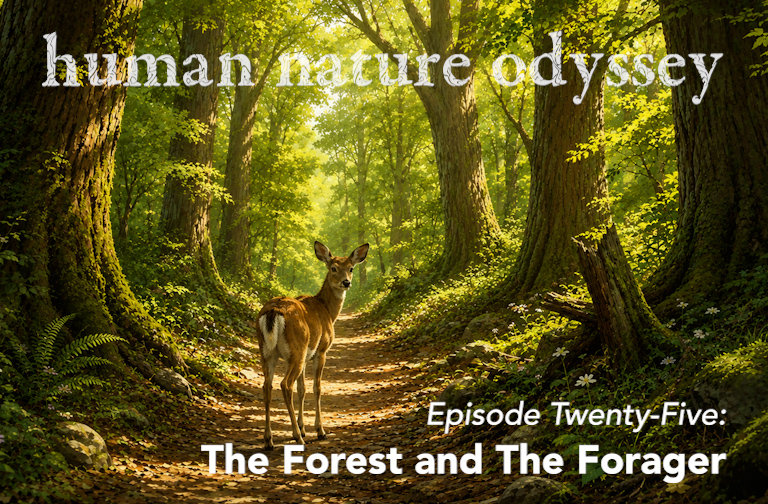
You might think that you are not a forager. But what if no matter our lifestyle or job title, we are forever hunter gatherers in this world: of food, of love, of meaning. In this immersive episode, join Alex on a walk through an ancient forest as you explore what it means to live life as a forager. It’s a journey through the Garden of Eden grocery store, a wrestling with the gods, and a coming home to feast and famine.
If you’d like to support Human Nature Odyssey, please subscribe wherever you enjoy your podcasts and leave us a review.
Sources & Links
- Changes In The Land by William Cronon
Extras
If you’d like to support Human Nature Odyssey, please subscribe wherever you enjoy your podcasts and leave us a review.
Join us on Substack and get exclusive access to audio extras, writings, and notes.
For full episode transcripts and additional context, visit: resilience.org/human-nature-odyssey-podcast
Credits
Theme Music is “Celestial Soda Pop” (Amazon, iTunes, Spotify) by Ray Lynch, from the album “Deep Breakfast.” Courtesy Ray Lynch Productions © Ⓟ 1984/BMI. All rights reserved.
Transcript
Listen. We’re pretty deep in the forest now.

C’mon. Let’s go. We’re so close to home.

Welcome to Human Nature Odyssey. A podcast about civilization. And what civilization can’t see. I’m Alex Leff.

So there’s a guy at a restaurant. He calls over the waiter and says, “Waiter, taste this soup.”

The waiter says, “I’m sorry sir, you don’t have a spoon.”

And the guy says, “aha!”

My grandpa used to tell that joke.

In a restaurant, it's the waiter's job to get you what you need.

And so if you don’t have a spoon, all you gotta do is call over the waiter, be a lil’ passive aggressive about it, and pretty soon you will get the spoon you deserve.

Back home, our basic needs are sold as goods and services to pay for.

Everything has its price. If we pay for a service then we’re owed it. And If that service is not rendered, then we have every right to go speak with the waiter.

But what about the things in life where there is no waiter?

Watch your head.

If you go camping and it rains so hard you can't even leave the tent, who do you call to complain?

Or if a relationship ends in disaster and heartbreak, you’re not gonna get your money back.

Who do we call when we don’t get what we need? When there’s no one to pay?

Hmmm. Yeah it’s this way.

So here we are. Far from civilization. I brought us some snacks if we get hungry. But what if we didn’t have snacks? What if you were thrown, naked and afraid style, deep into this forest, how would you survive?

Your first step would be shelter, right? A safe place to sleep for the night. Maybe lean some logs against a boulder. Fill in the gaps with dirt and leaves.

Then you’d gotta find water. Our bodies can only go a few days without water.

Then you’d need food, which you can go as much as a few weeks without.

Back home, we can pay for a shelter.

They even come pre-made. Just pay your mortgage or monthly rent and walk right in.

Back home, water comes through the tap. We pay a water bill.

If what comes through the tap is not drinkable, we can go to the store and buy water from the isle of Fiji in a plastic container.

And when we’re hungry, we can buy food. I bet your fridge or pantry has a pretty hearty stockpile right right now.

How many days you think you could live off the food in your house right now?

I'm not talking about how many meals could you eat before you get bored of them. I'm talking about survival.

If you were down to those cans of anchovies you bought ten months ago that are on the top shelf and really had to eat them all. How many days would you last?

Don’t worry, those anchovies will probably go bad before you ever have the need to eat them.

There’s always more anchovies at the store.

Of course, there is a cost to all of these survival necessities. And we pay that cost with money.

Now not only do you need to secure your survival necessities, you also have to obtain money.

But how does one procure this… “money?”

Well you can sell a good or perform a service. It could be useful, meaningful, or completely meaningless. It doesn't really matter as long as you obtain money.

You see that squirrel up there?

How do they secure their needs?

Squirrels don’t have money. They're broke as hell.

They can’t afford all those nuts.

Yet a squirrel needs them. So a squirrel must find them themself.

The same is true of those song sparrows.

The same is true of that beetle.

The same is true of that deer.

And for most of human history, the same was true for us.

If we didn’t have a spoon, there wasn’t a waiter to call over and demand they try this soup. We had to make our spoons. And if we were hungry, there wasn’t a store we could visit. Only the forest to roam.

You want one of these snacks? [rustling plastic, taking a bite, chewing]

So these days I’m living with my good friends and their kids. On weekends they go to the woods to forage. They usually return with a whole bounty of mushrooms. There’s all these different kinds. I’m tryna learn. Reishi, turkey tail, chicken of the woods. That’s my favorite name. Sometimes they bring back a basket of wild leeks or elderberries.

A small but tasty portion of our shared meals come from these foraged goods.

I was talking with the kids and wanted to see if they took for granted what to me is miraculous. I mean I didn’t grow up foraging. What’s it like to be a kid where this is a totally normal state of affairs?

So I said to the five and ten year old, “Isn't it cool that the woods is like a grocery store? All the food’s right there. You just get to go and pick it for free.”

The 10-year-old, with his uh, typical wit and occasional sassiness, quickly came back, “well we never have to pay when we go to the grocery store, we're kids. The woods and grocery store are the same for us.”

I thought that was a really good point.

I wonder if the same was true for our foraging ancestors.

Was foraging like going to a grocery store without having to pay?

When I was a kid, my mom would tell us this bedtime story about Earl the Squirrel. Earl was this magical talking squirrel who would show up outside our window at night. He’d give it a little tap on the glass with his little furry hands to let us know he was there. We’d come over to the window in our pj’s and Earl would shrink us down so we could hop on his back and fly off for an adventure.

And one of these adventures that I remember well was us going to a forest where food grew on trees.

There were all sorts of sweets and delicacies we could reach right out and pick. My mom presented this to us as a magical forest. And to my suburban mind, it did seem magical.

Little did I realize, and I think little did my mom realize, having also grown up in the suburbs, that a forest teeming with food that you can reach out and pick is not a fantasy and you don't need a magical squirrel to bring you there. That's just what a forest is.

To someone who’s never been foraging, this may be hard to believe.

It's like telling someone who's never read a book that all those weird squiggly lines on the pages actually contain a great deal of meaning.

In order to see it, you have to learn how to read.

Let’s take a break here. I wanna get this pack off.

So we can imagine our ancestors waking up with a growl in their belly, and heading into the forest to satisfy it.

Maybe they pluck a few of these, scoop up a few of those, and by lunchtime - boom - they have themselves a meal.

Of course, this meal required the modest labor of gathering it. They had to keep an eye out, bend down to pick berries, set snares for small animals, build a fire, boil a stew.

But our meals require work to gather. We have to drive to the store, find a place to park, wait in the check out line. Not to mention the labor required to obtain the money to buy the food in the store.

Which is more convenient and leisurely? I'm not sure.

I guess it depends on how cushy your job is and how well it pays.

Back home, one of the most important things about you, you know, socially, is what your job is. .

There’s this game we all learn how to play. It’s called… small talk. Round one: what’s your name? If you make it through that unscathed you’ll be asked the inevitable follow up: what do you do?

Meaning, what do you do for work? Which really means: what do you do to obtain the money you use to buy the things you need to survive?

That’s what a job is.

Jobs have been essential to who we are for hundreds, if not thousands of years - depending on where in the world you come from.

In fact, it’s been so deeply ingrained for so long, there’s a chance that your last name reveals your ancestors’ occupation.

I am a baker, you can call me baker. I'm a smith, you can call me smith.

That must have really made the whole small talk thing much easier. You could tell someone your name and what you do for work in the same sentence.

But our foraging ancestors, did not have jobs. For most of human history, we were all unemployed. Which was so hard for anthropologists to imagine, they came up with a job title for our ancestors. Hunter-gatherers.

You think anyone has hunter-gatherers listed on their Linkedin page? I’m sure someone thought of that.

But hunting and gathering is not really a job. You don’t clock in and clock out. You don’t get paid to be a hunter gatherer. You get to live.

But maybe when we imagine our distant ancestors, we imagine them barely struggling to survive. Starving in a forest devoid of any known food. But maybe we’re just projecting. When you were growing up, were you also told about all the things outside to not pick up and eat?

No, don't eat that. Don't touch that. Those berries are poisonous.

As a kid, I remember being confused why all the berries and plants that birds and squirrels and chipmunks chowed down on were off limits to me.

Adam and Eve had just one forbidden fruit. I grew up with many.

Why did it seem like all the human food was in the grocery store and not in the forest?

I was taught to read books. But no one taught me how to read the forest.

Here. This is Changes in the Land by William Cronon. It’s this great ecological survey of the New England forest the English settlers first came to, and the forest they quickly changed.

There’s all sorts of great first hand accounts in here. Like [flipping through pages] this one.

So when English settlers first came to the so-called New World they were blown away by its bounty.

Here. In 1630, just a decade after English settlers first arrived, Reverend Francis Higginson wrote, “The abundance of Sea-Fish are almost beyond believing.”

And this other 17th century traveler William Wood wrote that the fish swam “in such multitudes as is almost incredible, pressing up such shallow waters as will scarce permit them to swim.”

They also couldn’t believe the sheer amount of birds. Look at this line, William Wood is bragging about killing, “a hundred geese in a week, fifty ducks at a shot, forty teals at another.”

And then there’s John Josselyn’s account of the passenger pigeons, which were hunted into extinction. But back then, Josselyn wrote of passenger pigeons in the millions of millions, flocks “so thick that I could see no Sun.”

And the trees impressed them too. “Though it be here somewhat cold in the winter, here we have plenty of Fire to warme us. All Europe is not able to afford so great Fires as New England.”

And obviously, this bounty, abundance was not because New England was devoid of people.

No, the land was filled with people—peoples who had lived there for hundreds and thousands of years and somehow hadn't emptied out the great natural grocery store, as the English, Dutch, French, Spanish, Portuguese, and their descendants and cultural descendants would do.

A great of this earth are bountiful places full of food for squirrels as well as humans.

What a wonderful thing, to live in a world where our needs are met.

Maybe that’s what inspired those ancient storytellers to describe a garden of Eden.

But not everywhere on Earth is abundant at all times. Sometimes there’s famine.

Sometimes you’ll find the water’s run dry. The food’s gone scarce. How painful it is to not have your needs met.

Let’s keep going. Home’s this way. It’s not much farther now.

So what do you do when your needs aren’t met?

When you're a little kid, you cry and cry. With luck, your parents will come to provide for you.

But if you make it into adulthood, who do you cry to?

Okay. Let’s imagine we are our ancestors. We’re hungry and need food. I’ll go this way, you scout over there.

You search and search. What do you do if you find nothing? What happened here?

The trees are burnt and black. It looks like a fire swept through. You can see by the exposed soil there must have been a flood soon after.

Now there’s no berries to pick. No critters to catch. You turn back but we don’t find each other.

Your belly growls and growls all through the day and into the night. The next day is the same. Your body sheds fat it no longer can feed. You grow weary and sick.

And then, on the seventh day of your hunger, as you stumble through the barren landscape, you come upon a tree still standing. And from this tree grows fruit you’ve grown up eating your whole life. You know it’s safe to eat. It's ripe and juicy and dripping in the morning light.

You can’t believe your eyes. You reach out your hand and take one, two, three, as much as you need.

As much as you need. You take a bite and can't help laughing. A tear falls down your cheek.

What a miracle. What. A. Miracle.

Thank you. Thank you, you say.

And this might surprise you. After all, who are you thanking?

There's no one around. It is just you and this tree.

But you can't help it.

Gratitude flows as freely from you as the fruit grows on the tree.

In times of bounty, this is how things are.

Trees grow fruit, we grow grateful.

Grateful to who?

Grateful to the tree, yeah. Grateful to the fruit.

Grateful to the soil that held the tree and nurtured it as a seedling.

Grateful to the rains who have come and helped the seedling grow. Grateful to the sun who has called the seed up towards its towering height.

There’s so much to be grateful for and so many to be grateful to.

The fruit fills your body. Becomes your body.

The old saying “you are what you eat” is more profound than we give it credit for. The sugar from the fruit joins your blood, becomes your blood, is your blood. The cells and molecules that were once joined together as fruit are now joined together as you.

The rest passes through and becomes soil.

You are part of this too. You’re a maker of soil.

Now it's a different year. A different season.

You’re on your own and hungry again. And this time there is no tree to feed you.

But there is a deer.

Quietly munching on the grass.

You’re dangerously hungry.

You know if you don’t eat soon you’ll wilt like that old tree that once fed you did.

Look at the deer. You have no malice towards it. You even wish it well. It’s not your enemy by any means. In fact it’s a lot like you, hungry, searching for food, and a maker of soil.

But hunger can lead to desperation and desperation can lead to creativity.

And so you stalk the deer. And catch the deer.

You kill it.

You make a small fire.

You cook the deer. You eat the deer.

Like the fruit became part of you, now the deer has too.

And your body sings with joy.

Your body was made to eat the green plants of the forest as well as your fellow makers of soil.

The deer’s muscles and fat and organs enter your body and become your muscles and fat and organs.

Thank you, you cry. Thank you. This time perhaps more overcome by emotion than the eating of the fruit evoked in you. You took a life. The fruit you took was a life as well but now you’ve taken the life of a soil maker with fur and feet and heart.

Perhaps you feel guilt for doing so. But you most certainly feel gratitude.

Thank you. Thank you, you tell the deer.

Maybe the guilt brings unease. I mean, who were you to take this life? You took the life of the deer because you were hungry. But so was the deer. Why should you feast at the deer’s expense?

Who could answer such a question?

Who could possess such knowledge of whose time it is to live, and whose time it is to die?

Ah, now you’re in conversation with something beyond the deer, beyond the soil, beyond the trees, beyond the sun that shines upon them all. But beyond is not quite the right word.

The world is full of beings we can see. But some we can’t.

Like the wind.

We can only see the wind by how it affects all around it. You'd be a fool to think there’s no such thing as wind because you cannot see it.

And so you trust there are other beings like this as well.

Perhaps there is someone who knows whose time it is to live and whose time it is to die. For who shall go hungry and who shall be fed.

So maybe the next time you go out to look for food, you plead with them. You say please. You state your case. You bargain with them.

Perhaps when you find food you thank them.

If they don't respond, perhaps you lash out.

You cry and you wail and throw a tantrum like you once did that time your mother forgot to feed you or your father forgot to hold you.

Maybe that's what this entity is.

A great mother and great father.

Perhaps you call this great mother and father gods and speak to them often. Perhaps you call this prayer.

They have powers far beyond your own. They conjure floods and set the forest ablaze in fire. They decide when there is feast and when there’s famine.

We are free though, to do as we choose, to the best of our ability. We can become a skilled hunter or learn to set smarter traps.

But even the greatest hunter in the forest does not always catch their meal. Sometimes the deer will elude us. The deer, our sibling, is free as well.

The forest is wild and beyond our control. We won’t get our needs met all of the time.

How do we respond to this?

We might respond by cursing the gods.

You won’t decide when I go hungry! I shall decide when it’s time to eat.

Maybe you clear the forest and start a farm.

Instead of foraging for food you will grow it yourself.

But your crops have needs too so you construct irrigation ditches to divert the nearby stream to you.

Sometimes the stream runs dry. Sometimes it floods.

You build a dam. But even then you do not control when it rains.

So maybe you run from the farm to the factory. Where you build with efficiency and scale the tools you need to tame the forest.

You raise your meals in cages so you can fill your pantry. You build your restaurant. Hire your waiter. Keep it stocked with spoons for all your soups.

But in taming the forest you will deplete it.

In seeking control, the world will only grow more uncontrollable.

The winds will be wilder. The floods more severe. The fires more frantic and frequent.

In trying to never go hungry, one day your children might starve.

And it is then we might cry out to the gods we’ve forsaken and ask why they have forsaken us.

We may find that even on the farm or in the factory life is beyond our control. No matter what we do there will sometimes be feast and sometimes famine. Sometimes we’ll get what we need. Sometimes we won’t.

And we might see then that this is the truth of things.

That we are forever foragers.

And a forager is not merely a collector, a retriever of things. A forager is a giver as well. A giver of soil, of thanks and gratitude, of restraint and care.

For we are one of many siblings and must learn how to share.

The forces beyond our control are not waiters in a restaurant to demand of spoons.

“Come and get your own damn spoon,” we might hear the waiter say with a grin.

The world is not a restaurant and you are not its customer. The world is a forest. And you are a forager. You are part of it. You belong there. Well, here.

Here we are. We made it home.

That’s the funny thing: we never left.


Thanks for listening.

Until next time, I hope you’ll consider the ways of our forager and your place in the forest. How do we respond when our needs aren’t met? How do we learn to share?

Human Nature Odyssey is now on substack. There you’ll find monthly check ins, where I share some behind the scenes thoughts on where the podcast is and where it’s going. Jake, Maren, and I have been collaborating on monthly bonus video episodes as well. The last one was on Christopher Nolan’s film the Odyssey. You can find the two hour conversation all on substack. We dig deep into the Bronze Age collapse and the wisdom of Greek mythology. Substack is also a great place to connect with other fellow travelers and listeners of the show. Thank you so much to everyone supporting the show on Substack and for those who’ve long supported it on Patreon. Over the course of the summer, I’ll be transitioning the community side of HNO fully to Substack. If you’ve been supporting the project on Patreon I’d love for you to come join us over at Substack.

If you enjoy Human Nature Odyssey please share it with a friend and leave a friendly review.

Thank you to Jake, Maren, Nic, and Maia for your feedback on this episode.

This series was made in association with the Post Carbon Institute. You can learn more at Resilience.org.

And as always, our theme music is Celestial Soda Pop by Ray Lynch. You can find a link in our show notes.

Talk with you soon.




Comments
We changed commenting systems on September 10, 2026 as part of a site-wide functionality and security upgrade. Your past comments have not disappeared, and you can still log in with your old Disqus account credentials if you wish. Contact us with any questions.
I don't sign up for anything on Substack since I had a bad experience: Chris Smaje suggested checking out a substack blog about the Romantics. I thought I'd check it out so I clicked the button. Soon concluded it wasn't for me, and unsubscribed–but meanwhile I got a notification that my credit card had been dinged $60. I hadn't given permission, or my credit card number–but there is one blog I find worth supporting monetarily (there are others that are worth it but which I suspect are well enough financed without a contribution from me). So presumably Substack saved my credit card info from that donation, and applied it to this other thing without my sayso. Since then, if asked to subscribe to something on Substack, I don't.