

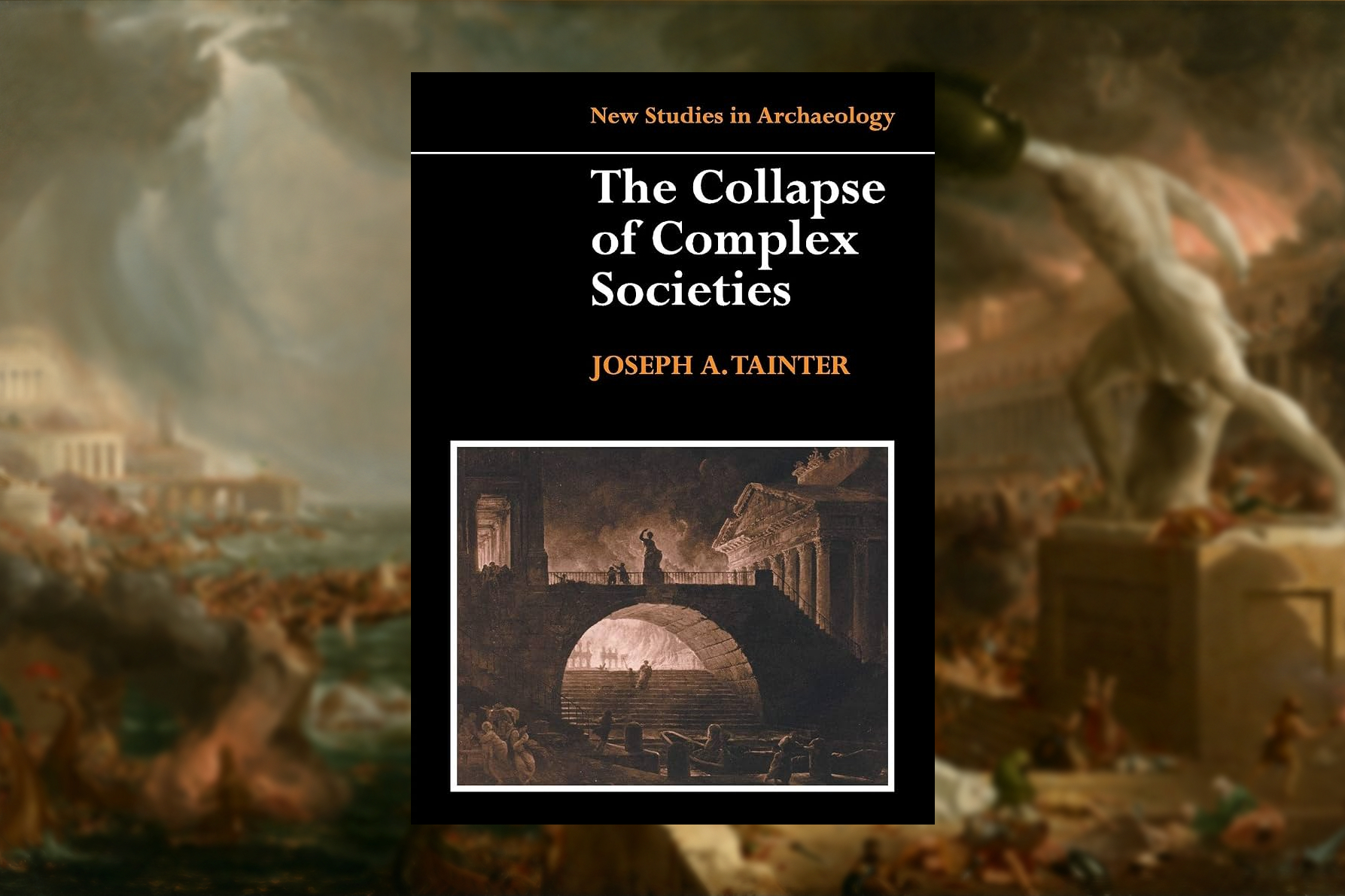
Investigating how and why complex societies or civilizations have risen and fallen in human history, American anthropologist and historian Joseph Tainter uncovered a pattern – or rather, a dynamic – that can help us make sense of our present situation and future prospects.
According to Tainter, complex human societies (i.e., societies that grow and develop increased heterogeneity and differentiation, hierarchy, specialization and division of labor, inequality and stratification, and regulation) have historically acted as problem-solving organizations. In order to solve the social, economic and political problems they face, these societies make choices and implement ‘solutions’ (e.g., new practices or operating processes, technologies, regulations, organizational setups, hierarchies, administrative layers, as well as new supporting beliefs and narratives, etc.) that tend to result in ever-greater socio-political complexity.
As their complexity grows, the problems they have to deal with become more difficult to solve, requiring rising investment in further societal and political complexity. At some point, though, investment in socio-political complexity typically reaches a point of diminishing returns, meaning that the marginal beneficial returns (i.e., problems solved) of additional complexity begin to decline, leading to a lowered capacity to solve the new problems that arise and to deal with their consequences. These returns may even turn negative, at which point societies are not anymore capable of upholding the level of complexity they have reached and tend to break down to a lower complexity level (i.e., to ‘collapse’).
This ‘Tainterian dynamic’ leading to The Collapse of Complex Societies (the title of Tainter’s seminal book, published in 1988) is fairly straightforward and easy to grasp. It basically transposes to the field of historical civilizational studies the law of diminishing returns, which is a fundamental principle in economics and posits that incremental units of input of a given factor of production in a productive process will inevitably, at some point, return a lower amount of output. This apparent simplicity, universal applicability and almost inevitability for a complex society of running into the declining marginal productivity of complexity is one of the criticisms that was directed at Tainter’s theory when it was published (see, for instance, this review of his book by British social anthropologist Edmund Leach (1910-1989) in the London Review of Books). Some of these criticisms may be justified from an academic point of view, yet they do not in themselves invalidate Tainter’s thesis – nor the attempts to understand its possible relevance to the travails of contemporary societies.
No need to insist
Joseph Tainter, now retired from academia, has always been reluctant to explicitly apply his theory on the collapse of complex societies to the interpretation of contemporary events. Even in recent interventions (see, for instance, this interview from August 2025 or this one from February 2026), he appears unwilling to relate his thesis to our present situation – much to the frustration of his interviewers, apparently. This attitude is rather understandable from an academic point of view, as his thesis is based on an analysis of ancient civilizations over long periods of time, which by definition cannot be either confirmed nor invalidated by relatively short-term developments in our own societies. Tainter’s reluctance to capitalize on his theory of collapse is thus a testament to his professional integrity and probably also reflects his personality.
The academic world in the West, especially in the United States, has become a largely commercialized and financialized enterprise that produces ‘celebrity’ thinkers and ‘thought leaders’ who maintain their status by publishing and marketing high-visibility books every few years. Most of the time, these books are based on the same tested recipe: the author claims that we have a massive problem that we have so far overlooked, or that we have been thinking completely wrong about something, and then reassures us that he/she knows the solution and/or can happily help us get our thinking straight as no one has ever done before. The author is then invited to give multiple interviews about his/her bestselling book and to deliver ‘inspirational’ keynote speeches or lectures to select audiences across the world, pocketing a handsome amount of speaking fees before moving on to the next editorial project.
Given the mounting interest in societal collapse in the last couple of decades and the growing popularity of his thesis, Joseph Tainter could probably have tried, had he wished to do so, to capitalize on his past work, published a few other books on the topic of societal collapse – and on how to prevent it – and become a celebrity academic with tens or hundreds of thousands of followers on social media and open access to media outlets and public decision-makers. Instead, he decided to pursue a rather low-key academic career and to stay away from the media spotlight. He continued to publish his research in academic journals but only wrote a couple of other books after ‘The Collapse of Complex Societies’, in each case with co-authors.
It is possible that, having understood the meaning and significance of what he had uncovered, Joseph Tainter did not feel the need to add further details to his theory of collapse or to explicitly outline what it might mean concerning our fate. He had told something crucial and consequential to anyone willing to listen, and there was no real need to insist.
The Crisis of Complexity
However, even if Joseph Tainter himself tends to refrain from explicitly applying his theory of collapse to contemporary societies, his insights might still inform our current situation in very valuable ways. Indeed, many elements of his thesis seem to resonate ever more clearly with our lived reality.
For a couple of decades now, the world has been facing a series of compounding crises that human societies have struggled to address and failed to solve. This has destabilized many societies and thrown them in unexpected, sometimes chaotic directions, in some cases reversing what was thought to be a well-established course of progress and calling into question long-held certainties and beliefs. This accumulation of compounding crises is sometimes referred to as a ‘polycrisis’, i.e., a set of multiple, interacting global crises whose combined effects are overwhelming societies’ ability to cope and respond.
Some analysts, however, argue that this characterization overlooks the fact that these compounding crises are not just unrelated problems occurring at the same time, in conjunction, or in rapid succession, but are in fact driven by common underlying root causes. These analysts thus prefer to talk about a ‘metacrisis’ that results from systemic failures within human societies and manifests in various ways.
Indeed, the concept of polycrisis probably misses the fact that the various crises we are experiencing are not just piling up on each other by coincidence, out of bad luck or because of the sheer incompetence of the ruling elites. There might be an inherent historical logic to the accumulation and conjunction of these crises and problems at this particular moment, as well as to the fact that whatever we are doing to address them seems largely to be failing. The concept of ‘metacrisis’ might thus be more useful for understanding our situation; however, its proponents often fail to explain clearly what the root cause(s) of our systemic failure(s) might be.
This is where Joseph Tainter’s thesis becomes useful. About a decade ago, I suggested that the ‘Tainterian dynamic’ might, in fact, help us understand the underlying historical logic of the accumulation of compounding crises and increasingly intractable problems our societies are facing, as well as our inability to address and solve them effectively. Our ‘metacrisis’, in essence, could well be a ‘Crisis of Complexity’, whereby globalized industrial society, entangled in its own Tainterian dynamic, finds itself confronted with the diminishing returns of its ever-rising investments in complexity.
The energy-complexity spiral
Ever since their emergence about 250 years ago, industrial societies have relentlessly grown more complex, socio-politically and technologically, to the point of becoming, by far, the most complex human societies that ever existed. They have in particular grown exponentially more complex through the unprecedented increase in global interconnectedness, technological advancement, and resource consumption that has characterized the 20th century.
The “Great Acceleration” of this process after the Second World War could, in fact, also have been called a “Great Complexification”. This process has required and been made possible by the globalization of industrial societies’ metabolism, which has given rise to what American systems thinker Nate Hagens calls a global ‘superorganism’ – i.e., a self-organized, mindless, energy-hungry, resource-gobbling and waste-spouting metabolic entity bent on maximizing its own growth (and, incidentally, its complexity) by any means.
The main reason why industrial societies have been able to grow and become more complex to a much greater extent than previous human societies, according to Tainter, has been their capacity to access ever-growing supplies of affordable energy. The availability of abundant, inexpensive, high-quality energy in the form of fossil fuels has indeed been instrumental for the development of industrial societies’ capacity to build increasing complexity into their economic, technical, political and social systems.
Fossil fuels have provided human societies with unprecedented amounts of ‘surplus energy’ (i.e., usable energy in excess of the energy consumed in the process of energy extraction, transformation and delivery), and this surplus energy has made it possible to solve a number of societal problems and increase socio-political complexity far beyond what would have been possible otherwise. This, in turn, has produced new and more complex problems, which have required further increases in the production of energy and other resources to meet growing demand and address the new problems that societies needed or wished to address, which in turn has produced additional complexity, and so on and so on… This is what Tainter calls the ‘energy-complexity spiral’, i.e., the process by which socio-political complexity and energy availability feed into and grow together through a mechanism of positive feedback.
This fossil-fueled energy-complexity spiral is what has been powering the unprecedented growth of the human enterprise over the last couple of centuries, in terms of population numbers, material living standards, and socio-political complexity. In ecological terms, it has pushed the human species into massive ‘overshoot’ territory, i.e., in a situation where our species’ population numbers far exceed our natural environment’s sustainable carrying capacity, where our demand for resources far exceeds our natural environment’s capacity to sustainably supply them, and where our production of waste far exceeds our natural environment’s capacity to metabolize it.
Yet the fossil energy sources that have underpinned this growth, as well as the other natural resources they have made possible to access and use, are inherently subject to depletion, which over time inevitably puts rising pressure and constraints on both the quantity and the quality of energy and material resources that can be accessed and used, and raises the cost and difficulty of doing so. In addition, the large-scale use of fossil energy causes massive environmental damage, directly and indirectly, including but not limited to climate change, which compounds over time and makes this use increasingly costly and risky.
Consequently, the fossil-fueled ‘energy-complexity spiral’ that underpins the very existence of industrial societies is inevitably poised to reach its limits at some point, due to the mounting and compounding effects of depletion, of pollution, or of a combination of both. In Tainterian terms, this means that industrial societies are poised to run into the diminishing returns of complexity at some point, and hence to ‘collapse’, i.e., to experience a rapid and significant loss of socio-political complexity.
This dynamic does not, in itself, set industrial societies apart from the complex societies that preceded them. According to Tainter, any human society that becomes ‘complex’ is poised to complexify ever more as a result of the way it has to address and solve the problems it faces, and then to run at some point into the diminishing returns of complexity – and any society that runs into the diminishing returns of complexity is poised to collapse (i.e., abruptly and quickly simplify).
“Once a complex society enters the stage of declining marginal returns, collapse becomes a mathematical likelihood, requiring little more than sufficient passage of time to make probable an insurmountable calamity”, Tainter wrote.
What sets industrial societies apart, however, is the speed, scale and extent of the ‘complexification’ they have achieved thanks to fossil energy. Consequently, the global ‘superorganism’ into which they have morphed could very well be set for a ‘collapse’ or simplification that could also be unprecedented in speed, scale, and extent. That could be the case, in particular, if the fossil-fueled ‘energy-complexity spiral’ that has been propping us up for the last 200+ years were to turn from being an upward spiral into being a downward spiral, bringing us down as the availability of surplus energy shrinks and/or the accumulated waste of our energy and material use overwhelms us and chokes the planet.
But are we there yet? Or are we about to get there?
This piece was edited and condensed for length. You can read the piece in full here.





Comments
We changed commenting systems on September 10, 2026 as part of a site-wide functionality and security upgrade. Your past comments have not disappeared, and you can still log in with your old Disqus account credentials if you wish. Contact us with any questions.
Almost there. The complexity "death spiral" could also easily be an order of magnitude faster than the historical increase in complexity.
In terms of preparation, As Arbair notes, " the chance of successfully sheltering oneself and one’s people from what is coming seems to be rather dim", but the chance of success for those who make no attempt at shelter is zero.