

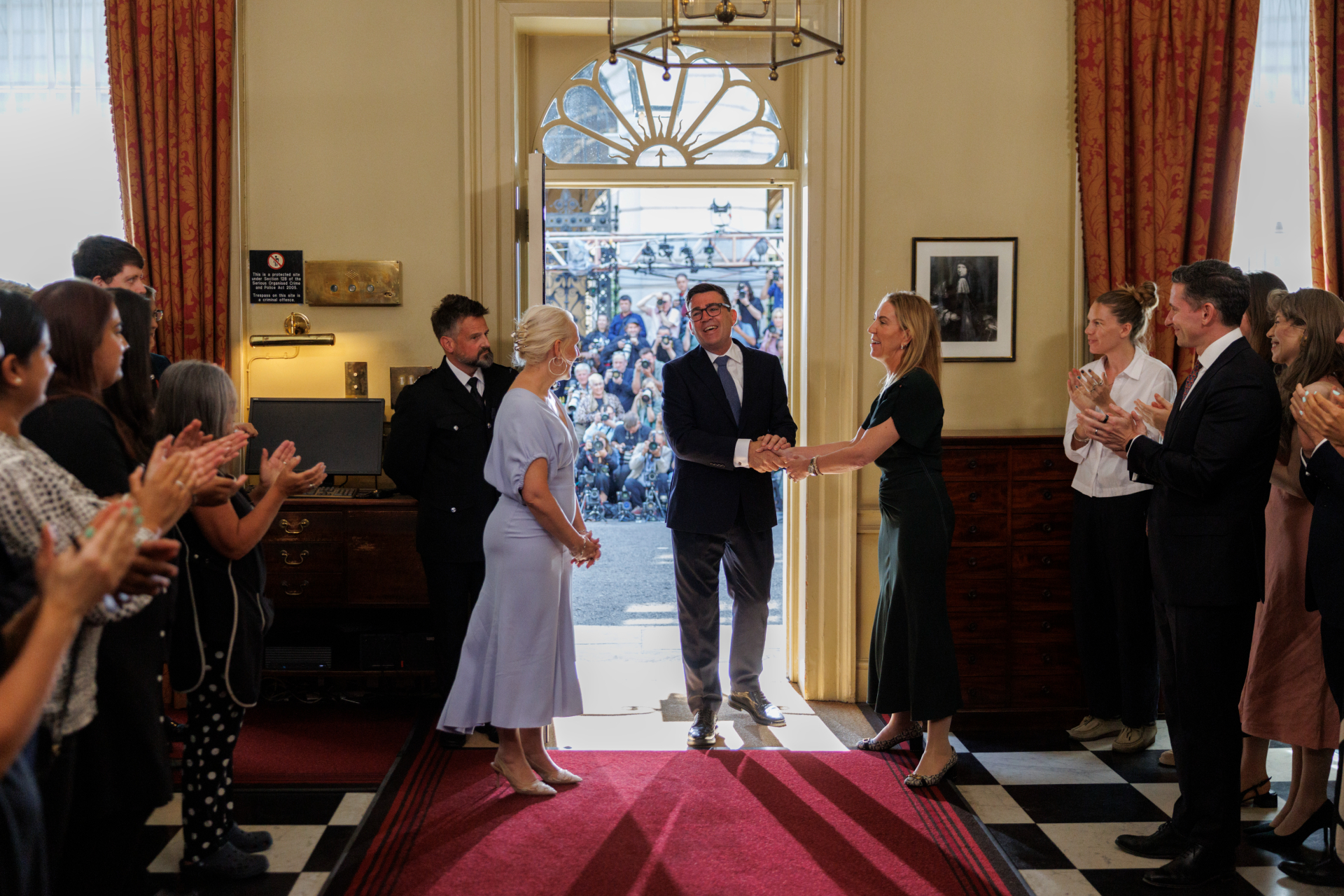
As the UK emerges from an unprecedented three heatwaves in as many months, one of them a full-on record-breaking heatstorm, causing levels of public concern to rise along with the temperatures, our new Prime Minister – as of this week – must put climate breakdown firmly on his agenda. That has to include ruling out more oil and gas drilling in the North Sea. If he does not, he could burn through the goodwill he has earned in Makerfield and across Britain well before the next general election.
Frustration with Britain’s inability to cope with the broiling weather has the potential for political jeopardy and Andy Burnham risks getting stuck in a ‘derailment’ doom loop if he doesn’t tackle climate adaptation. He has remained quiet on the climate emergency, but with May and June’s heatwaves alone estimated to be responsible for more than 2,700 excess UK deaths, this is not a conversation he can ignore.
The question is, which conversation will he be having?
There are two quite different conversations going on about climate adaptation. One, which increasingly is taking place up and down the country in village halls and workplaces from Orkney to Penzance, is uniting concerned citizens around the People’s Emergency Briefing film to hear the evidence from experts and discuss how to respond. The Climate Majority Project’s SAFER work is complementing and deepening this endeavour through workshops in which those brought together by the film screenings can explore how they can collectively build lasting local resilience (more on this below).
The other is the narrative from government advisory body the Climate Change Committee (CCC), which tells a rather more partial story in its recent climate risk report, A Well-Adapted UK. That CCC report does not take into account the concerns expressed in two suppressed Government reports that have greatly concerned us this year: a DEFRA report on the UK’s ‘Critical Systems’, which talks of a “realistic possibility” that our food, water and natural ecosystems are “at strategic risk” of catastrophic failure; and the Government’s still-half-suppressed ‘National Security Assessment’ commissioned from the Joint Intelligence Committee (and using the intelligence services’ methodology) on ‘Biodiversity loss and ecosystem collapse’, which opens by warning that “High ecosystem degradation is occurring across all regions. Every critical ecosystem is on a pathway to collapse”.
The AMOC (Atlantic Meridional Overturning Circulation, a major ocean current system responsible for our temperate climate) is one entirely possible cause of collapse. Despite the latest science showing that AMOC shutdown could start this century – possibly as early as 2055 – which would plunge London to -20C during the winter (and Edinburgh to -30C) and potentially eliminate the possibility of growing crops across most of the UK, the CCC’s report has just one brief paragraph about it across its 554 pages.
Another tipping point, dieback of the Amazon, now considered possible at 1.5C of warming (the planetary boundary that we are in effect passing in real time right now) gets similarly short shrift. The Amazon rainforest has already moved from being a carbon sink to becoming a carbon source. Large-scale dieback would reduce the region to savannah, with devastating impacts on indigenous people and wildlife. The resulting release of atmospheric carbon would be equivalent to 5-7 years of human emissions, raising global temperatures even further.
Meanwhile, leading scientists are warning that the earth’s energy imbalance has doubled in recent decades, with 90% of the excess heat being absorbed into the oceans and the consequences playing out across the entire earth system. The much-talked-about (apart from in the CCC’s report, which doesn’t mention it) ‘Godzilla’ El Niño, historically a natural phenomenon, has acquired monster status before it’s even occurred due to the exceptionally hot ocean conditions superheating it.
While we should, at least, be pleased that adaptation is finally being talked about – for years it’s been the Cinderella of climate, and a poor relation to ‘net zero’ – this high-level fudging does not protect us. Instead, it makes us even more vulnerable.
Within government, the true story is fighting to get out. The above-mentioned National Security Assessment, forced partly into the open by an FOI request, has a stark warning about ecosystem collapse and the threat to UK national security and prosperity. The Government has done all it can to stonewall the Assessment’s release, including at a special Environmental Audit Committee hearing specifically about the NSA. The vast majority of it continues to be unavailable publicly.
The DEFRA ‘critical system’ report, meanwhile, is only publicly known about at all because of a strong piece on it obtained via sources by the Times and there is much more in it yet to come out. These reports are clear, official evidence that we, and not just other countries, or our children and grandchildren, are truly in trouble. How can we adequately prepare for that trouble if the nature of it is kept from us?
Our systems are giving us a code red for humanity. But the government is not acting like this is an emergency. It is time to stop pretending this will all work out all right if we simply switch to heat pumps (let alone air conditioning) and put up shutters (important as these are), and to start telling it like it is. We need adaptation to be taken seriously, and it must be on an equal footing with decarbonisation. Both are urgent and vital; we must be ready for climate impacts while rapidly reducing our emissions to prevent even more global heating taking us into never-experienced-before territory. We need adaptation and decarbonisation to overlap thoroughly: which, in the form of Strategic Adaptation, they do.
The CCC’s report calls for a stronger public debate on what we value, and puts the ball firmly in the court of politicians. But politicians aren’t talking about it – worse, some are denying it – feeding a ‘spiral of silence’ on the subject.
Research shows that the majority of the public want action on climate breakdown, but remain a silent majority because they (wrongly) suppose that only a minority share their views. Result: politicians aren’t hearing a clamour for action – particularly with contrarians dominating the discourse on many platforms – and don’t have the confidence to act.
Debate is shut down. A few lone voices speak up to empty benches in the Commons chamber and ministers try to fob them off. All the while, citizens, whom it is the government’s number one priority to protect, are left in the dark.
People want to know. A citizens’ panel recruited to contribute their views to this latest climate risk assessment were surprised by the speed, scale, and irreversibility of climate impacts in the UK, and learning more throughout the process made them more concerned. They wanted their friends and family to have access to the same information and felt that educating the public is vital.
Crucially, they wanted government investment in adaptation to start now, and to be done ‘properly’ (in our terms: strategically), prioritising proactive, durable measures, even if they cost more upfront. The panel repeatedly stressed they wanted effective mitigation to prevent further negative consequences and highlighted the need for more robust and resilient infrastructure. They wanted the most vulnerable to be protected but were concerned about costs for citizens and wanted accountability and transparency on government spending on adaptation.
The panel’s demand for long-term, preventative solutions rather than relying on short-term fixes chimes precisely with the Climate Majority Project’s SAFER campaign to make strategic adaptation a national priority.
SAFER is about overcoming the ‘soft denial’ that mitigation efforts alone can prevent serious climate damage and making the climate reality visible. By grounding climate action in real communities and real lives, it can break the spiral of silence, restore collective purpose and identity, and galvanise public support for the radical climate interventions we so urgently need, including, obviously, decarbonisation initiatives. Alongside that, the SAFER campaign calls for a national adaptation strategy with funding to support local authorities with adaptation measures.
Despite describing government adaptation plans as being unfit for purpose, the CCC’s report fails to fully embrace this bigger picture. While it does include solutions – some of which hint at more joined-up measures (including a call for “coordinated assessment and management of cascading climate risks between sectors and joint planning of the responses across sectors to extreme events”) – the opportunity to recommend an embedded strategic approach to the clear and present danger we face is missed.
It is evident, from all the climate signals, that 1.5°C will be passed between now and 2030 (and entirely likely that it could be this year, given the concern about this huge incipient El Niño). The fact that we are, right now, breaking through this limit, our supposed ‘safe zone’, needs to be said publicly, and urgent action prioritised.
The CCC is right that we need a debate – so let’s have it, and involve all parliamentarians and the public. A first step would be to hold the televised National Emergency Briefing on the climate and nature crisis that people up and down the country are advocating for, to communicate the scale and immediacy of the risks we face.
And then we need to get to work.
We need transformative adaptation that acknowledges that the world we know has changed forever, and a plan to support each other to navigate this new one.
We can be SAFER. It starts with telling the whole story.
That is why the two of us have been working hard these past several months on promoting what the suppressed Government reports on ecosystem collapse and grave societal vulnerability say. The latest instance of that is Caroline’s The Rest Is Politics podcast series with Goalhanger, which examines them and has just launched. Do have a listen wherever you get your podcasts to dive deeper into this conversation.



Comments
We changed commenting systems on September 10, 2026 as part of a site-wide functionality and security upgrade. Your past comments have not disappeared, and you can still log in with your old Disqus account credentials if you wish. Contact us with any questions.
We've been doing this since the 1970s.
And we lost.
Because the dominant System always subsumes all subservient Systems, in quest of its task. And its task is the pursuit of economic growth. Which cannot be achieved at a lower EROEI (at a higher level of entropy, if you prefer) and so we will stay with fossil energy, yntil we can't maintain the dominant System.
How to navigate the fallout, collapse, bottleneck, global nuclear war, whatever the pathway – is the only variable worth addressing. That's personally, and in groups. Ironically, national-level formal governance is probably not do-able (hierarchies have always been the children of surplus energy) at the energy-throughput we'll be down to. So few seem to understand this,