

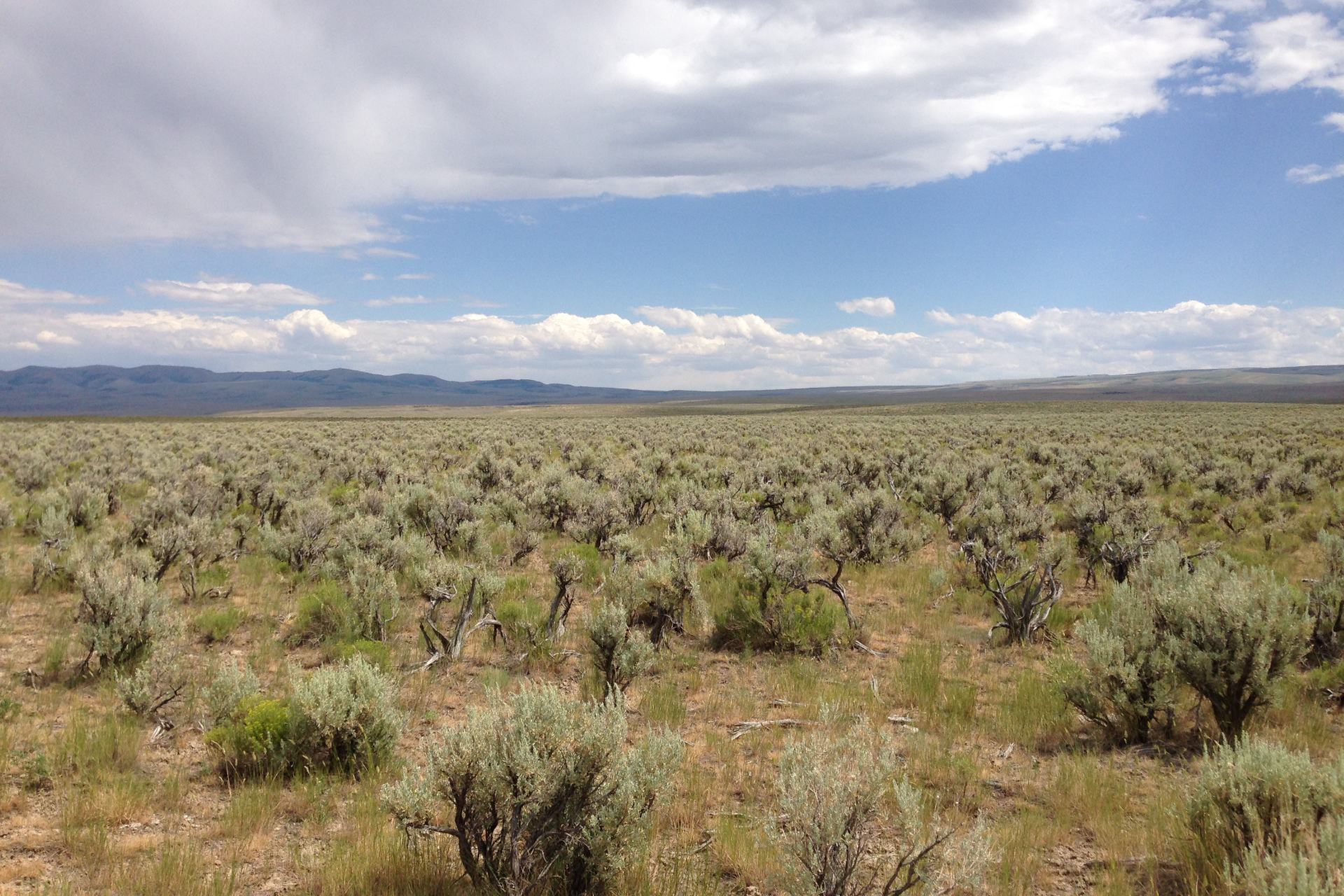
Drive west from Denver on I-70, and somewhere past Grand Junction, the country starts to look, to most Americans, like a mistake. The trees thin out. The mountains flatten. Brown stretches to the horizon in every direction, broken only by a single ribbon of asphalt and the occasional dust devil. People in the car start checking their phones. Kids ask how much longer. The land outside the window registers as something to get through on the way to somewhere worth stopping.
That something is the sagebrush sea. According to the U.S. Fish and Wildlife Service, it covers more than 175 million acres across eleven western states, comprising roughly one-third of the entire land mass of the continental lower 48. It’s the largest contiguous ecotype in the country. It supports more than 350 species of wildlife. It stores carbon at depths we’re only beginning to measure. It produces the water that fills the Columbia, the Missouri, and the Colorado. And most Americans, including most Americans who live next to it, have been trained their entire lives to see it as wasteland.
That training has consequences. The sagebrush sea is being sacrificed right now, in real time, because nobody mourns it.
The aesthetic trap
Americans inherited a particular way of looking at land. We learned to value scenery that maps onto European pastoral tradition. Forests. Mountains with snow on them. Rivers we can fish. Anything that photographs well from the deck of a national park lodge.
Sagebrush country fails every one of those tests. It’s flat or rolling instead of vertical. It’s silver-grey instead of green. It doesn’t reward a quick glance, and it doesn’t pose for the camera. You have to slow down, get out of the vehicle, and walk into it before it starts to make sense. Almost nobody does.
That visual prejudice isn’t accidental. It got built and reinforced for more than a century by everyone who needed Americans to look away while they did something to the land. Nineteenth-century settlers called it the Great American Desert and meant it as a slur. Twentieth-century boosters called it wasteland and used the word to justify everything from atomic testing in Nevada to coal leasing in Wyoming. The federal land managers who wrote the rules for sagebrush country in the early twentieth century built their framework around the assumption that the land’s highest use was running cattle through it. The bird counts, the soil studies, and the migration corridor maps that would have told a different story didn’t exist yet.
By the time the science caught up, the cultural software was already installed. The people who profit from sagebrush extraction never had a reason to update it.
You can see the legacy in how Western states market themselves. Wyoming sells Yellowstone and the Tetons. Nevada sells the Strip and Tahoe. Idaho sells Sun Valley. Utah sells the Mighty Five national parks. The sagebrush country that covers most of the actual ground in those states almost never appears in a tourism brochure. The travel economy that runs on public lands runs on the parts that photograph well. The other 70 percent gets treated as the boring drive between the good stuff.
What the land actually does
Start with the things you can count.
Pronghorn run the Sublette herd migration, also known as the Path of the Pronghorn, which the Wyoming Wildlife Federation measures at roughly 160 miles between Grand Teton National Park and Interstate 80 near Rock Springs. It’s one of the longest land migrations in the Lower 48, and it depends entirely on intact sagebrush country. Mule deer run a parallel corridor across the same kind of ground, including the Red Desert to Hoback route, a 150-mile push between Wyoming’s Red Desert and the Hoback Basin, the longest mule deer migration ever recorded. Golden eagles nest on the rim rock and hunt the flats. Pygmy rabbits, the smallest rabbit in North America, can’t live anywhere else.
Greater sage grouse are the bird most people associate with this country, and for good reason. They’re the indicator species. The USGS measures sagebrush ecosystem health by counting them, and the numbers are damning. A landmark 2021 USGS analysis found range-wide populations had declined 80 percent since 1965, with nearly 40 percent of that loss occurring just since 2002. The most recent USGS analysis, published in November 2025, found a 2.9 percent average annual decline continuing across the bird’s range.
Then there’s the carbon. Sagebrush is evergreen, and the soils beneath it store carbon at depths that would surprise anyone who only knows the surface. A 2024 study in Nature’s Communications Earth & Environment found that soil carbon in sagebrush systems gets depleted by 42 to 49 percent when invasive annual grasses and wildfire move in together, with the loss concentrated in deep horizons that took centuries to build. The researchers estimate the cycle is releasing somewhere between 17 and 20 teragrams of carbon a year across roughly 400,000 hectares of disturbed ground. That’s coal-plant-scale emissions coming out of land most people think is doing nothing.
And then there’s water. As the Department of the Interior puts it, sagebrush is essential habitat at the headwaters of major rivers including the Columbia, the Missouri, and the Colorado. The snowpack that hits Salt Lake City, Las Vegas, Phoenix, Denver, and Los Angeles comes off mountains whose foothills and watersheds are stitched together by sagebrush. Convert enough of it to cheatgrass monoculture, burn enough of it in invasive-fueled megafires, and the hydrology changes. The water gets warmer, more erratic, and less reliable.
The land’s already doing the work. The bill for replacing what it does, if it stopped, runs into the billions every year. Recreation alone on sagebrush BLM land generated roughly $623 million in nearby community spending in a single year, with hundreds of millions more circulating through state and national economies. That’s before you count the water, the carbon, the wildlife, or the grazing.
The people who need you to see nothing
We covered the framing fight in detail recently, and sagebrush country is where that fight gets won or lost. The “empty land” lie reaches its purest expression here because the visual case for the lie is strongest here. Anyone defending forest knows what’s at stake when a logger shows up. Anyone defending a coastline knows what an oil rig means. Sagebrush has none of that intuitive protection. The land looks like the developer’s promise is true before he even opens his mouth.
So the cattle lobby calls it forage. The energy industry calls it leasable. The data center developers call it underutilized and start running transmission lines through bird habitat. Senator Mike Lee calls it “garden-variety”. Every industry that wants the land for itself reaches for a word that means nothing important is happening here. The same trick works every time because the land won’t defend itself in the language Americans were taught to use.
The Bureau of Land Management (BLM) gave that machinery a major win on December 22, 2025. The agency finalized plan amendments across eight states, Idaho, Montana, North Dakota, South Dakota, Nevada, California, Utah, and Wyoming, that open more acres of sagebrush habitat to energy and mineral development than the 2015 plans allowed. Acting BLM Director Bill Groffy said the new approach would strengthen American energy security while ensuring the sage grouse continues to thrive. The bird’s been declining 2.9 percent a year under the old plans. The new plans weaken the protections that produced those numbers, and in March 2026, a coalition of seven conservation groups filed suit in U.S. District Court in Montana to challenge the rollback across 71 million acres in nine states.
The rollback isn’t happening in isolation. It arrives alongside the dismantling of the Forest Service, the transfer of 1.4 million acres of protected Alaska land to state ownership, the confirmation of Steve Pearce to lead the BLM, an executive order opening federal lands to data center construction, and a sham oil emergency being used to fast-track drilling on public lands. The sagebrush sea sits at the intersection of every one of those fights, because it’s where so much of the available federal land happens to be.
Cheatgrass is doing the rest. The invasive annual grass, introduced from Europe in the mid- to late-1800s as a contaminant in seed and straw, now covers an estimated 50 to 70 million acres of the West. It burns hot and burns early, which lets it outcompete native sagebrush after every fire. Each acre of cheatgrass monoculture stores a fraction of the carbon the original sagebrush did, supports almost none of the wildlife, and primes the surrounding country to burn next year. Overgrazing accelerates the conversion. The same livestock operations that benefit from “forage” framing are running cattle on the land that’s losing its fire resistance because of them.
Every piece of this depends on Americans not looking too closely.
A place that rewards attention
Spend a week in good sagebrush country. Camp out in the Owyhees, the Red Desert, or Hart Mountain. Wake up before dawn and watch the eastern horizon turn pink behind a horizon you can see for 50 miles. Listen to the sage thrasher and the western meadowlark take their turns. Walk a quarter mile off any road and find yourself in country where the only sound for an hour is wind and your own boots in the gravel.
Then look down. Biological soil crust holding the surface in place, a living skin built from cyanobacteria and lichens and mosses that took decades to form. Pronghorn tracks pressed into the dust. The mineral smell of sage when you crush a leaf between your fingers. Tiny wildflowers most people never notice. A horned lark scuttling between bunchgrasses. The way the light changes the color of the country every fifteen minutes as the sun moves across it, from silver to gold to copper to lavender.
The land rewards the people who give it time. It always has. The Shoshone and Paiute and Bannock and Nez Perce knew how to read it long before anyone showed up to tell them it was empty. The biologists working today in the BLM and USGS, the ones whose careers got upended by political appointees who couldn’t tell sage from rabbitbrush, know exactly what’s there.
There’s an older wisdom buried in all this, and it cuts against the way we’ve been taught to value land. The first rule of keeping any living system running is to hold onto all the pieces, including the ones whose purpose you can’t yet name. We measure a landscape by what it pays out this quarter and bulldoze the rest as waste. The soil crust took decades to build and we crush it under a tire tread without a second thought. The intelligence of a place like this works on a timescale that makes a human lifetime look like a single afternoon, and that’s exactly why we keep mistaking its patience for emptiness.
The country isn’t empty. It’s just refusing to flatter the people who can’t be bothered to learn its language.
What this piece asks of you
Two things.
First, change how you see. The next time someone tells you the high desert is just dirt, ask them how many species they think depend on it. Ask them when they last walked into it. Ask them what they’d put in its place that would do the same work for free. The framing fight matters because every bad policy that hits sagebrush country starts with the same sentence about empty land, and every defense begins by refusing the premise.
Second, look at how your representatives have actually voted on the public lands that include the sagebrush sea. The Congressional Public Lands Scorecard grades all 535 members of Congress exclusively on their public lands votes, with no other issues bundled in. The senators and representatives who voted to weaken the very protections the December 2025 rollback finished off are on that page. So are the ones still fighting for the land. And if you want to see what’s currently under assault near you, the Threatened Lands Map tracks every active fight we know about.
The sagebrush sea is the largest intact ecosystem we have left in the Lower 48. It runs an economy nobody bills for. It holds carbon that took thousands of years to accumulate. It’s home to one of the longest big-game migrations in the country. And it’s being sacrificed right now because Americans were taught to look at it and see a parking lot.
Here’s the part that should keep you up at night. The capacity to see worth in a place that gives you nothing back is the same capacity that makes a person worth anything at all. A landscape this old and this patient asks one thing of us, and it’s the hardest thing. Pay attention to something that will never pay you. Sage that won’t photograph. Grouse that dance for no audience. A pronghorn running 160 miles across ground we’ve decided is empty, on the only planet we know of where any of it happens. The land doesn’t need us to survive. We need it, and we need to know it’s still out there on the days we never go, because a country that can still leave one great expanse alone is a country that hasn’t yet decided everything has a price. The day we look at the last of it and see only acreage is the day we’ve told on ourselves. We will have proven we lost the one skill that was ever worth keeping, the ability to love a thing for what it is instead of what it pays.
That training can be undone. One person at a time, one piece at a time, one conversation at a time. Send this to someone in your life who calls it wasteland. Restack it. Share it. The framing fight is the whole fight, and the sagebrush sea is where it gets decided.
The land isn’t empty. It’s just waiting for us to catch up.
A version of this was originally published on the More Than Just Parks Substack.



Comments
We changed commenting systems on September 10, 2026 as part of a site-wide functionality and security upgrade. Your past comments have not disappeared, and you can still log in with your old Disqus account credentials if you wish. Contact us with any questions.