

In early spring, I wandered through the woods, where branches seemed quietly lifted in expectation of leaf and bloom. The forest held a gentle pause between seasons — a still breath between winter’s retreat and the promise of renewal. I walked carefully, not wishing to disturb the creeping phlox just emerging across the forest floor like a pale yellow tapestry unfolding beneath the trees, and spreading beyond.
The woods were quiet in the peculiar way that belongs only to early spring. The great chorus of summer had not yet arrived. Many branches remained empty, and the lingering cold still held the landscape in restraint. Yet beneath that restraint, something had begun to awaken.
Then a sound broke the hush.
A clear call moved through the trees with quiet authority, as though the forest itself had paused to listen. I stopped. Each note entered the stillness with intention and intensity, carrying outward and lingering among the trunks before dissolving into the cool morning air, while its echo reverberated in the distance.
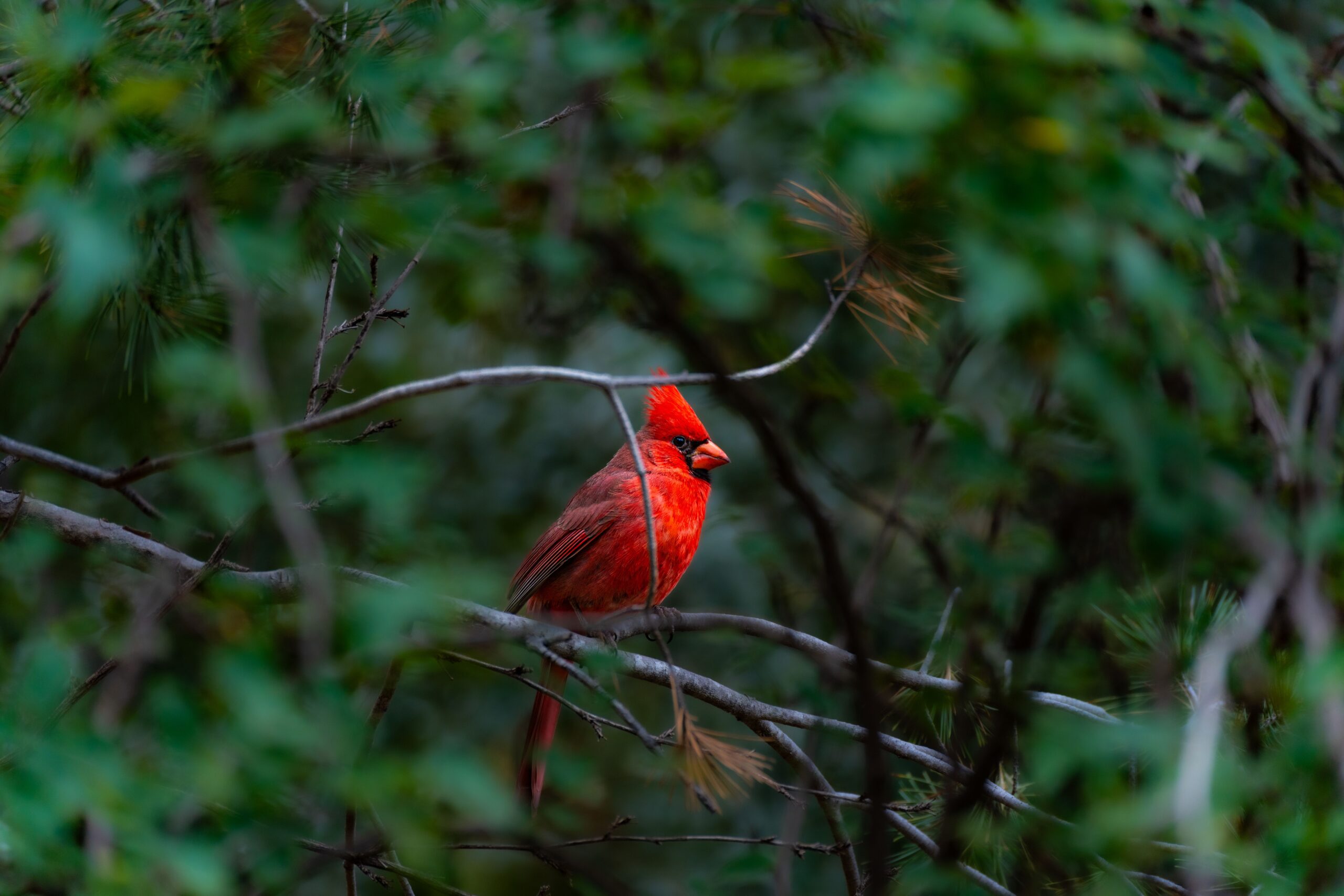
My gaze followed the sound upward through the branches until I saw him — a sudden flare of red against the pale woods of early spring. A cardinal. His color glowed among the gray limbs like a small steady flame held carefully against the fading memory of winter.
He sang.
He sang as though he hoped the melody would travel through every corner of the woods until it reached another willing to listen, understand, and respond. He sang with remarkable clarity. Each phrase seemed deliberate, shaped by a careful attentiveness to every note, every syllable, every modulation of tone. A language I could not comprehend, yet could still feel in its rhythm, resonance, and temper.
The cardinal himself seemed entirely absorbed in the present moment. His breast rose and fell gently with each phrase he sang. Nothing distracted him. Nothing appeared hurried. He sang with the quiet confidence that a response would return in time, as though patience itself had been woven into the rhythm of his song. Then a long silence. A faint reply came from far deeper within the woods. He paused to listen. The exchange began across the trees — one voice calling, another responding, each note altering the silence that followed it. For several moments, I remained motionless beneath the branches, listening.
The cardinal’s call becomes meaningful only because another bird receives it. Sound alone is not conversation. The living exchange depends upon attention — upon one presence recognizing another across distance and uncertainty. The forest itself seemed organized around this ancient principle. Calls moved between trees not as interruptions of silence but as extensions of it. The spaces between the notes mattered as much as the sounds themselves.
Birdsong has long served as one of nature’s seasonal thresholds. Before leaves fully emerge, before warmth settles permanently into the land, birds announce transition through sound. Their voices become some of the earliest signals that winter is loosening its hold. For countless generations, human beings have unconsciously relied upon such changes in the soundscape as markers of seasonal movement and continuity.
Yet the modern world grows steadily louder.
Engines, machinery, traffic, electronic noise, and constant distraction increasingly shape the environments in which we live. Many of us move through daily life surrounded by continuous sound yet rarely experience true listening. The subtle acoustic textures of the natural world — wind through branches, moving water, distant birdsong — often disappear beneath the pressure of human noise and hurried attention.
Perhaps this is one reason encounters with birds continue to affect us so deeply. They restore an older rhythm of awareness. To hear a cardinal calling through early spring woods is to remember that communication within the living world depends not upon dominance or volume, but upon responsiveness. Nature speaks through relationships of attention.
Watching him, I realized how rarely human attention now rests so completely within a single moment. Modern life rewards interruption, acceleration, and divided awareness. Yet the living world often reveals itself only through patience — through the willingness to remain still long enough for meaning to emerge gradually.
Again, the distant answering call returned through the trees.
For a moment, the forest no longer felt empty or silent, but threaded together by invisible lines of recognition moving from one living presence to another. The cardinal’s call had altered the landscape simply because it had been heard.
And I understood then that perhaps much of the environmental crisis surrounding us is also, at its core, a crisis of attention. What human beings fail to notice, they rarely protect. What they no longer hear, they gradually forget.



Comments
We changed commenting systems on September 10, 2026 as part of a site-wide functionality and security upgrade. Your past comments have not disappeared, and you can still log in with your old Disqus account credentials if you wish. Contact us with any questions.