

Show Notes
You, me, and everyone we know were born on the Titanic.
Some are warning of icebergs. Some are shoveling coal into the furnaces. Some are jamming out while the band plays louder than ever.
In this special episode beginning Year Four of Human Nature Odyssey, Alex gathers friends together in a living room for a live-recorded podcast potluck conversation exploring civilization, collapse, climate change, community, and the strange experience of trying to live a meaningful life while the world feels increasingly unstable.
Drawing from Lord of the Rings, the Titanic, Daniel Quinn’s Ishmael, ecological philosophy, and the first three years of Human Nature Odyssey, this episode becomes both a reflection on the journey so far and an exploration on what it means to “come home” to the living world.
Come join us in the living room. There’s still space on the couch.
Citations
- The Lord of the Rings by J.R.R. Tolkien
- Ishmael by Daniel Quinn
If you’d like to support Human Nature Odyssey, please subscribe wherever you enjoy your podcasts, leave us a review, and visit humannatureodyssey.com.
Join us on Patreon and get exclusive access to audio extras, writings, and notes.
Theme Music is “Celestial Soda Pop” (Amazon, iTunes, Spotify) by Ray Lynch, from the album: Deep Breakfast. Courtesy Ray Lynch Productions © Ⓟ 1984/BMI. All rights reserved.
Transcript
  You, me, and everyone we know, were born on the Titanic.

And as this hulking mass makes its way through the briny sea we carry conflicting stories about our predicament.

On one hand, we were raised to believe that we are on the best ship that has ever been constructed.

There has never been a fancier, more well-designed vessel in human history. And in fact, we’re told, it is unsinkable.

So it makes perfect sense if you notice your fellow voyagers walk with a sense of pride up on the main deck, admiring the handiwork. I mean look at how shiny this thing is.

What an incredible marvel of human ingenuity. A crowning achievement of civilization. I mean, I don’t see any primitive tribes making a ship like this.

And then on the other hand, you might walk down below deck, and see there are masses of people living in very different conditions than the people up on the main deck.

Even though we’re all on the same boat, some people are having a better time than others.

Then, you might hear rumors of an iceberg.

For some it’s obvious. Look out at sea. It’s literally right there. Some can see the collision has already begun.

Some are below deck desperately trying to escape the rushing waters. Some can’t afford to get away, shoveling coal into the furnace as water slowly rises to their waste.

For others, this is an obvious hoax. This is the unsinkable ship, after all. It’s in the name! The captain, I’m sure, is on top of it. Well at least the people around the captain. Like what? You think they’d send us out into the middle of the ocean on an unsinkable ship to let a  little iceberg cause a problem?

But it is becoming unavoidable to almost everyone on the ship to indeed see that the ship is taking on water - though not everyone is sure why. Should we be worried? Something's happening here. But at the same time, the band is still playing. And in fact, the band has never played louder and more enthusiastically than right now.

Welcome to Human Nature Odyssey. A podcast exploring the wild ride our civilization is on and how we all might need to learn how to swim.

I’m Alex Leff.

This episode begins Year Four of Human Nature Odyssey.

Three years ago I gathered my friends together for a podcast listening party and shared Episode One. I had been working on it for a couple years before finally releasing it. If you’ve listened to those first few episodes, you’ll know that in a way, I was working towards Human Nature Odyssey for half my life.

Since that first episode I moved back from Los Angeles to the northeast. I’m closer to family and quiet spots in nature and living with good friends and their kids.

And once a month my friends here gather together for a podcast potluck party, to listen to the latest episode, and discuss together after. Also to hang out and eat food. Oh a couple months ago Kokoro led a mending circle beforehand and helped people stitch torn jeans or patch up holes. I sewed a button back on one of my favorite shirts.

It is indeed a miracle of civilization to be able to share this podcast with people I’ll never get to meet from all over the world. And it’s always incredible to hear from you if you’re finding it meaningful on your journey too.

And it’s a miracle of life to get together with people in the real world. I’ve needed that. And often the conversations I have with my friends after the episode help inspire future episodes.

So what I wanted to do, for this month’s podcast potluck party, was do a sort of live taping. I presented them the ideas I wanted to share in this episode and turned what came from that into an episode.

And I wanted you to be here too. Come join us in the living room. There’s still a few spots on the couch and we have plenty of yoga mats and meditation pillows strewn across the wooden floor. I’ve dimmed the lights so we can watch the natural light fade from sunset. It’s a room full of friends I’ve known since college or met when I moved back. My housemates are here and their oldest son Michi is sitting next to me on the couch. You may recognize his voice from the beginning of episode 3 of Human Nature Odyssey. He was six during that recording. He’s 10 now.

So anyway, come get comfy. In this episode you’ll hear excerpts from the live recording, and the storytelling that came from it, all trying to answer the question: what is Human Nature Odyssey?


Thank you guys so much for participating in this experiment tonight. So this is a live podcast recording. It's designed to be paused, interrupted, derailed. I might regret saying that. and expanded upon by all of our ideas today. Human nature odyssey, as of this month, just turned three years old. Woo!

so today what I wanted to do is tell the story as I see it of what human nature odyssey is, where we've gone on our Odyssey, the Odyssey thus far. It's live, so there's a million people listening right now to everything. Titanic. What? Thanks, Michi. You're welcome. Okay, so okay, so we're gonna we're gonna try this out. Thank you for bearing with me. We live in an absolutely ridiculous time. And I think of it as like we were born on the Titanic.


Same boat. Different experiences, depending on where you are, the people you're interacting with, and the stories you carry about what we’re experiencing. It’s almost like we’re experiencing completely different movies.

The question is what genre are you living this through?

If you're seeing the water bursting through the cabin doors and flooding the spiral staircase you might be like, okay, this is an action disaster movie.

But if you’re pigging out at the buffet this might feel like a cheesy romantic comedy.

We’re living through the same story, just viewed through the lens of these different genres.

To someone working their 9 to 5 job, saving up for a new lawn mower, you know, planning their trip to the Bahamas, they might think the people who are acting like this is a disaster film are crazy.

But we’re not just living through a disaster film or a rom com. We are living through something much closer to Lord of the Rings.

After all, we are all alive during one of the most climactic moments in human history.

Now, I know, there's a certain humility we tend to have about this.

Who, me? Little old me? Alive during one the most climactic moments in human history? No! No, certainly not! People must always think that about the time they’re living in.

But guys, no, it’s now. There have been disasters, calamities, and plagues for millenia but nothing in human history quite on the scale of what’s coming.

We live in a highly advanced civilization that has never been more powerful in how it can shape the whole planet, yet at the same time our civilization has never been as fragile and vulnerable as right now.

I’ll even do you one better. It’s not just one of the most climactic moments in human history, it is one of the most climactic moments on our planet's history.

Now, again, there’s the tendency to be humble about this. No, it can’t be. But I don’t know what to tell you.

Our civilization is causing a rapidly accelerating extinction of biodiversity around the planet. We talked with Professor Gerta Keller in episode 2 about how 200 species are going extinct every day. Scientists call the extinction event we're going through the planet’s sixth mass extinction. In life on earth’s 4 billion year history, it’s happened only five times before this. The last one was 65 million years ago. And that's what wiped out the dinosaurs.


TAMSIN
But while we’re set up for catastrophe, but we are not experiencing catastrophe.


Now it’s hard to exactly place where we are in the Titanic metaphor. We can see disaster looming but it hasn’t fully struck yet.


JOSEPH
That scene and Austin Powers, this guy's writing the thing that smashes concrete in the guy's name. It goes, you guys going really slowly? Just, it was like, as he doesn't move, he gets smushed.


ADAM
I think we're thinking of it, though, as like, there's going to be one thing that's going to hit us, and then, instead of, like, cycles of continually like we're going to hit this tiny iceberg and then this small, like it'll just be an ever changing like, and we're locked into a certain amount of it. Yes. Climate change. Yes. And like we can only really control our response to it or we can lessen it and then like, try to build systems that you know, make us more resilient to that. But it's not going to be like the end of the world in the way that like a new or impacting is or it's just like one boom. And then the after.

Right. If, if only if only this was the Titanic and there was one iceberg.


ADAM, JOE, MICHI
There’s icebergs everywhere. Yeah. Every different people to all. It's just yeah the complexities that they're melting were melting. That’s what I was going to say.


So that's it. So then what I want to bring us is what does this mean for us? What does it mean to live in a Lord of the rings genre?


MICHI
Fear.


Well, I think yeah here's fear that goes into it. You know, Frodo says to Gandalf, like, I wish this wasn't happening to me. And Gandalf says like something. What?


ADAM
So do those who live in such times and yet we we don't have a choice. We have to respond.


Yeah. So I think it's about not seeing what's happening as a side quest.


MICHI
It's the whole quest.


That this is what the show is about. It can feel like a distraction and all these disasters in these calamities, in this, like, existential thing that is looming can feel like, oh, man, I was just like trying to do X, Y, or Z in my life. I was just trying to get my like salsa class off, off the ground, you know, I was just trying to, like, make the perfect salsa recipe in the kitchen.


TAMSIN
Don’t include that in.


JOE
Include it!


We all have our own call to adventure. The looming iceberg is not a distraction from your life. It’s an invitation to live the life we’re called for.

In the hero’s journey we’re faced with the question of how we can use our unique skills and gifts to face this moment? To be alive in it?

And how can we use this moment as a catalyst to do something unexpected and brave with our lives?

We do not need to carry the weight of a mountain. We only need to be the seed that pushes through a crack in the concrete and makes a little space for life there.

But even in the fantasy epic genre, there's still romance. And there's still comedy. That's the good news. The stakes are incredibly high but we're still going to be laughing and falling in love throughout all of it.

And in this hero’s journey, there’s not one protagonist. Our stories don’t typically prepare us for this. There’s usually a single chosen one who will save us all but our real story is about many, many heroes, who all have their own trails to travel.

And since this journey is so beyond what any of us could possibly even fathom or seemingly do anything about, the key thing is to find the fellowship. How do we find the other people in our lives that we can join with and experience this together? The journey’s not supposed to be this solitary thing that we're off on, toiling away, sacrificing for the greater good.

Our call to adventure is an invitation not only to live a meaningful life and respond to the iceberg in a way that feels worthy of the moment, but also to discover the many forms of community that can accompany us on that journey.

So let’s retrace our steps from the beginning of our odyssey to now.

In the first couple episodes of Human Nature Odyssey are about my own call to adventure that began during the summer before high school, when I was assigned the book Ishmael by Daniel Quinn. Back then, reading a book for school was the last thing I wanted to do. But Ishmael planted seeds in my mind and Mr. Wilman, my 9th grade English teacher who assigned Ishmael helped those seeds grow.

Ishmael is about a telepathic gorilla’s conversations with the narrator about humanity’s place in the world.

It became my favorite book and helped shape how I saw the world. When I was 14 I told myself that some day I’d make something about Ishmael. I didn’t know what it would be. I just kept it as this sort of mountain on the horizon. And about double my life after first reading Ishmael, it felt like it was time to try and climb that mountain.

That became Year One of Human Nature Odyssey, the first seven episodes, exploring the ideas in Ishmael, wrestling with those same questions I had when I was 14, learning about climate change, mass extinction, and the destruction of a world I was just getting to know.

I wanted to know why this was happening, why were we doing this?

I think for many people the answer is: well, the problem is humans. And it's this kind of humblebrag, where we’re insulting ourselves, but also boasting about it, because well, you know, our brains are just so big. We’re just too intelligent. Any intelligent species with a really big brain would cause the mass extinction of life on the planet. We’re the dominant species - that’s what happens. We can’t help it. We’re doomed to go around destroying the world.

But Ishmael, the telepathic gorilla, argues that humans are not doomed and not the fundamental problem here.

Then what is the problem?

There are so many different stories we tell to understand what we're experiencing. We use these words like capitalism, Western civilization, the first world and third world. These are academic terms, so we take them academically seriously. But at the end of the day, these are just different mythological ways of explaining what's going on. They’re metaphors we're using to describe something too complex to describe with words.

But that doesn’t mean they’re not real. It just means at the end of the day, they’re all a story. Stories are always incomplete, but they can always help us see something.

The author of Ishmael, Daniel Quinn, had another idea for a story, another way of seeing our predicament. He divided societies into two categories: Takers and Leavers. The idea is that humanity is not destroying the world, one kind of society is.

And there’s a whole episode about this. Episode Four of Human Nature Odyssey looks at the difference between Takers and the Leavers.

There’s been different ways of describing this dichotomy throughout history, with words like civilized and primitive. And Episode Four goes into how those words aren’t just a little mean spirited, they’re also nondescript.

So Daniel Quinn proposes we use the terms Takers and Leavers instead. We can think of Takers as our extractive, expansive, global civilization. We can think of Leavers kind of as indigenous cultures - but not quite. To be indigenous means to be native to a place and it also refers to a way of life that’s in balance within a local ecology.

This double definition becomes an issue when someone who is considered indigenous, grows up in a traditional rural village, then moves into the city and buys all their stuff from Amazon, does that mean they’re not indigenous anymore? No, because being indigenous is an identity tied to heritage.

That’s why I think it’s helpful to have a term like Leaver which is about a culture’s way of life. It’s less focused on individual identity, but is a whole culture Taker or Leaver?

The main way Daniel Quinn describes the difference between these two types of culture is that they’re enacting two different stories.

Takers are enacting the story that the world belongs to us. And we can see the evidence of that all the way from megadams and data centers, down to our lawn mowers and pesticides.

Leavers, on the other hand, are enacting the story that we belong to the world. And if you believe that story to be true, then you act very differently.

So it’s not human nature that’s flawed. It's this one boat we’ve built for ourselves.

Taker Civilization is destroying the world not because it’s evil, but because it’s acting as if the world belongs to us.

Of course, the world doesn’t seem to think so. It’s always acting out. Never quite raining when we want it to. Lil’ bugs eat our crops. Rivers flood our towns and roadsides. It’s a constant struggle for us to maintain our rule. But in our search for control, we’ve made incredible advances in science and technology, in medicine, you name it. We’ve accrued a vast amount of knowledge about how the world works.

The funny thing is: all that we’re learning seems to disprove that the world belongs to us.

We talk about this in Episode Six. We always thought we were the center of the universe. But what has astronomy shown? Turns out: nope, we’re a tiny blue dot revolving around the sun. Oops.

We liked to think we were created separately from the rest of life, like we were the icing on the cake. The pinnacle of all creation. But whatd’ya know? Evolutionary biology has revealed we actually evolved just like all the other freakin’ species in the world and all life is actually our cousins. Who knew?

And the craziest thing of all we’re learning? It’s in the field of ecological sciences. I mean guys, you’re not gonna believe this, but human beings seem to be a completely interconnected part of this planet. We’re part of the earth like a finger is part of a hand.

All of our learning is pointing to the fact that the world does not belong to us, like our Taker mythology told us, but that we belong to the world.

Taker Civilization thinks it’s on a quest - this linear journey of advancement and progress. But if the world is our home, then this quest we’re on is actually an odyssey. And our destination, in the end, is to come home.

And so for me, what I see as the point of Human Nature Odyssey is orienteering ourselves back home. This is a question for us as individuals and as a culture.

And of course, at the end of any odyssey, we're going to find that when we return, our home is drastically different than when we left.

And we are changed as well.

In episode 5 we talked about the story of the Garden of Eden, when the first two people are banished from home and the rest is history.

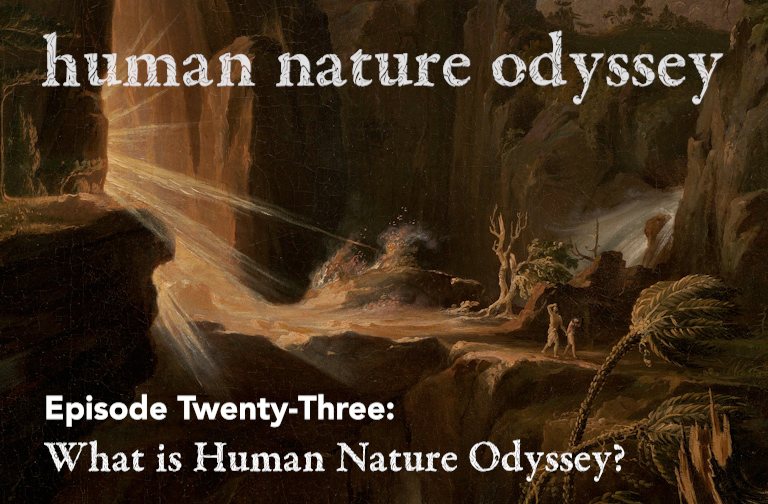
I don’t know if you ever noticed but the background image of Human Nature Odyssey is a Thomas Cole painting titled The Expulsion of the Garden of Eden. If you look closely you can see a lil’ Adam and Eve being cast out of the garden. The story tells us how Adam and Eve were kicked out. But the story about how they return has yet to be written.

When Adam and Eve are cast out of the Garden of Eden, it’s described as a physical place they are leaving. There’s even gates and a fiery sword banishing them to the other side. But that’s just a story. It’s a metaphor.

Adam and Eve never really left the Garden of Eden. They just thought they did. The Garden of Eden is all around us. It’s in wild raspberries at the edge of the mowed field, in the hawk soaring over the telephone poles, in the dandelion pushing through the crack in the concrete, it’s in the wind on your face, the air in your lungs. In many ways, we’re already home.

The reality is, we already do belong to the world. Boom, we did it. Here we are and it’s happening.

Our hero’s journey is allowing ourselves to know that, and to feel it, to start enacting that story in our lives and build a culture that believes it and acts accordingly.


MICHI
What’s this episode going to be about?


That's a great question. This is - the answer’s this.


MICHI
How long do you think you’re odyssey’s going to be?


Well I will say that… the first season of Human Nature Odyssey was Ishmael - seven episodes. And as I was making it, I had no idea what was going to be beyond that. But I just trusted, like I was just going to make that. And then I got an email from, Rennie Quinn, the wife of Daniel Quinn, who wrote the book, and she had heard the podcast and she liked it.

And, and we which is a very surreal moment in my odyssey. And, we talked on the phone and I asked her and she was telling me, like, all these stories about them writing the book. And we talked on the phone, and I convinced her gently, but with encouragement to do her first ever interview. And so episode eight is a conversation with her. And then I had this bizarre experience. And I felt almost like depressed for a little bit after season one of like, it felt like getting to the top of the mountain and like all of a sudden, like I saw this whole landscape that I like, and I was like, well, I don't know, like, I don't know what to do next.

Like, what's an episode next? so what what have the episodes since Ishmael been? Has it just been a bunch of random stuff? It kind of felt like it was random stuff as I was writing it, but I've seen like, different ways to understand, like potential navigation.


The episodes since the Ishmael series explore the potential paths back home.

Episode 9 followed the inspirational and cautionary tale of Christopher McCandless, the young man who burned his money, forsake his family, and ventured into the wild. Is that how we come home, by trying to escape society and leave this all behind?

Then there was a three part series called the King Is Dead, Now What? on the 250 year history of the struggle for democracy and the left and right political spectrum, followed by Episode 15: Are Hunter Gatherers Liberals or Conservatives?

Will the left wing or right wing get us back to the garden? Where do these lofty questions about civilization and odysseys meet with the political realities of our time?

Then in Episode 17 we asked if renewable clean energy will save us? Is our way back home lined with solar panels and wind turbines or cracking the code of nuclear fusion?

Episode 19 was about our fixation on space colonization as the way to solve our problems.

Without meaning to, I realized these episodes were all about bursting bubbles of false escape routes.

Our way home is not by escaping society, or to just think in terms of liberals and conservatives. It’s not about just finding unlimited clean energy. It’s not about going to space.

And then the last couple of episodes - episodes 21 and 22 - with help from the post-apocalyptic sci-fi novel Earth Abides, we imagine what it could look like to come home again over the course of generations, how our great-children might one day live as if they belong to the world.

And that is where our odyssey has come so far.

We’ve climbed the mountain of Ishmael and looked out upon a whole range of potential paths lined with booby traps and have begun our descent into a valley of other ways of being in the world.

What comes next in the fourth year of Human Nature Odyssey? Well that my friends is a story for another time.

Thanks for listening.

Until next time, I hope you'll consider what’s one way you might enact the story we belong to the world? What’s one way you might answer your call to adventure and come home?
Thank you so much for listening to Human Nature Odyssey. New episodes come out the first Thursday of every month. Thank you for being along for the ride.
I also wanted to share a small evolution in the project.
Over the past few years, Human Nature Odyssey has grown into something bigger than just a podcast feed. More and more, I’ve wanted a space for the broader journey around these episodes — additional writings, reflections, behind-the-scenes thoughts, bonus conversations, and the larger questions we’re exploring together.
So Human Nature Odyssey now has a home on Substack.
If you’d like to dive deeper into the world of the show, that’s now the main place to do it. In the coming weeks, I’ll be sharing bonus episodes, including the live conversation that inspired this episode, so you can really be there in the room with us.
And to everyone already supporting the show on Patreon: thank you. You’re a big part of why HNO has been able to grow into what it is becoming.
You can find a link to the Human Nature odyssey substack in our show notes.
This episode was made in association with the Post Carbon Institute. You can learn more at Resilience.org.

And as always, our theme music is Celestial Soda Pop by Ray Lynch. You can find a link in our show notes.

Talk with you soon.



Comments
Welcome to the new Resillience commenting system!
We have moved from the former Disqus commenting system to a new system as of September 10, 2026.
We made this change because of privacy concerns regarding Disqus. It's also part of a set of changes to bring more services to the Resilience community under a single login: commenting, (coming September 2026), and online courses (coming 2027). Unfortunately, your old Disqus comments may not reliably link to your account in this new system. Please contact us if you have any questions or concerns.