


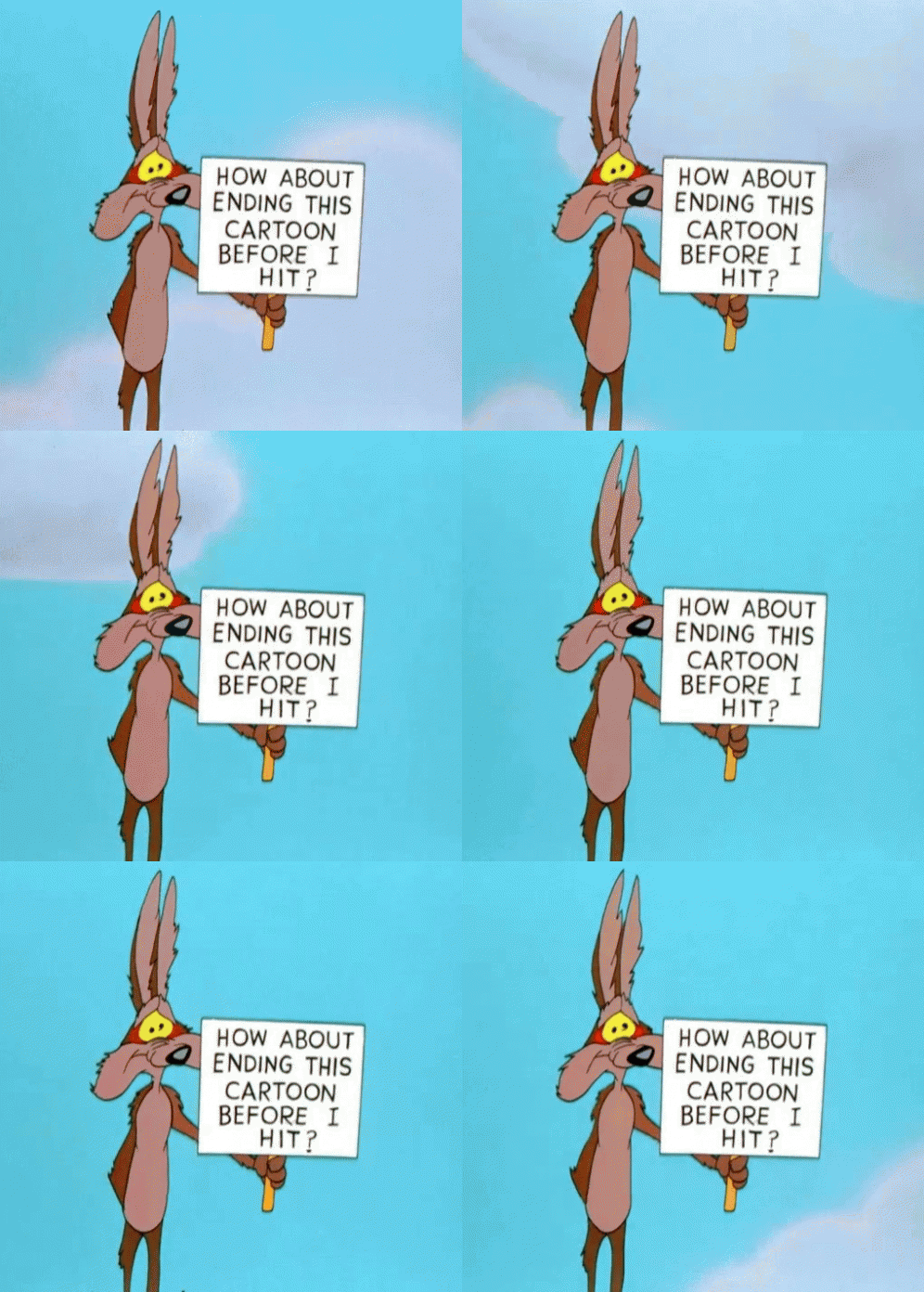
Pop culture has long memorialized the Warner Brothers cartoon gag in which Wile E. Coyote, lured by his nemesis, the Roadrunner, races off a cliff. Instead of immediately falling, Coyote keeps running, then looks down and realizes there’s nothing beneath him but empty space. His expression turns from anger to panic, whereupon he plummets. Coyote’s belated moment of realization is a trendy metaphor for our response to inevitable, though not yet fully realized, consequences of foolish behavior.
For the past couple of decades, we at Post Carbon Institute have been pointing out that energy is the basis of the economy, that oil is our foremost energy source, and that a transition to alternative energy sources will necessarily be slow and incomplete. Given that oil is a depleting, polluting, non-renewable resource, industrial society is due for a reckoning at some point. We are all in an extended Wile E. Coyote moment.
But now, as the United States’ war on Iran has set off a global energy crisis, humanity has arrived at a more immediate and critical Coyote moment. The International Monetary Fund (IMF) has issued a report suggesting that continued oil shortages could reduce global economic growth by 2 percent and raise inflation by 2.3 percent. Some analysts say the IMF warning is far too weak and that the crisis could trigger a global recession or worse.
Oil is a key ingredient in most consumer products and their packaging; expensive oil, therefore, translates to price hikes for toys, car parts, electronics, clothing, and more. It powers or is a critical input into essential elements of industrial society, including the food system. And oil moves everything: global supply chains depend on transportation by truck, rail, ship, and air, and over 90 percent of transport energy is oil-based. That means an extended crisis would likely lead to stagflation, in which the economy is hobbled simultaneously by inflation and slow growth or economic contraction. When prices for food and medicines are eventually impacted, no one will remain unaffected.
However, for the moment, the stock market is hardly signaling imminent economic peril; instead, the Dow Jones is near peak levels. Further, the US, which started the war, seems somewhat spared from its consequences when compared to many other countries. And oil prices, while higher than before the hostilities, are nowhere near inflation-adjusted historic peaks.
What’s keeping Coyote airborne?
Chokepoint: The New Urgency of Ending Our Fossil Fuel Addiction
Join Nate Hagens, Kumi Naidoo, and Gaya Herrington for an urgent conversation about the Strait of Hormuz closure, fossil fuel dependence, and possible paths through the new global energy crisis.
American Oil Un-exceptionalism
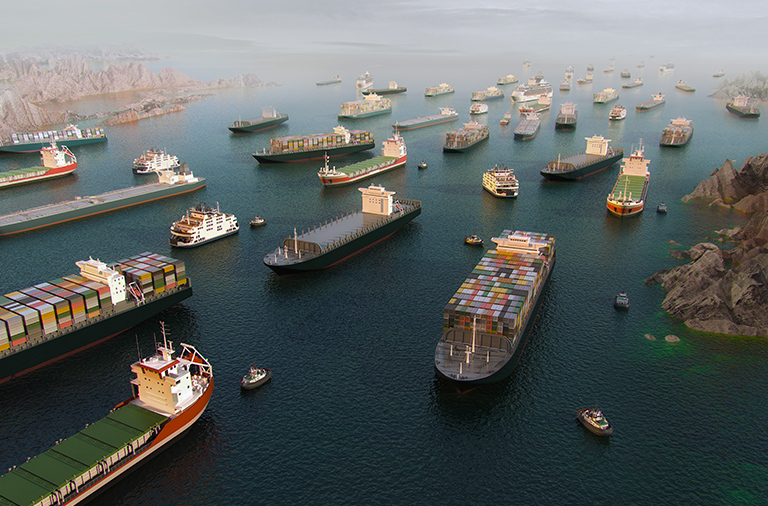
Myanmar, Bangladesh, Slovenia, Sri Lanka, Cambodia, and Vietnam are rationing or restricting the purchasing of fuel. Germany’s Lufthansa airline has cut 20,000 summer flights due to rising fuel costs. The examples could be multiplied: countries in Asia, Europe, and Africa are already experiencing symptoms of energy scarcity, while Australia faces dire impacts to its agriculture.
But in America, the worst fallout so far is expensive gasoline. Before the first attacks on Tehran in late February, the average price of gas in the US was $2.98 a gallon. It’s now above $4—a political worry for the president and other Republicans, but a price that’s not quite as high as ones motorists faced in the 1970s. US airlines have raised their checked baggage fees in response to higher fuel costs. Yet, otherwise, business hums along more or less as usual. Why have Americans seen so few repercussions?
Two reasons are widely cited. The first is that the US is currently the world’s biggest oil producer and is therefore far less vulnerable to shortages than nations that import most, or all, of their fuel. The second is that the US has the world’s second-largest strategic petroleum reserve (after China), which, in an emergency, can be brought to market to lower prices and avert scarcity.
However, these two pillars of US energy resilience are shaky. First: Even though the United States produces over 13 million barrels of oil per day, it uses almost 20 million barrels. Further, the kinds of oil extracted from American wells are not always the kinds that the nation’s refineries are set up to use. So, oil companies export light crude and import heavier crude to produce the blends of gasoline, diesel, and jet fuel that the US market demands. The result: America is the world’s second-largest oil importer, even though its politicians love to brag about “energy independence.”
Second: Strategic petroleum reserves are only meant to last a relatively brief time. Currently, the US has about 400 million barrels of oil stored in four underground salt caverns along the Gulf of Mexico. That’s 20 days’ worth of total American consumption at current rates. Therefore, the government has limited ability to influence oil prices during a months-long supply crunch.
America’s status as oil-production king and its cushion of reserves have indeed helped it weather the early stages of the crisis. But the nation won’t be insulated from serious economic damage for long.
Oil-Price Roulette
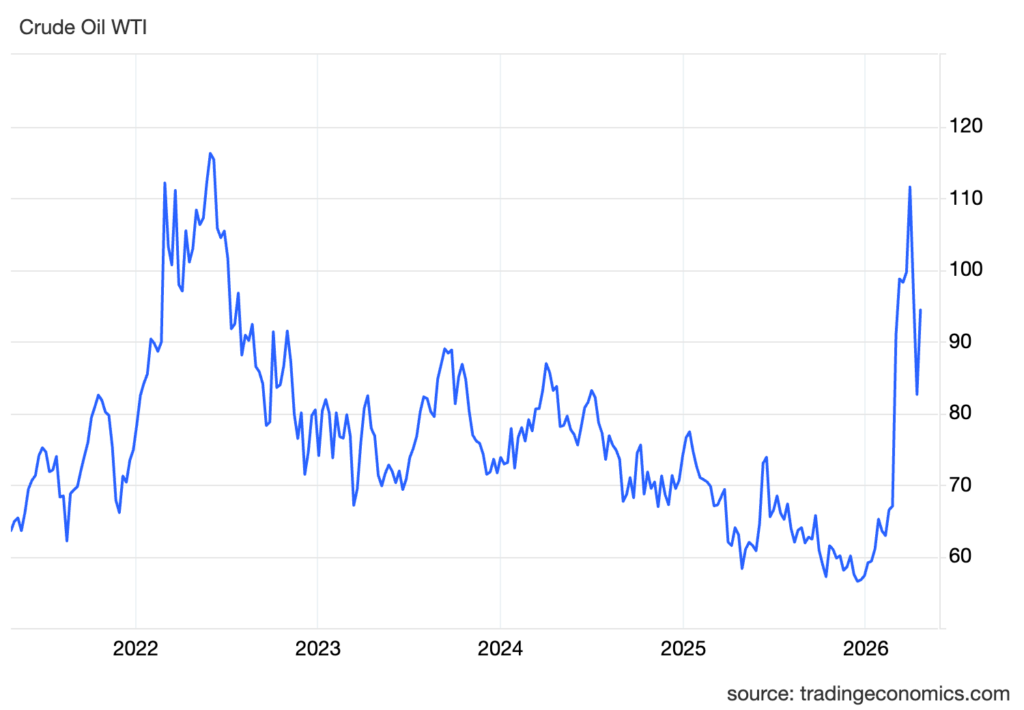
Oil has been trading at roughly $100 a barrel since the start of hostilities, a price somewhat lower than ones seen in June/July 2022 when Russia invaded Ukraine. The closure of the Strait of Hormuz would intuitively seem a much graver threat to world oil supplies. Given that a fifth of the world’s petroleum flow is now unavailable, why haven’t prices shot even higher?
One factor is the so-called TACO trade. Donald Trump has repeatedly shown the tendency to make threats and then back away; hence the meme “Trump Always Chickens Out” (TACO). The term “TACO trade” gained currency during 2025, when the president announced steep tariffs, then canceled or moderated them, ostensibly to leave time for negotiations but also perhaps in response to negative impacts those announcements had on stock prices (stock market activity appears to influence Donald Trump’s behavior more than most other factors). Savvy stock traders learned that if, instead of taking Trump’s most belligerent threats seriously, they bet against price dips, they could make more money.
The TACO trade has also followed Trump’s recent statements about the Iran war. When he said, in a late-night Truth Social post, that “a whole civilization will die tonight, never to be brought back again” if a deal to reopen the Strait of Hormuz was not immediately reached, many oil traders sat tight, assuming Trump would renege on his threat. He did. If Trump’s backdowns happen on a Tuesday, as on April 21st, the internet explodes with “TACO Tuesday” comments.
However, the longer the crisis drags on, the harder real shortages will bite oil-importing economies worldwide. And there are reasons to expect the impasse between the US and Iran to continue. Trump’s instinct is to bully and bluster, but every time he attacks Iran or threatens to do so, oil prices rise (despite the muting effect of the TACO trade) and the stock market dips. Both trends are political kryptonite. However, it would be even worse politically for Trump if he were to accede to a long-term Iranian peace deal that looks like a defeat for America. So, the standoff persists, with the Strait of Hormuz blocked, 20 percent of world oil supplies offline, and the global economy held hostage.
The Strait has been closed for over two months. Analysts say that if it remains shut to tanker traffic for months longer, oil prices could soar to $200, which would almost surely send the global economy into contraction.
Dow Derangement Syndrome
An acute Wile E. Coyote moment is also happening in global stock markets. Many people (including most investors) tend to think of stock prices as a barometer of the overall soundness of the economy. Others disagree, pointing out that stock prices just measure future profit expectations of listed companies, not current employment or wages, much less the health of the biosphere. Further, stock ownership is highly concentrated, so market booms often benefit only the wealthy. Nevertheless, the opinions of the rich tend to be amplified throughout society, so even many non-investors watch the Dow Jones and S&P 500. And, despite the Iran war and resulting higher oil prices, and despite warnings from experts about rising fertilizer costs and the possibility of global food shortages, the Dow seems to be doing just fine. The major market indexes dipped significantly between late February and late March but have recovered since then and are once again near record highs.
The market’s resilience is puzzling for another reason as well. Most investment action during the past couple of years has centered on artificial intelligence (AI). Nvidia, which makes computer chips for AI, is now the world’s most valuable company by market capitalization, even though the AI industry is struggling to be profitable. Many analysts say that AI is a classic financial bubble—and a historically big one.
So, are investors stupid, or what? A more nuanced take might be that they exhibit herd mentality, and that they tend to chase short-term profits, hoping to sell shares just before prices plunge.
Here’s another factor. According to some analysts, the markets are simply high on cash. Governments created enormous amounts of money to stanch problems created by the Global Financial Crisis of 2008 and the COVID epidemic, and much of that money eventually found its way to investors. When the US federal government racks up giant fiscal deficits, it is creating new money, much of which winds up inflating bubbles.
In short, the market runs on investor sentiment, which is now detached from both consumer sentiment and business prospects—as well as from long-term biophysical reality.
But sooner or later, reality imposes itself.
Look Down
In the cartoon, it’s not until Coyote looks down that he realizes his predicament. This sudden awareness triggers his fall.
Of course, in the real world, temporary ignorance can’t cancel gravity. Actual coyotes don’t hover until they glance groundward. However, the human economy can do something like that—because it’s a hybrid of a real-world component comprised of energy and material flows (which ultimately depend on nature), and an imaginary-world component comprised of money, prices, hype, and speculation. This hybrid semi-reality can run up ecological deficits and undermine the conditions of life for future generations while still maintaining affluence and entertainment for hundreds of millions of mostly clueless people. For now.
It’s our bigger, longer-playing Coyote moments to which we should be paying most attention—climate change, resource depletion, chemical pollution, and the disappearance of wild nature. Markets and prices are of little help in shifting our awareness in that direction: cutting down an old-growth forest for timber can result in corporate profits and a bump in GDP, but the human and environmental impacts that will linger for generations don’t figure into this quarter’s P&L reports. We’re all dancing somewhere off the end of history’s biggest cliff, sensing that something isn’t quite right but blaming that sensation on people whose politics we disagree with. We do anything we can to avoid looking down.
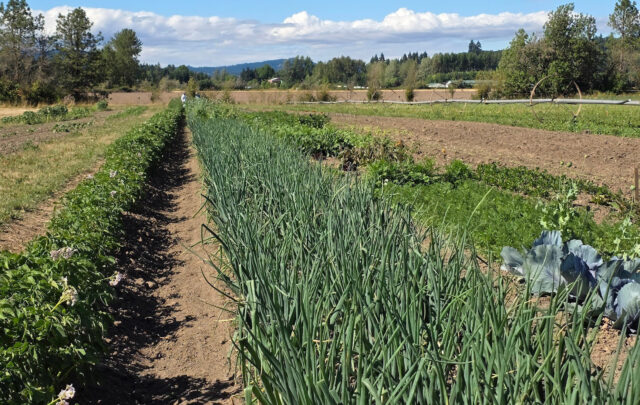
Returning to the main subject of this article: Will oil prices skyrocket? Will Trump continue to TACO? Will the economy crater? Or will the US and Iran reach a deal and open the Strait, so that normalcy can resume? Your guess is as good as anyone’s. But if you’re starting to have nagging worries, you’re not crazy and you’re not alone. Do something. Plant a vegetable garden. Talk to your neighbors about sharing tools and skills. Examine your oil dependency and see how you can reduce it. Imagine how your life might look if the economy were smaller, not bigger, and start making adjustments. Most of all, focus on building community with those around you.
Chokepoint: The New Urgency of Ending Our Fossil Fuel Addiction
Join Nate Hagens, Kumi Naidoo, and Gaya Herrington for an urgent conversation about the Strait of Hormuz closure, fossil fuel dependence, and possible paths through the new global energy crisis.





It can work if you have the policies to support it. Stock prices fall when supply outstrips demand. But thanks to a bundle of policies that make corporate stock buybacks not just legal but effectively subsidized, that creates a ready backup source of demand. And it used to be that rich people would have to sell stocks (and pay taxes on the gains) in order to turn it into spendable money, but thanks to liberal lending policies that treat stocks like gold-backed collateral, borrowing against stock is cheap, it preserves the stock value, it avoids the capital gains tax, and in many cases, even the interest is deductible. And so long as the stock value keeps going up, paying off the old loans can be done with new loans, and the base of wealth is preserved.
But are we damned if we replace it? We know how to take CO2 out of the air, and hydrogen out of water, and how to build hydrocarbon synfuels which would work as drop-in replacements for our current liquid fuels. At, say, 20% efficiency, burning one kilogram of uranium would produce enough energy to make over 100,000 gallons of gasoline, or diesel, and we'll never run out of uranium.
Some things are worse than others. Diesel trucks deliver over 90% of all food in the US. (I live rural, so I see it more clearly, although I know folks at the LA Central Produce Market.)
It's been pointed out that the Affluent/Elite are not a monolithic group – could that even work?
The best uranium ores are mostly mined. It's a finite resource, too – and fission creates hundreds of radioactive isotopes incompatible with life. It's also the path to make nuclear weapons, which may see "use" in the last scramble over the last oil fields.
Our oceans hold 4.5 billion tonnes of uranium. We know how to extract uranium from seawater at a cost of around $300 per kilogram. That isn't competitive with land mining yet, but even with no further improvements, that's plenty cheap enough. We are also developing reactors which will be able to extract about 200 times as much energy out of a kg of natural uranium. For each 100,000 gallons of fuel produced, the amount of fission products that would still be radioactive after ten years would be around 200 grams (7 ounces). We actually have uses for some of that, but even if we threw it all away, a single Deep Isolation borehole could hold all the fission products from producing enough gasoline and diesel to cover current U.S. consumption for a year, and those fission products would drop to natural rock radioactivity levels in around 300 years. Civilian nuclear plants have consumed the cores from 20,000 nuclear bombs, and new kinds of reactor would be even better for that. But yes, China is developing a reactor which could produce high-purity bomb fuel, and they definitely plan to export that reactor. We can't stop them, so our best hope to limit its spread is to develop safe reactors which can out-compete it.
Oh, it will, it will.
Indeed, is.
Fracking postponed energy rationing.
Damned if we drill (pollution).
Damned if we stop (concentrated energy powers everything).
Damned as it runs out (we're unprepared logistically or psychologically).
The world is falling back on the giant oil fields that remain, which are mostly concentrated in a very small part of the Middle East. Thus oil depletion was always going to drive a geopolitical fight over the last of the oil fields.
There seem to be two major petro state alliances forming up and they met on the battle field of the Strait of Hormuz. The first petro state alliance was the US and Saudi alliance + Gulf Arab States.
The other petro state alliance seems to be forming up between Iran and Russia. China appears to be backing that alliance with its massive industrial capacity.
I wish I could say the US and Europe were the good guys but US fossil fuel companies are famous for creating and supporting dictatorships abroad (and now at home).
Some former US allies were squeezed too hard and have tried to break free: Iran, Venezuela. Threats to end sovereignty in Canada or annex Alberta is forcing that nation down a similar path.
The problem for the US alliance is it is fighting a war that Iran prepared a long time to fight. Missile and drone technology makes it possible for Iran to block the Strait. That also gives it a way to break the Gulf Arab nations who have been trying to topple it for years now. Iraq is mostly Shia and took Kuwait once before. What would stop that happening again? The US who cannot get into the Strait? The Europeans who are scrambling to defend their eastern flank from Russia?
At this moment in time, technology, geography, and depletion have created an opportunity for Iran, Russia and China to ally together and gain control of the last of the giant oil fields. The last of the high EROI oil. That would be a huge win for that alliance. And it does not look like the US can do much to stop it. The Confederates who seized the US government have shattered it's past alliances. (This is part of The Changing World Order, most great powers have economic stagnation, growing inequality, then internal civil conflict, then they are too internally fractured to project force abroad in an effective manner. Structural Demographic Theory).
Once the Iran Russia China alliance have the Strait, who will be allowed access to the oil and oil products? Europe? Japan? Korea? Australia? Asia Pacific? What will they have to do to keep the oil flowing? Hand over intellectual property? Taiwan? Chip making? What will be the cost to get the oil they need?
Thus we can expect a lot more fighting over the other remaining oil that is not in the Middle East. Canada, Venezuela, Nigeria, Sudan, Libya, etc. And a lot of pressure to exploit whatever oil can be reached.
I also wonder if people with lots of money are propping the stock market up so their investments don't tank, to prevent a recession, to keep republicans in power, to keep AI stocks from plunging, to protect treasury bills, and project stability so people keep sending U.S. money. Egads, am I resorting to conspiracy thinking? Perhaps, but only because the denial of biophysical reality is so forehead smackingly obvious
Among ardent renewables enthusiasts I'm hearing quite a lot of loud cheering that Donald Trump has unwittingly done the world a huge favor in accelerating the shift away from oil as a result of his Iranian war adventure.
I do understand their headspace – being enthusiastic devotees of the renewables energy transition – but I think few pundits realize the extent to which modern society is so soaked in oil across every sector that the disruptive influence will be anything but clean and neat. For the past three decades or so the very binary supply-side power struggle is seen to be the only thing that matters.
I would like to think that this pivot point could take us all back to our earlier headspace – when many of us fostered Living-Better-With-Less and worried that Limits-to-Growth would eventually bring about a civilisational train wreck.
Alas, that thinking is not to be. At least for now. The green thrust is now far too alive with uplifting masculine thoughts of EV cars and miracle green technologies being churned by the millions as renewables celebrate a stunning victory over coal and oil.
For the time being there's not enough left over space to allocate to the core of the human predicament. So we are advised to be patient and let that stuff kick in in due course after the dust settles.
I do ask myself if that time may ever come about. And conclude that it won't.