

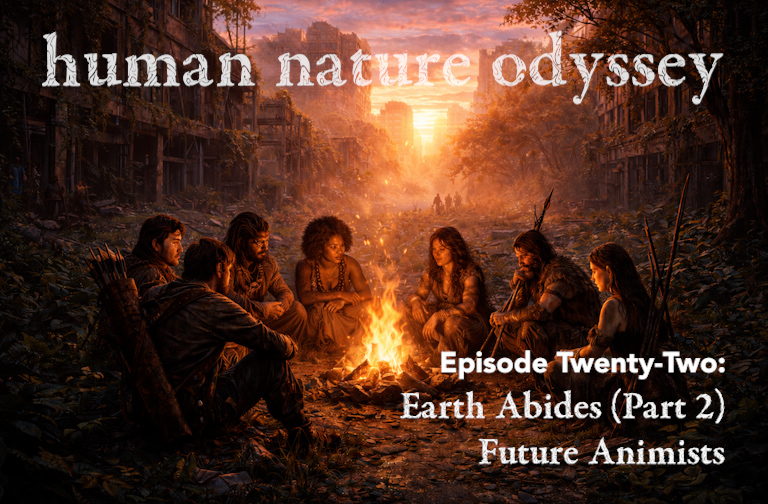
Show Notes
Okay, it’s been twenty-two years since the sudden collapse of civilization – why isn’t everything back up and running already? In the 1949 sci-fi novel Earth Abides, Isherwood Williams tries and tries to teach the next generation about law, economics, and geometry but these dang kids would rather explore the streams that flow over abandoned boulevards and overgrown shopping malls.
In Part 2 of this two-part series, Alex and astrophysicist Tom Murphy explore the unexpected evolution of life after the fall—when civilization fades into myth, and a new way of seeing the world begins to take root.
It’s been decades since airplanes filled the skies, since stadiums roared with crowds, since global supply chains stitched continents together.
The children born after the Great Disaster have never known that world. To them, skyscrapers wrapped in vines are normal. Mountain lions at the edge of the cul-de-sac are normal. The quiet is normal.
And as they grow up, they begin to tell different stories.
Stories not of dominance, progress, or control—but of relationship, mystery, and a living world they are part of, not apart from.
You don’t need to have read the book to enter this world—this episode is an experience in itself.
Citations
- Earth Abides [book] by George R. Stewart (1949)
- Tom Murphy’s Do The Math blog
If you’d like to support Human Nature Odyssey, please subscribe wherever you enjoy your podcasts, leave us a review, and visit humannatureodyssey.com.
Join us on Patreon and get exclusive access to audio extras, writings, and notes.
Theme Music is “Celestial Soda Pop” (Amazon, iTunes, Spotify) by Ray Lynch, from the album: Deep Breakfast. Courtesy Ray Lynch Productions © Ⓟ 1984/BMI. All rights reserved.
Transcript
It’s been 22 years since anyone has flown in an airplane. 22 years since crowds packed into football stadiums. 22 years since anybody’s had anything shipped to them from halfway around the world. 22 years since the sudden collapse of civilization.

These kids today have no idea what life was like back then. They’ve all grown up after the Great Disaster - when a horrific plague reduced earth’s population of humans down to a handful of survivors scattered across the world. These kids live in a different world. One where once-buried streams now flow over abandoned boulevards covered by a thin layer of grass. These kids have only known skyscrapers to be completely covered by vines and thickets. To them, the sight of a mountain lion on the edge of the overgrown cul-de-sac is completely normal. And one day, when these kids grow up, and become parents and grandparents themselves, they’ll tell their children new stories, for they will see the world with new eyes.

Welcome to Human Nature Odyssey. A podcast imagining unexpected futures that shift our sense of self, society, and our relationship to the natural world. I'm Alex Leff.

Astrophysicist, writer, and friend of the show Tom Murphy rejoins the podcast for Part 2 of our 2 part series on the sci-fi novel Earth Abides. Written in 1949 by George R. Stewart, Earth Abides details decades of the life of Isherwood Williams, nicknamed Ish, and the community of survivors and their children that have gathered on his childhood home of San Lupo Drive in what was once known as the San Francisco Bay Area.

Now 22 years have passed. The survivors have kids and call themselves the Tribe. It kinda started as a joke but the name stuck. Ish and the other six adults who lived through the Great Disaster are known to the kids as the Americans. But the kids don’t really know what America was. Which worries Ish. Everything worries Ish. Ish is a worrier. He desperately longs for the rebuilding of civilization. He even dreams he encounters the Governor of California and the United States government is restored - I mean, weren’t those the days? But no one listens to him. Ish has been trying his darndest to teach the next generation about law, economics, and geometry but these dang kids would rather go fishing or carve intricate designs into wood for fun. There’s not much distinction between work and play these days.

But Ish’s youngest son named Joey gets it. Joey likes reading, and wants to learn all the things Ish can teach him. Finally, Ish isn’t alone in his thirst for knowledge of the old ways. Ish puts all his hopes and dreams in Joey - even starts to think of him as the chosen one.

And then, one day, the water they’ve depended on from the old pipes that were built long ago during the time of civilization, stops running.

I’ll let Tom take it from here…

Tom Murphy (00:00.234)
And so as a result of this water shortage, Ish says, God damn it, we should have seen this coming. Like, why did we get caught off guard? This is an important thing to us. We should have known where our water is coming from and checked up on the reservoir every few months or whatever. And this is on us. We should really know more about what's out there. Are there other tribes that are potential threats?

He just throws out just a casual, almost throwaway comment about, should go on a trip to see, and they really latch onto that. So this is another point where he just sort of rolls with it because he's not the dictator. You know, he's part of a collective and, and he thought, it's anything's better than nothing. Okay. If they want to do this trip, okay, let's get behind that. Cause that's, you know, usually they just clap when I, when I go off on one of my speeches this time, they actually want to do something. So fine, let's do this. And they got.

a car ready to roll a Jeep and two of the young boys went off to do recon and try to repeat his trip. They couldn't make it as far as he did because the roads had deteriorated.

Alex Leff (01:06.158)
It's now been 20 plus years, so yeah.

Tom Murphy (01:08.802)
things were in bad shape, they did make it to Chicago, they found some weirdos along the way and some decent people along the way. And they came back with one troublesome fellow who created quite a bit of conflict in the group and forced them to reckon with some uncomfortable decisions that hadn't really faced them. I don't know that we should really fully go into that, but the main thing is that he brought a disease with him.

You know, so they had lived a very healthy life. mean, they didn't have, the common cold was gone for them because there were no carriers. They did have measles would surface, but they mostly would get through that. And they had, you know, just a few things, but they were very healthy. And so outsiders became extremely dangerous because they could have pathogens that they weren't used to. And so I'll stop there and let you pick up where you want to go because we could.

branch into that other troublesome character, I don't know that we need to.

Alex Leff (02:08.45)
I kind of feel you. didn't, I don't need to go into Charlie too much either. It's, it's, it's such an icky part of the book. Cause like Ish is really distrusting of him and like Ish is trying to be self-aware. Am I distrusting this guy for legitimate reasons or am I just like jealous that now like some other kind of person that the young people are looking up to comes in. yeah. And so Ish kind of feels gross by how much he hates this guy.

I felt gross reading about it. I remember when I was reading that as a 12 or 13 year old, I remember being like, I don't like this part of the book.

Tom Murphy (02:44.718)
But of course his friend Ezra, who is a really good reader of people, thought, you know, this guy might be okay or he might be rotten to the core and I don't trust him yet. So at least Ish had that reassurance that this well calibrated individual that he knew very well was also pretty suspicious. So it wasn't all made up in his head, but he did still worry that he might be making more of this than needed to be.

Alex Leff (03:08.888)
Totally. And then I guess what we're already talking about might as well say the adults decide not just the original seven survivors, but some of the young babies have grown up to be young people and they kind of have this council and they ultimately decide to kill him. Yeah. To kill Charlie. And it's the disturbing truth of like, there's no, you know, I think it's like Max Weber's a sociologist who talks about the state has a monopoly of violence, you know, that we only view violence that the state's committing is legitimate.

but anyone else committing violence is, know, unsanctioned murder or terrorist act. And so they are now coming to grips with just like, actually, we're just going to decide to kill him. And we have to tell ourselves that we came to the decision through a proper channels. And that's just how it goes. what kind of a gross.

Tom Murphy (03:59.203)
Yeah.

What's really kind of amazing about this is, and they struggle with this, is we are deciding to kill him for something he hasn't done yet, but we're pretty sure he will.

Alex Leff (04:12.142)
Spread the disease. or sleep with Eevee who has like a mental disability.

Tom Murphy (04:13.42)
Yeah

Tom Murphy (04:18.816)
Right. And just basically he's bad news and he's going to disrupt. He's going to be very disruptive. And so he really threatens everything that we've worked for here. And I think they were correct about that. He was a bad seed and he was going to bring all kinds of trouble. And so he is what we would call an agrandizer. And I've read some of Hayden's work. He's an archeologist who talks about the complex hunter gatherers.

Alex Leff (04:32.568)
Yeah.

Tom Murphy (04:46.678)
not the immediate return ones, but ones who had maybe food surpluses and had institutions of more hierarchy. And so there were these tendencies for aggrandizers. And, you know, one thing that aggrandizers in egalitarian hunter-gatherer societies are not tolerated. And so if somebody is showing those tendencies, narcissistic and kind of coercive, first attack it with humor and you try to like shame them in a sense into not being such a jerk.

Alex Leff (05:09.153)
If

Tom Murphy (05:15.638)
And if that doesn't work, you start to shun them. And if that doesn't work, you might banish them. And that's usually kind of a death sentence on its own because, you know, band level hunter-gatherers really need the whole group. They don't work as rugged individuals, but you might also just, you know, knock them off a cliff and you've got weapons all around, you know, so it's not hard to get rid of a problem. And so I think this is actually more who we are as humans to just judge a situation.

with your peers and say, yeah, this is no good. And if I take care of them, my peers have my back. they're not gonna, we're all in agreement that this is kind of a bad situation. And so, you know, one of the things that aggrandizers do, once they seize control, they make laws and one law is you can't kill people like me, the aggrandizer. So I think that's really kind of interesting that the laws are protecting the aggrandizers.

Alex Leff (06:11.629)
sh-

Tom Murphy (06:11.959)
Because I have to have done something first, you know, you can't just kick me out because you think I'm a jerk.

Alex Leff (06:17.518)
Oh man, ugh, this is gonna fuck me up. I'm gonna think about this for a long time. Because, yeah, how do I feel about that? Because it seems like the mentality of just like, I don't like and trust that guy, he seems like an asshole, let's kill him. And be like, yeah, yeah, yeah. It seems like that can be manipulated. I mean, as like a bullied kid in middle school, I'm just always a little afraid, I think, of like...

If the group just gets to pick, then it starts to feel like a Lord of the, I mean, Lord of the Flies is, you know, they pick on and kill the weakest.

Tom Murphy (06:52.792)
Yeah. But see, it works the opposite direction. And that's how it happened in Earth abides with Charlie. And it's how it happened in the fierce egalitarians. was the bullied knocking off the bully with no repercussions because you don't abide by some stricture, some written law. You're more fluid, more plastic, more case by case, not rigid elevating this

artifice, this fiction above your own lives. You're taking everything more seriously than that in a sense. And, and just judging the situation as best you can in community. mean, not as an individual, but you're consulting with your trusted fellows and there's nothing unnatural about preventing something that you see that could be very bad. mean, like a hunter gatherer.

will let a snake go if the snake is really posing no trouble. But if the snake is in camp and somebody might get bitten in the night, they'll kill it. We don't want to hear. And that's all fair game. That's fair play. So yeah, this does raise a lot of really big questions about law and order.

Alex Leff (08:14.87)
Yeah, we were almost going to skip this whole part. And you're talking about the different ramping up of ways to deal with this. First the mocking, then the shunning, then the banishment. Just the straight up murderers. Because yeah, if that just becomes the like, I don't like that guy, he insulted me, you want to kill him? If that's the first strategy, that just seems like... Not crazy about that. But okay, so we made it through that part. We did.

Tom Murphy (08:35.822)
That's not so great.

Tom Murphy (08:43.266)
I think we're good.

Alex Leff (08:44.374)
So they all get a terrible disease from Charlie. Yeah. Even after Charlie was killed.

Tom Murphy (08:49.944)
brought a lot of STDs by the way. mean, this was a nasty clown.

Alex Leff (08:55.214)
Yes. And it's very funny how the author writes about this, trying to be as polite as possible. It is, it's so funny to like have this book written in 1949. And so it kind of a pauses culture. It's surreal to read this like what 75 years later almost and hear how outdated everything is. It's like still the forties, even though hypothetically this stuff is happening in like what we would call the seventies even eventually.

If you do the math, think the book ends in like the nineties. Okay. Yeah. And that that's surreal to be like, huh. But obviously they're not keeping track of time that way. But, so they all get this terrible disease and it's during that, that Ish is like in this fever dream again, we're just seeing it from Ish's perspective. And I think it's really well written how he's going in and out of consciousness during this time. And he finds out the saddest of all, Joey.

His beloved son, the chosen one, the one that was going to help restore civilization died of this disease. And this is a huge turning point for Ish. Up until that point, the civilization mania he had from the time of his first child being born to 22 years later until Joey's death, he has just been like, I am going to, through sheer willpower, whip these kids in the shape, get them to appreciate civilization. And we're going to get things back in business.

After Joey, he sees all the kids gathered in his living room waiting for the next class without any regret. says, school dismissed forever. And the kids are like, what? And he's like, yeah, we're never doing school again. And you wonder, you know, it's a great part of the hero's journey where you think like, know, issues defeated, but he has this epiphany. He's going to let everything go. Page two 95, it says, yes, the future was certain.

The tribe was not going to restore civilization. The tribe didn't want not want civilization. Right. Yeah, sorry. didn't want civilization. Yeah, yeah. Hey, you've read this book.

Tom Murphy (10:53.388)
right. I even remembered that. That was very memorable. The tribe doesn't want civilization. They've spoken, you know.

Alex Leff (11:00.387)
Yeah.

Yeah. And so then Ish has this idea and the book kind of does a good job of keeping it a secret as he's like working on it. He goes to this tree, he gets the materials, he gets the kids together and he shows them.

Tom Murphy (11:14.924)
He doesn't even get them together. He just starts whittling and working on this thing and lets people say, Hey, what are you working on?

Alex Leff (11:21.068)
Yeah, yeah, you're so right. you're so right. Okay, so then how does forgetting the details of like how he presents this new idea?

Tom Murphy (11:26.254)
Yeah, so he's working on a bow and arrow basically. And he uses all materials that aren't scavenged from the remnants of modernity. He uses, you know, a lemon tree branch, which is very flexible and strong. And he uses some cow hide to make the straps for the string and he braids them together and notches it out and he makes an arrow out of some pine and notches that and it's able to shoot. And so the kids are just kind of watching like, whoa.

That's And so he shoots more and shoots more. And finally, he knows that one of them is going to say, I want to try. It's not heavy handed. He just lets their natural curiosity play. And then they're off to the races making their own. They want to make their own and they learn all the skills, how to make their own. And it becomes this friendly cooperative competition. And this is how a lot of hunter gatherers work. They engage in something that looks like play, but they're learning a hell of a lot and from each other.

and from the mistakes. And at one point he says, you know what, if you put a little quail feather on the back, you'll get a straighter flight. And now that's a big thing. And for years, this is just a seasonal play thing. They associate with this time of year. This time of year we make bows and we have fun.

Alex Leff (12:40.888)
You're right that it's not just the idea of the bow and arrow, but how he's going to present this information. so even when they lose interest, is trusting that it's going to come back to them. that I know that maybe for some generations, they're going to just view this as like a fun, trivial game. But hypothetically, my great grandson, who spoiler alert, he ends up meeting, might be taking this bow and arrow very seriously. This is how he describes it on page 302.

A lot of the language is from the perspective of someone who grew up in the 30s and 40s and is like viewing civilization in a very traditional way. So this is how Ish describes it. During 20 years, during 100 years, if need were, the bow might remain a children's plaything. In the end, after the ammunition failed, it would still be there. It was the greatest weapon that primitive man had ever known and the most difficult to invent. If he had saved that for the future he had saved much,

After the rifles were useless, his great grandchildren would not have to meet the bear's rush empty handed or starve in the midst of the cattle herds. His great grandchildren would never know civilization, but at least they would not be groveling half apes, but would walk erect as freemen bow and hand. Here he was trying to like figure out how he could teach them about geometry and get them to start producing electricity again and like get the lights back on. now he's just like, at least they won't be groveling half apes.

They'll just have a bow and arrow and like for him that's like, right? His life accomplishment, which is pretty remarkable trajectory.

Tom Murphy (14:17.228)
Right. And it's not long after that, that the book takes a different pace and he sort of enters the period of senescence. You know, so he's kind of coming and going, he's sitting on the chair speaking with Ezra and sometimes he. Right. Yeah. Decades pass and he's not sure if this is the next day or another summer day of the year after. And I actually really appreciated that.

Alex Leff (14:30.668)
Decades pass.

Tom Murphy (14:41.78)
view into what seems like a realistic sense of how you have your lucid moments, but then a lot of things are a blur. think it might capture what that feels like. yeah. And so he finds this guy standing in front of him who says he's Jack and he knows that it's not Jack because Jack is his son, but he eventually realizes this must be his great grandson.

And this Jack is standing there and he has, you know, bow and arrow and it's just like, let me look at that. You know, looks at the craftsmanship. It's really great. The arrows are really well-made. And he said, what, what about rifles? the kids play with them, but you know, when you're really hunting, you don't want to misfire and they misfire a lot. And so we're not fooling around. These are the ones that you can depend on a hundred percent. So it's really fascinating to see how they kind of.

naturally sloughed off as they stopped being reliable. Some of these old trappings and embraced what used to be a play toy as a reliable, improvable tool that required skill to make and to use. But again, that skill comes through play and it just, felt very real. It felt like, yeah, that's how, that's how it would go.

Alex Leff (15:55.818)
Yeah, I found that conversation between Ish and his great grandson Jack really, I just want to like paint everyone the scene of he's on San Lupo Drive. This is the same house he's lived in since he was a kid during the old times before the great disaster. now like everything has changed. know, buildings have collapsed and bushes that have grown on the rubble and streams have

returned to the tops of the streets. And he's like this old man and the activity and the community and the decisions have moved away from him. And he's like thinking hard, but it's hard to think. And he's confused about time passing and, and this young man who's wearing jeans on his bottom half, then a lion on top, this like post-apocalyptic hunter gatherer man, who's this very friendly, long haired guy is talking to him and.

Tom Murphy (16:36.654)
or something, yeah.

Alex Leff (16:47.34)
Ish is always looking out at the Golden Gate Bridge, which is still there. know, so in my head, I just like really love this scene and what this must look like. And I know for a fact that you also highlighted this. There's no way you didn't also highlight this. Ish asks his great grandson, Jack, are you happy? And his response is so profound. Yeah. What does he say?

Tom Murphy (17:05.282)
Yes. It's right here.

Tom Murphy (17:12.578)
Yes, I'm happy. Things are as they are and I am part of them. And boy, if that's not an animistic kind of acceptance, I don't know what is.

Alex Leff (17:24.354)
issues reflecting on that in the quote on 333 is, though the language itself had not changed more than a little, there were ideas and differences that had gone out of people's thoughts. No longer, perhaps, did they make that sharp distinction between pleasure and sorrow. This concept of are you happy is kind of irrelevant to Jackie. He notices that there is a lot of laughter and happiness. He talks about how gaiety has not left the world. One of the young men who's sharpening his knife or something is like whistling.

Jingle bells. And, and, and, but he doesn't know what the words are.

Tom Murphy (17:59.31)
Just calls to mind memories of snow and bells and.

Alex Leff (18:03.564)
You know, it's just like, was that song? Yeah. Right. So he recognizes like, people are joyful, but the question of, you happy? Jack just answers, yes, I'm happy. Things are as they are and I am part of them. Yeah.

Tom Murphy (18:16.428)
and happy to be a part of them. And yeah, yeah, that was, I think, very profound. And later there's a fire that sweeps through. so they have to evacuate. And so Jack, his great-grandson, and two others are pulling him out. And they have a funny language. They say, as you yourself-ish well know, Ish is kind of confused about things. And they're like, he can't actually be confused about this simple thing. So he's just.

Alex Leff (18:37.09)
They keep saying that to him.

Tom Murphy (18:45.71)
playing with us and as you yourself well know, they're evacuating and with these three young guys, this is on page 330, he says, then at last Ish looked at the faces of the young men and he saw that they were different from the faces of the men long ago. These faces were young, but they were also calm and they seem to have on them few lines of strain and worry and fear. And so here's this disaster and they're just taken in stride.

and they're still laughing and they're still kind of whistling and this is just what's going on. They're confident of their world and how they can work within it.

Alex Leff (19:23.534)
Yeah. And it's a key moment. goes to show just how drastically the tribes mindset has shifted because the initial survivors that all lived at San Lupo Drive, know, George and Marine had their TV still, even though it didn't work. Like George kept the white picket fence. He kept painting the fence white, which is so funny. Ish lived in his childhood home that he always lived in and they never thought to leave it. But now that whole neighborhood burns down in a fire and the tribe seems

To be unconcerned, they are going to move to some new lakes. And there's precedents for this. I was reading this about a tribe who experienced some kind of house fell down or like a tree fell on it. And they all kind of laughed. The anthropologist that was with them recorded how they just like laughed and like, all right, we'll build another one.

Tom Murphy (20:08.622)
That was in this book, Don't Sleep There Snakes by Daniel Ebert.

Alex Leff (20:12.566)
And so yet when the fire burns down the old homes of San Lupo Drive, that's when the tribe really becomes nomadic. And they're just not that concerned because the most important thing isn't the stability and the sedentary lifestyle. It's just, well, we still have the community. It really recontextualizes the severity of natural disasters. And not only that, but you can imagine how people living with that kind of mentality, that nomadic mentality views.

their relationship to the natural world so differently. like, if there's a fire, you're not like, why has God forsaken us? You're just saying, yeah, okay, well, time to move on. Thank God that there's so many great spots for us to inhabit.

Tom Murphy (20:54.678)
It's a world of abundance. It's a world of provision. And I think that's a lot like the pietahan that Daniel Ebert lived with, that they had such calmness because they knew that anything that came their way, they had the tools to handle. And so why be worked up about it? We'll just deal with things as they come. And we've always done that and we're always fine. So there's a lot of kind of wisdom in there. I did want to point out that on their track, as they're doing this flight from the fire,

Alex Leff (21:24.204)
Ish and the young man.

Tom Murphy (21:25.078)
and the young men, they run into a mountain lion who's kind of growling at them, right? And it's on the street and they decide, you know, that they have their bows ready and they sort of have a standoff for a few seconds. And then one of them says, he's not going to attack. They know the animals, they know the mentality. They'd say this one, this is okay. Let's just sort of melt back and go around and take a different path. And Ish was really taken by this that

They weren't at war with this mountain lion. And there's this paragraph. Okay. Yet certainly he could not help thinking that the men had lost that old dominance and the arrogance with which they had once viewed the animals and were now acting more or less as equals with them. He felt that this was too bad. And yet the young men were going along just as unconcerned as ever cracking their little jokes and not feeling that they had been at all humiliated by having to detour the lion.

Alex Leff (21:59.276)
I highlighted this too.

Tom Murphy (22:23.776)
any more than if they had to detour around a fallen tree trunk or a ruined building.

Alex Leff (22:30.19)
Yeah. Such a different mindset. And not because Ish had to teach it to them. Right. In fact, despite everything he tried to teach them.

Tom Murphy (22:40.578)
Yeah, he was kind of shocked by that attitude that, you I did feel that that captured the mentality of our ancestors pretty well.

Alex Leff (22:51.808)
Yeah, which is interesting. You know, I have this ongoing conversation with my friend, Jesse, about she always is very generous and humors me in letting me talk about all these things I'm interested in. As you yourself well know, sometimes you know not to bother some friends with it too much, but talking about the different mindset we're going to have to evolve to that Daniel Quinn talks about.

If there are people alive 200 years from now, we know they're going to be living a different way because if they don't live a different way, there's not going be people alive 200 years from now. so imagining that in order to survive, we're going to have to re-adopt an animist perspective. And Jesse asks, and I think it's a good point. It's like, well, how could they have a different perspective? Like, won't they, they'll come from us. They're going to just keep adopting what we give them. And I think this book shows how it's not that, and you know,

Who knows? I don't know. But what the book is positing, which seems convincing to me, that animism is not like a philosophy that has to be taught. It's kind of like the factory reset of how humans, any animal would engage with the natural world if there's not all these artifices placed on it. So Earth Abides is kind of exploring how like, if people have to just become hunter-gatherers again, it's not just a

Lifestyle, it's not just a way to survive. It's not like that hunter gatherers are just like, man, this sucks. I can't wait to build civilization again. It's that to be a hunter gatherer comes with a mentality of philosophy that is much more in tune with respecting life and viewing animals as equals and all of that.

Tom Murphy (24:32.866)
Yeah, and you know, young kids naturally think of their stuffed animals as alive. They think of their cat as having, you know, personhood. And we have to basically tell them in our culture, no, they're not persons. They're not people. But I think, yeah, humans naturally kind of project that onto everything around them. And yeah, I don't think you have to teach that. That just comes out.

We have to teach them not to do that. And the naturalness of this is sort of highlighted, I think, by a quote that George Stewart, I can never remember the name of the author. I don't know why, but.

Alex Leff (25:15.918)
Same. George R. Stewart is just the most generic name.

Tom Murphy (25:20.966)
Right. So I had to look at the front to even see, but he includes this quote on page 147 just says, you know, one of these kind of intro to a section bits. And it's a quote from a name that's almost as long as the quote J Hector St. John Crivicure or something like that. And he says, there must be in their social bond. He's talking about native Americans in their social bond, something singularly captivating and far superior to anything.

to be boasted of among us. For thousands of Europeans are Indians and we have no examples of even one of those Aborigines having from choice become Europeans. And I found the source that has that quote and I need to read more of it. It's a long letter about just how natural in a sense that this life is. as soon as an Indian child who had been raised,

with lot of privilege and riches and given everything they wanted, kind of at the first opportunity, if they found a way to be with their people, they would, and they would sleep on the ground and be very happy. And so it perplexed the Europeans. As you say, it's not like, curses, this life is really tough and I really hate that I have to live this way. Because if that were true, Europeans would have been like a life raft and

the Native Americans would have been like drowning rats saying, thank God, finally we have, you know, reliable food. Finally, we have security. Finally, we have Nintendo or, you know, they just, they didn't do that. And that tells you a hell of a lot. And I think this book helps illustrate that transition. And you were talking about how

early on, it's all very pro-civilization. And so as you're reading it, you're very proud. is very proud that the lights stay on, that we've done such a bang up job. This is wonderful. And the author, think, knows that the readership is sort of of that mentality to themselves. And so it's a very easy sort of entry. And over the course of the book, you start to see things differently because you're experiencing the things that Ish experiences.

Tom Murphy (27:35.634)
And understanding how he can change his mind and how he can come around to the point where in the end he realizes that he doesn't really wish the cycle to repeat.

Alex Leff (27:45.13)
Mm-hmm. I've quoted that. it's 344. 344. did not even desire that the cycle should be repeated. He suddenly thought of all that had gone to build civilization of slavery and conquest and war and oppression. And this is like a huge deal that Isherwood Williams would have such a thought. He's the last person you would ever expect. mean, this is like civilization's number one cheerleader. When Ish is proud of civilization.

Tom Murphy (28:04.782)
Yeah.

Alex Leff (28:12.786)
you, the reader, are proud of civilization. It's not ironic pride. It is things to be proud of. You know, sometimes online there's these conversations about, you anti-civ or pro-civ? And I always feel like that's just like, it doesn't have to be so binary. I don't even feel like I'm like anti-civilization. Obviously it's the thing that's happened. I've benefited from it. I've never existed outside of it. But just the fact that, know, Ish kind of lets go of it needing to exist.

And then he realizes, because he sees how happy the guys are and that life continues, you he makes peace. He realizes that everyone that died from that virus at this point would be dead anyway. What it's like to really experience old age on the cusp of death and just all these tragedies that happened, making peace with them and realizing like, you know, it went the way it went. I found that very interesting.

Tom Murphy (29:08.876)
Yeah. And it, sort of feels to me a lot like how I used to view teaching, which is that if a student is starting, you know, at one place and you want to get them to the other place, you don't hit them with a bat. I think of them like an egg. have to gently and in a slingshot, used to with friends in college use a three man slingshot and eggs was, were really good projectile. we were a bit miscreant, but,

But anyway, you you want to get this egg going really fast. You can't do it with a bat. You've got to do it by finding them where they are, gently accelerating them to some hopefully great speed. And I feel like George Stewart really does that in this book by finding the audience, cheerleaders for civilization, and then slowly eroding that pride and.

arriving in a different place. think it's a powerful journey that he allows the reader to go on.

Alex Leff (30:14.156)
Yeah, totally. And the journey kind of comes full circle. Ish is, you know, going with the young men and he is having these acceptances of where his life has gone and that the tribe doesn't want civilization. Ironically, when he looks around, he realizes, this is the campus. This is the university campus. This is where I could have been a professor my whole life if things hadn't changed. And what a beautiful...

for him to have these realizations. He realizes that the library is still there. All the books are probably still intact, but like who's going to be there to read them? That used to be like, you know, his religious monument. And ultimately he's like, you know what? It's okay. It's okay if they don't read those books. They're doing all right.

Tom Murphy (31:02.168)
Yeah. And even starts to realize that a lot of the books are kind of crap anyway. You know, he talks about how a lot of them are.

Alex Leff (31:10.472)
Harry Potter was written so keep that in mind. Right.

Tom Murphy (31:14.53)
He started to really question the value, the inherent value, intrinsic value in those books as well. So I think that was an interesting turn for him because before he just worshiped basically anything that was in the library.

Alex Leff (31:30.816)
And so as Ish is dying, he realizes they do kind of treat him like a god, but the young men get really angry at him and they're pinching him, but he can't hear them. He realizes he may have had a seizure or something. And they're like gesturing and he doesn't know, but he realizes that they still have the hammer. You know, this is this like religious symbol for their tribe essentially. And he doesn't even quite understand what meaning it is for them. He realizes they're asking him, which of us should get the hammer?

So he gestures to Jack, his great-grandson, Jack's like very solemnly like, wow. And then Ish dies on the bridge. The Bay Bridge. From San Francisco to Oakland.

Tom Murphy (32:12.554)
on a monument to civilization, you know?

Alex Leff (32:15.394)
yeah, there's a great line about, now that he would soon be dead, he felt himself more a companion of the bridge than of the men. It too had been part of civilization. And he kind of has this like psychedelic coming to terms with the earth, looking at the hills, seeing that hills is breasts, reminding him of his wife's breasts or his mother's breasts. But he's also like, embarrassed to have such a.

silly thought he's like no I have to be intellectual this way and but like he's like well it's comforting and like I'm gonna go back home I'm going into the hills and the last paragraph then though his sight was now very dim he looked again at the young men they will commit me to the earth he thought yet I also commit them to the earth there is nothing else by which men live men come and go but earth abides

Tom Murphy (33:10.922)
The abides. Yeah, very true. And a good perspective and a good recognition of our place as part of, not masters of. And we fooled ourselves for centuries and millennia that we're in charge. And I think we're gonna learn the hard way that's not true.

And for some, won't be a hard way. I mean, that's what this book kind of says is that these survivors are fine. They're happy. They're laughing. They're singing. They're whistling. They're joking.

Alex Leff (33:50.734)
Well, descendants of the survivors.

Tom Murphy (33:52.79)
Yeah, the descendants, right. That's right. They get on with life and accept it for what it is. And it's not misery. It's a privilege to be alive and to have experiences. And you can't take that away from, from anybody or any living being. So I don't look out at the squirrel and think, what a miserable sod because they live outside and have to deal with rain. They're busy and they're collecting nuts and they're remembering where they're putting things and

You know, they have to be alert because they don't want a hawk to come get them or an owl. But they've got it basically figured out and the chickadees that come around, I mean, you can't watch them and think that they're miserable. I mean, they just seem very, very happy. And I just feel like that's, they're happy because they are alive and they're doing what they know how to do. And they're in a land of abundance that takes care of them. And they've got it all figured out and what's to worry about. So they're more like the.

the descendants and not as much like Ish the warrior. Yes.

Alex Leff (34:56.366)
Yes, I am happy. Things are as they are and I am part of them.

Tom Murphy (35:01.826)
a very good mantra for living. Well, I think we got to the end of the book.

Alex Leff (35:10.35)
Yeah. I mean, it's funny cause like you were bringing up this book to me in the context of a conversation we were having about what's a vision for the future that we would view as positive. You know, we both kind of have this, we're going to have to live off the land. It's going to maybe resemble more of a hunter gatherer past. It's not something that you and I are going to live and see. It's one thing to have that vision, but how we.

get to that, I find myself the-ish, the worrier. This is a destination we have to get to, we're going to get to, whether we want to or not, or, you know, we could just completely scorch the entire Earth and there's no life left at all. But if we don't do that, we're going to have to get to this place. It seems like, you know, a virus is like the easiest scenario you can imagine of just like, we'll just snap our fingers, people are gone, and now here they are. And maybe that'll happen.

Tom Murphy (36:00.942)
you

Alex Leff (36:08.814)
Maybe it'll be nuclear war. Maybe it'll be other horrific things. mean, like, the descendants, that's why I was distinguishing between the survivors and the descendants. The descendants are happy. The survivors, especially the ones who Ish first finds when he's walking around are like unimaginably traumatized. And I just really would love for us to avoid any more trauma.

Then, you know, we're already experiencing, obviously, many people are living their lives around the world as if the world is ending and it is for them. And I want a book that helps us imagine what those steps could be to transition us intentionally towards that. But I don't know if it's even possible.

Tom Murphy (36:53.826)
Yeah, and I think this book definitely helps. mean, it's not a template. It's not how things are going to go. One thing I really don't like about almost any post-apocalyptic story is that the apocalypse itself is just almost instant and devastating. And the real story is going to be boring and slow and multifaceted and messy. And so it doesn't really work there. But one thing

I think about when asking these big questions is we get hung up on trying to figure out how this is all going to work out for everybody. As if we're one big monolithic ship and we're really just not. And so we can make our lives a lot easier if we don't put that burden on us to think about how, for instance, 8 billion people sort this out.

And I've got a post on Do The Math that's coming out in a week. About eight billion people will die because eight billion people will die. All eight billion people on the planet today, you realize, are not going to live forever. Nobody's immortal. Everybody dies. And so the question is, what is the manner of that dying and what's the manner of the replacement or the people coming in? And so there's a lot of freedom within that. We don't have to figure out how to get the eight billion people currently on the planet.

to live in an ecologically sustainable way, because we're not going to. That's just way too big and it's not going to happen. So if we allow ourselves time scales that go for many generations, then the real point is that those new generations will figure things out. They will discard a lot of antiquated ideas that just aren't working for them, that have no place anymore. They're dying out.

that world has changed and they're going to leave it behind. And I think this book really helps me see that the kids will be okay, that we'll adapt to the circumstances and it's not going to be the same story everywhere. Each place will have its own unique set of challenges and advantages and the people there will learn to deal with those challenges and learn to take advantage of what's available or not.

Tom Murphy (39:12.972)
We don't have to think that we have to save humanity as a monolithic group of 8 billion people. And that releases a lot of the pressure.

Alex Leff (39:25.996)
Yeah. It's like, I, here I am like Ish thinking like, how am going to save the existence of domesticated crops? Maybe it's not for me to do. I wanted to share one part of the book that I really love page 331. It's in another italicized section. That's where we get to hear some kind of narration that's beyond what Ish is aware of. A description of other communities elsewhere in the world. And it kind of is subtly referencing some of the communities that they meet on the

car ride, expedition. I don't want to just read the whole thing, because it's just so much fun. mean, this is like the kind of like imaginative creative stuff that makes the book really fun to read. Again, in that day, each little tribe will live by itself and to itself and go in its own way. And their differences will soon be more than they were even in the first days of man, according to the accidents of survival and of place. Here.

Tom Murphy (39:57.666)
Yeah, I like this section.

Alex Leff (40:23.426)
They live always in awe of the other world and scarcely dare make water without a prayer. They have skill with boats among tidal channels. To eat, they catch fish and dig clams and gather seeds of wild grasses. Here they are darker skinned and talk another language and worship a dark skinned mother and child. They keep horses and turkeys and grow corn in the field by the river. They catch rabbits and snares but have no bows.

Here they are darker still. They speak English, but say no Rs and their speech is thick. They keep pigs and chickens and raise corn. Also they raise cotton, but make no use of it, except to offer it a little to their God, knowing it from of old to be a thing of power. Their God has the form of an alligator and they call him Old Satan. Here they shoot with the bow, now this is talking about Issh's track, skillfully, and their hunting dogs are trained to give tongue.

They love assembly and debate. Their women folk walk proudly. The symbol of their God is a hammer, but they pay him no great reverence. Many others there are too, each differing. In the distant years after these first years, the tribes will grow more numerous and come together and cross fertilize in body and in mind. Then doubtless, blindly and of no one's planning will come new civilizations and new wars. I didn't want to read that last part. That last part's a little bit of a bummer.

Tom Murphy (41:49.592)
Well, and I'm not so sure it's true because it's biophysically not likely that when we plunder the non-renewable resources that regenerate over, you know, hundred million year time scales, that this is actually a repetition. don't think humans are still a species or even a genus by the time we get back to that. So yeah, I'm not, I'm not a fan of the rinse and repeat idea. don't, I don't think that's realistic.

Alex Leff (42:12.558)
You're right, because we can't, we're not going be able to do the whole oil thing again.

Tom Murphy (42:16.834)
Right, for sure. But even, even copper, you know, we've picked the low-hanging fruit. You have to go really deep now. It's not on the surface and you have to have a lot of power and energy and fossil fuels to even do that. So it's all going to be scavenging. There's still going to be plenty of metal that we've pulled up, but it's going to corrode and you know, there's only going to be so much. So I don't think it's a rinse and repeat.

Alex Leff (42:38.178)
This is the most hopeful thing I've ever heard in my life.

Tom Murphy (42:40.514)
Yeah, yeah. No, this is a one-time shot in my mind. Daniel Quinn talks about there's no one right way to live. And I think that's a really important message. And to each his own, to each ecology, to each environment, different things will make sense. And a raven in Arizona lives a lot differently than a raven in Alaska. And they have a culture. They teach each other how to live the life there, where to find food. And if you transported

a raven acculturated to Arizona into Alaska without giving them that cultural access, they'd probably die. That's culture. So ravens have culture. They pass down that knowledge. Each place has its own set of practices that make sense. And the diversity of the world itself automatically lends to a diversity of ways to live. Whereas modernity has kind of done a monoculture

Alex Leff (43:18.434)
Huh, wow.

Tom Murphy (43:40.854)
We're all going to live this one quote right way, which is turning out to be quite wrong. And so we're used to that. We conflate humans with modernity, but really among our ancestors, it was incredibly diverse. Cultural diversity was enormous. And that comes about because places are different and what works one place doesn't work another place. So yeah, I think that's the way of it. And that's why I think it's not one monolithic eight billion people are going to

adapt in a certain way, now you just have to take the constraints off, dissolve the bars to the cage, and then see what the escapees do in different places. And it's going to be a million different stories. And I think that's fantastic. We don't need to script those stories. We can't. We don't have the imagination to do that.

Alex Leff (44:32.054)
No, it is comforting to think that we've selfishly taken all of the cheat codes the earth had to offer us. So we can't live like addicts to power in the future. It'd be really interesting. wonder what I've never dug into like George R. Stewart interviews. I would love to hear if someone talked to them about Earth Abides. I don't know what the reception was at the time.

Tom Murphy (44:58.362)
I'll bet it didn't make a lot of sense at the time. think we're better prepared now to understand modernity as potentially dangerous to ourselves.

Alex Leff (45:10.286)
Well, don't you think that 1949 started the Cold War? They're thinking about the end of civilization through nuclear apocalypse. imagine that's on the front of some people's minds, but I think like that is probably the end a lot of people have. But I think the way the book goes at the end, the fact that the end of civilization is not something necessarily to lament, but actually maybe celebrate. imagine that part was harder for the average reader to maybe even

recognize. I wonder if the average person was reading it and thinking like, that's kind of sad that this old man gave up on that.

Tom Murphy (45:47.32)
Right, and if only Joey had lived, it would have been different or whatever hopes that they might pin to it. But you know, this is well before it was recognized that we're creating a sixth mass extinction. And a lot of people haven't really recognized this, that modernity isn't really a choice. We can't just decide to continue it indefinitely. It it fails by its own success. I mean, maybe 10 % of people now could go along with that or more, hopefully more.

Alex Leff (46:13.132)
I was gonna say west.

Tom Murphy (46:14.382)
But at the time, in 1949, I think it was much smaller.

Alex Leff (46:18.232)
Yeah. Yeah. Yeah.

It’s interesting to wonder how much our minds have changed since Earth Abides came out in 1949. On one hand we seem to cling to the promise of civilization as much as ever. Yet how many more of us today are aware of the fragility of our global system, aware of our interconnection with the rest of life, and question some of our core cultural narratives that the world belongs to us, rather than we belong to the world.

The end of civilization won’t be the end. The end of one chapter is the start of another and lines between both are blurred. Maybe a new story has already begun, and a world beyond civilization already is beginning to poke through the soil, even while the storm rages all around us. Who knows? We’re just one piece in a puzzle that spans generations we’ll never meet. But we are the future’s ancestors. And maybe our great-grandchildren will know a different kind of happiness. Yes I am happy, things are as they are, and I am part of them.





Comments
We changed commenting systems on September 10, 2026 as part of a site-wide functionality and security upgrade. Your past comments have not disappeared, and you can still log in with your old Disqus account credentials if you wish. Contact us with any questions.
"If there are people alive 200 years from now, we know they're going to be living a different way because if they don't live a different way, there's not going be people alive 200 years from now." summarizes the wisdom of this conversation informing my engagement with others as I watch modernity collapse. I'm 75 so I probably won't see a lot, but things can change PDQ. Exciting! Thanks very much…