

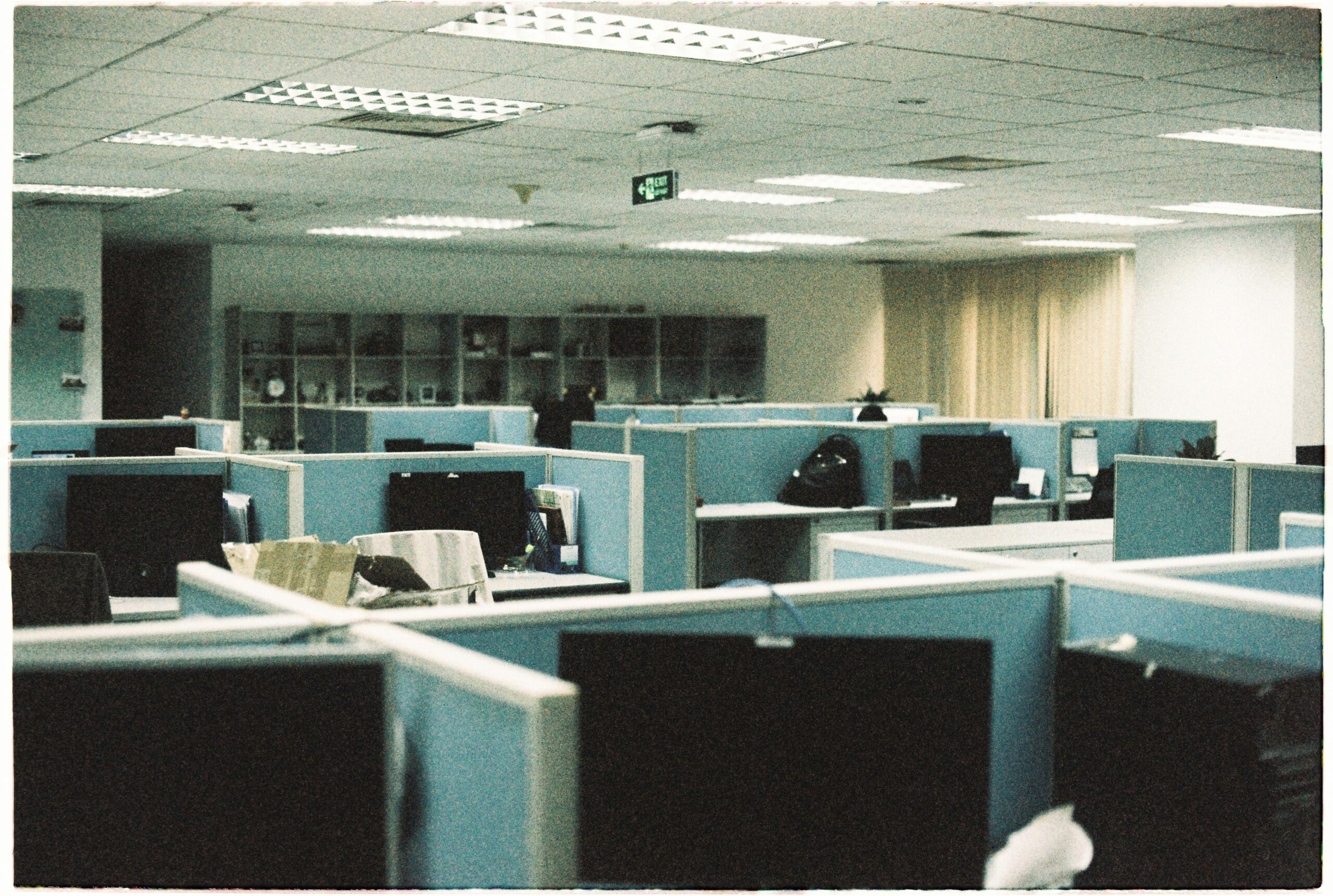
There is a particular scent to modern productivity. It isn’t the smell of fresh ink or the aroma of fair-trade office coffee. It is the pungent cocktail of nitrogen oxides, fine particulate matter and the invisible scent of rubber eroding from tires—it is the smell of the 8:00 a.m. gridlock.
Statistically, office workers spend dozens of hours every month staring at the bumper of the car in front of them, breathing in the very fumes that shorten their lives and turn our cities into grey, unliveable heat islands. We call this ‘the commute.’ In reality, it is a staggering theft of human life — a ritual sacrifice of time offered at the altar of ‘being present.’
And for what? Simply because we were told we have to be there.
The great vanishing act
Do you remember 2020? Amidst the tragedy of the pandemic, a strange, silent miracle occurred. The unending rivers of steel in our streets simply vanished. The 8:00 a.m. traffic jam dissolved into thin air. Puff. Gone. The world didn’t stop spinning; instead, the birds sang a little louder, and for the first time in decades, the horizon over our cities didn’t look like a smudged charcoal drawing. We realized, collectively and somewhat bashfully, that the world could function quite differently.
Fast forward six years. We are currently juggling a permanent rotation of global crises. And yet, corporate leaders are increasingly demanding a return to office. The logic? A superstitious belief that quarterly earnings can be saved by physical proximity. “It worked better in the old days,” they sigh, looking at spreadsheets with the nostalgia of someone yearning for the era of the telegram.
They are attempting to control the only thing they still can: their employees’ physical location. It’s easier to police a desk than to admit that global market volatility is driven by geopolitical actors who can upend the economy with a single post on social media. The market isn’t soft because you’re working from your kitchen table; it’s soft because the world is on fire. But it’s much simpler to blame the person in sweatpants.
The win-win-win (that we keep losing)
The case for a legal right to work from home for desk-based professions is so overwhelming that it’s almost embarrassing.
For the employee, it is a liberation of time. It’s the ability to balance care work without the frantic sprint between the office and the daycare center. It is a lifeline for those with chronic illnesses —those for whom a flare-up of Crohn’s or Colitis, for example, makes a commute a gauntlet of anxiety. It is a sanctuary for neurodivergent individuals, particularly those with autism, for whom the sensory assault of an open-plan office is nothing short of hell on earth.
We talk incessantly about the skills shortage, yet we categorically exclude brilliant minds with limited mobility or health challenges by insisting they must occupy a specific chair in a specific zip code. The labor shortage is a lie as long as we maintain these physical barriers to entry.
For the company, the benefits are equally stark: rested, motivated employees who haven’t spent their morning fighting for a parking spot or dodging road rage. Not to mention the overhead. The less office space you rent, the more you save. It is the ultimate corporate efficiency, yet it is being rejected in favor of supervision.
And for the planet? Reducing carbon emissions by eliminating millions of unnecessary car journeys is the lowest-hanging fruit in our climate strategy.
The ‘nightingale’ fallacy and other outcries
Whenever the right to remote work is proposed, a predictable outcry follows: “But what about the nurses?” the critics shout. It is fascinating how, suddenly, everyone becomes deeply concerned about hospital staff — the very same staff they are happy to underpay and drown in bureaucracy and overtime the rest of the year.
The comparison is, frankly, ridiculous. Of course, a surgeon cannot operate from their living room. But here is a counter-question: Why do we want to force these essential workers to sit in even more traffic caused by millions of office workers who don’t need to be on the road? Freeing the streets for those who must travel is a service to them, not an insult.
Then there is the control argument. We’ve all seen the tabloid stories about someone caught at the hairdresser’s while on the clock at home. Meanwhile, the same critics ignore the people in the office who spend half their day in the smoking area, or at the coffee machine, or perfecting the art of looking busy while browsing the news. Perhaps it’s time we introduced actual job descriptions and defined goals. Let’s judge people by their output, not by the amount of time they spend warming a seat.
Cults and culture
“But our corporate culture!” they cry. Looking at some of these companies, I often suspect a cup of yogurt has more live culture than their office environment. Cultures evolve. Unless these CEOs are nostalgic for the office culture of the 1850s, they should accept that meaningful human connection in 2026 doesn’t require sharing the same air.
As for teamwork? The watercooler moment is important, but it is not magical. It can be replaced with intentionality — virtual coffee breaks, structured networking events or designated collaboration days where the goal is connection, not clearing your inbox.
To the managers who feel they must see their subordinates’ faces to believe they are working: have you ever worked internationally? If your team is spread across Germany, Namibia, India and Mexico, you are already a remote manager. You cannot be on four continents at once. I have successfully led global teams for years without ever meeting some of my team members in person. The secret isn’t a shared hallway; it’s a chat window that is always ‘open’ — the digital equivalent of an open-door policy.
The question of choice
“But what about those who actually prefer the office?” is a common refrain. And they are absolutely right to ask. This is precisely why we should advocate for a right to remote work, not an obligation. If you draw energy from the office buzz or simply need a clear physical boundary between ‘work’ and ‘home,’ the office door should remain open. However, we often hear the concern that an office is ‘too empty’ if only one person shows up. While understandable, the solution shouldn’t be to draft the rest of the team into a commute they don’t need just to provide atmosphere. If the goal is social connection and a professional environment, a vibrant co-working space is a much more modern — and sustainable — answer than forcing nine people back into gridlock just to keep the tenth person company. Choice, after all, works both ways.
The need for political clarity
Currently, we are living in a chaotic ‘flexibility’ lottery. Companies boast about hybrid models that require four days in the office and offer one merciful day at home. This isn’t flexibility; it’s a disruption of the very routines that make remote work productive. It’s a half-measure designed to tire people out until they give up and return to the cubicle full-time.
We need a political North Star. A simple rule of thumb: if a job was done successfully during the pandemic, it must be eligible for a legal right to remote work now.
Without this clarity, we continue to exclude the vulnerable. We continue to place the heaviest burden on women, who still perform the bulk of unpaid care work. In countries like Germany, politicians lament the rise of part-time work, yet they ignore that a right to work from home would address more labor-participation issues than any patriotic appeal ever could.
The majority of us are employees, yet we seem to have no lobby. The solution is simple, beneficial for the planet and humane for the worker. All it requires is that we start treating adults like responsible citizens rather than children who need to be watched. It’s time to close the commute and open the future.


Comments
Welcome to the new Resillience commenting system!
We have moved from the former Disqus commenting system to a new system as of September 10, 2026.
We made this change because of privacy concerns regarding Disqus. It's also part of a set of changes to bring more services to the Resilience community under a single login: commenting, (coming September 2026), and online courses (coming 2027). Unfortunately, your old Disqus comments may not reliably link to your account in this new system. Please contact us if you have any questions or concerns.
"Whoops, I just had a flare-up of my chronic condition–can't make that Zoom meeting now. Just re-schedule it for me will you?
As opposed to the alternative of shitting your pants in an in person meeting with all your colleagues. The meeting could have been an email.
Good points, but I think the reality is more balanced than fully remote work.
gtu
She is a long way from the dialogue.
Firstly, what office people do is not work. Work has a physics definition; what they do is parasite on an energy-flow. They get 'paid' in a socially-agreed amount of energy-tokens, and all of them pretend that tomorrow will somehow provide stuff to cash those tokens in for.
But every day there is less planet, and less energy-stock. So she is having a discussion about whether to catch the lift to B Deck, or stay writing on C deck – about an hour after the iceberrg impact…
I just want to thank the author for so accurately including people with disabilities in this discussion. When the remote team I was on last year was called back into office full time, half of us had disabilities, and they denied ALL of our accommodations. They said cruel things to us when we fought our accommodations denials. It put one of my coworkers over the edge, and she become suicidal and had to be put on a mental health hold when they denied her accommodation. She is okay now thankfully.
As a team of 11, 8 of us left within 4 months of returning to the office. They were left scrambling for someone to answer calls, work referrals etc. I even heard after we left, they asked the billing staff to help with those tasks, and the billing staff laughed at management and said no. I hear they’re still not up to par as others left when their workloads doubled after we left.
Luckily, I had enough experience to get another remote job that was essentially a promotion and paid better. I was so lucky though.
So again, as someone with MS, thank you for crafting this article so thoughtfully with us in mind as well, I don’t see enough of it in the world, and after what I experienced, I hope remote work is seen as a right one day. Unfortunately stories like mine aren’t rare. For some living with disabilities, remote work keeps them off our shrinking public assistance programs as well, another bit food for thought for any managers itching for control.
As a statistician, I've worked remotely for about a decade, & am loving it even more than I expected.
That said, the environmental benefits could be over-estimated by the naive analyst. First, when people don't commute to work, they often compensate for a lack of outdoor time by taking more pleasure trips or, at least, to run errands, often by car.
Second, working from home could mean more bits & bytes transferred over the internet, which will increase electricity-based burning of fossil fuels, until electricity generation relies solely on clean energy.
Third–and probably most importantly–much of the money that remote workers save by driving less is often spent on other carbon-intensive ways, such as vacation trips via air travel.