

I recently read an article by Matthew Green, dated March 1, 2026, in the Guardian about Benicia, a town of about 30,000 in Solano County, on the northeast edge of the San Francisco Bay Area. Benicia is known as an attractive community with good schools, historical buildings, a vibrant downtown and an active art scene. For a brief time in 1853 during the Gold Rush, it was the capital of the State of California.
The Guardian article catalyzed this essay that will describe what a community process might look like to pursue social and economic sustainability instead of more economic growth.
Benicia is also home to an oil refinery that sprawls for over a square mile. The refinery, owned by Texas based corporation Valero since 2000, refines about 150,000 barrels of oil a day into various products, including some 9% of the gasoline used in California. The plant employs over 250 people and its various taxes to the city add up to $11 million a year. That’s pushing 20% of Benicia’s entire city budget of nearly $63 million.
The refinery is set to close over the coming year or so joining two other nearby and recent industrial closures. This adds up to about about 1000 jobs total.
The article described what the refinery means to the city. Jobs, customers, money, opportunity. There is a wide range of opinion among local residents about the refinery closing ranging from lament to relief. Many businesses depend on sales to refinery workers while Valero has donated millions over the years to the United Way, kids’ sports, the arts scene and more. Employees are well paid. The article reported that Valero was fined $62 million for air quality violations over 15 years and Benicia has the highest rate of cancer and asthma in the county.
Valero points to California’s strict environmental regulations and plans to become carbon neutral by 2045 as reasons for closing. The article mentions that only nine refineries are left in California. There used to be dozens. The article states California is using two billion fewer gallons of gasoline, per year, compared to its historical high point. Times are changing.
State Of The City
The recent Benicia state of the city address by the city manager assured the public the city was proactive and doing all it could to minimize the effects of the refinery closing. The address described possible grants, a home sales transfer tax, a port upgrade and more ideas that might, over time, replace the lost economic vitality from the refinery. Solano County recently received a three million dollar federal grant to mitigate closure of the three large industrial facilities in the county which includes the refinery.
The state of the city address was articulate but made no mention of any actions for Benicia’s greatest assets, its own citizens, to help with the post refinery transition, other than share its thoughts about possible city cost cutting options. Rather, the remediation strategies described in the state of the city relied on the capricious nature of the same economic system that delivered the refinery dilemma and high cancer rates to Benicia in the first place.
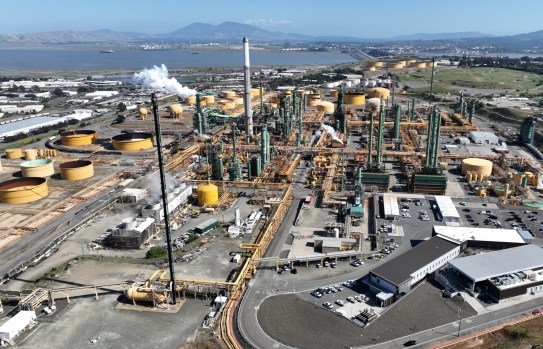
The Valero refinery in Benicia.
Many other cities have lost factories, employment and tax revenue. Eugene, where I live, doled out millions in tax breaks to attract a large corporation to build a computer chip factory here. Overcoming spirited opposition, Hyundai did build its first phase, creating about 1000 new jobs. The plan was for the plant to eventually create a total of 3000 jobs. Instead, Hyundai left town after ten years, terminating 1000 jobs and leaving an enormous empty building out in the West Eugene wetlands.
The Rust Belt refers to a sizable geographic area in the US from Illinois through Indiana to Ohio to western Pennsylvania to western New York State. The area was a vital part of American heavy manufacturing of cars, tires, steel, chemicals and consumer products of all kinds. The jobs moved elsewhere with the prospect of greater profits. Many of those cities have less population now than they had generations ago. Some cities have recovered and moved on but one can still see the remains throughout the region – patchwork neighborhoods with vacant lots and decayed homes, superfund sites and graffiti covered abandoned factories.
The writer of this essay considers the consumer culture to be non-sustainable in terms of the environment and not even a good idea for many other social and ethical reasons. See aprimerforparadigmshift.org
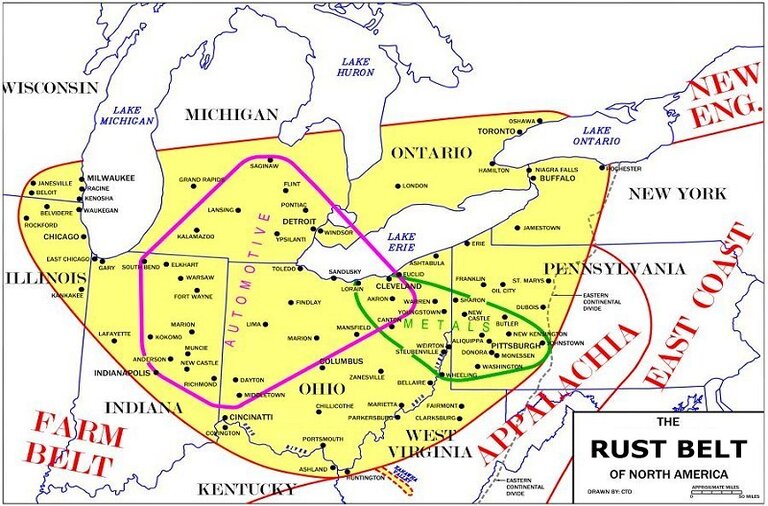
The Rust Belt. An early precursor to the economic downslope.
Times do change. There is no question there are more people with more stuff than ever, even as a growing number of people slip out of the middle class and struggle to pay basic expenses. We live in a bi-polar society. Some believe the economy can grow and push more over-consumption forever while others ready themselves for the polycrisis of overshoot, climate change and deepening social and economic disruption.
The writer of this account completely appreciates many of the benefits of middle class life but also shares the opinion we are already in the outer bands of the polycrisis storm. With many downward conditions and trends in clear view, I have transformed my own ¼ acre suburban property over the past 25 years to produce more basics at home like food, energy, water and aesthetics. [see suburbanpermaculture.org]
So-called off the grid living is not part of my agenda but substantially reducing my eco-footprint is. I have been vegetarian for 50 years and car-free by choice. I grow almost all my own fruit and veggies. I have personal experience with an intentionally downsized lifestyle. The footprint calculator has me close to one earth, not the dream of most Americans. I am also a very active board member of our River Road neighborhood association.
With smart priorities of time and money at personal, community and national scale, we can enjoy the healthy benefits of modern life and leave a lot of the baggage behind. I can write with my own experience and I personally know dozens of others who could do the same.
The Outer Fringes
With the closing of the refinery, Benicia is finding itself fast forwarded to those outer fringes of the storm. Every town and city should have a high-quality sustainability discussion. Better to economize now by choice rather than later by default and on the fly. The downslope is unpredictable but no matter what, it will be disruptive. It already is for a growing number of people.
The Guardian article did not suggest any course of action for the citizens of Benicia but with no editor or chaperone, I will suggest some ideas that can be helpful to Benicia or any city or town. Many of these suggestions can apply at the scale of one’s own lifestyle with friends and neighbors. No permission needed.
First as used here, paradigm shift is the purposeful movement towards a society that takes care of its needs within the boundaries of the natural world. That society would place a high value on building civic culture and social uplift. And that society would be served by an honest and responsible economic system. Its’ important the public discussion is not a greenwash.
Making a start to the process
The most important start for boosting sustainability in Benicia or any town is empowering citizen action. Sustainability should be owned by people where they live, in how they invest their own time and money at home, in the community, what they expect from the city, where they work and their relationships with others. People should have a much higher expectation for their quality – not quantity – of life, well-being and their own responsibility to make it better. The city is a critical partner. Both city and citizens have capacities the other does not and their combined output can be elevated greatly by complementing each other.
The following is a possible sequence of initiatives from start to “further along” for moving towards sustainability. People can take many of these actions on their own or with others but it is best if there is a larger intention people can be a part of. The greater the movement towards sustainability, the more benefits to people and planet. It is important to be clear that the goal here is not to make familiar lifestyles green. That is not possible. Our familiar middle class consumer culture-based lifestyles ARE the problem.
The goal of sustainability is to seriously reduce eco-footprints and build community cohesion. The adventure is to craft a sensible plan, put the plan into action and experience and share the results. Every community has far more assets and allies to work with than they realize. A sensible plan will recognize, engage and activate those allies and assets. They will often be people, projects and organizations already known.
An effective sustainability initiative will cause people to see themselves and their communities in positive and different ways. The following are some suggestions. Every community will have its own unique sustainability adventure but there will be many common denominators.
Short Overview
A mix of existing groups or even a single group could call for a public meeting to discuss the idea of a sustainable community and society. The media should be invited. The gathering is for the entire community and would be open to everyone. It would be good to invite city officials, faith groups, business, education, activists, everyone.
The first meeting would form a sustainability working group [SWG] with an extensive range of backgrounds, both relating to sustainability and those with no experience. It would be best if this working group is citizen-led, not city-led but with city participation. The SWG would meet to identify a mission statement, purpose and goals. The SWG could form committees to create an online presence, design a public survey, contact local individuals and groups already working on sustainability, and identify preliminary goals for the sustainability initiative.
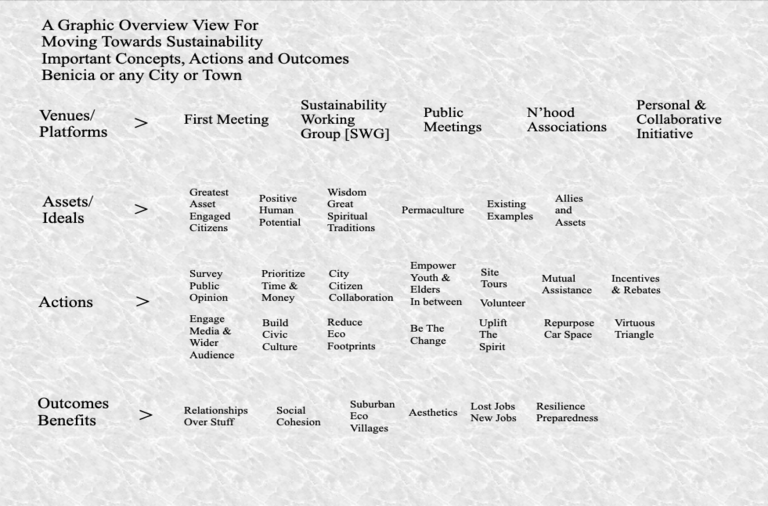
A graphic the shows many of the aspects of a community sustainability process
An early task would be to organize a series of educational public meetings to discuss various aspects of sustainability such as food, transportation, housing, eco-footprints, special needs of the town and any other topics of interest.
Over time with community input from meetings and the survey, the SWG would craft a Sustainability Action Menu [SAM]. The SAM would BE ambitious but voluntary in regards for taking action for sustainability. No reason to be shy. Even people not wanting to be ambitious could learn from the SAM.
There could be site tours to visit places in the community that have sustainability value. Those who take notable actions for moving towards sustainability would be encouraged to share their experiences with the community as their own sustainability adventure unfolds, such as blogs in local media, visits by the media, or a sort of reality report. Over time, many of the public meetings would shift from theory to sharing real life experience.
Concurrently, the SWG could start to articulate a wish list for what the city and community at large can do to boost sustainability. Again, these would be ambitious ideas and voluntary. Every city and town has community organizations that exist to make the community a better place. Those groups have interest in public health, the environment, walkable neighborhoods, aging in place, school gardens, human rights, affordable housing and many more.
Not all these groups or individuals would identify with full on paradigm shift but all of their goals and ideals are about making the human condition better and care for the natural world. Many individuals and organizations might start as sustainability “lite” and evolve towards deeper engagement. They are allies and assets and need to be included. A community sustainability initiative can build momentum and popular interest.
A Bit More Detail
The first meeting could start with the question why is this discussion about sustainability happening in the first place? There could be an assessment from a variety of points of view in regard to history, economics and sociology. There would be content in favor of the existing system and content that was critical of the existing economic and social system. Discussions would touch on what is the American Dream, what has the system delivered and at what cost? Also, where does climate change come from, what is the polycrisis, the principles and mythologies of the consumer culture, the vision of Edward Bernays and Walter Lippmann and more. These meetings would be non-partisan, simply to inform the community of the diversity of points of view about sustainability.
Early meetings could touch on ideas and ideals that can boost sustainability such as recognizing and working with allies and assets in the community, and also how to prioritize time and money. Mention could be made about the wisdom of the world’s great spiritual traditions, which are totally non-religious. There could be permaculture trainings. An entire meeting could explain eco-footprints, the footprint calculator and and assessing one’s own footprint and lifestyle and how to reduce those footprints. It would also be very important to discuss civic culture and social uplift.
Meetings could include break-out groups and world cafe discussions. Many ideas can manifest in a range of personal actions. These meetings would offer the opportunity for like-minded people to connect with each other, compare notes and take any actions they care to.
An entire meeting could be devoted to the idea of neighborhood associations. Early in this sustainability process, bringing about active and effective NAs is a high priority. If a city already has active NAs, that is a huge plus. If a city or town does not have a neighborhood program, creating one is a core task. it is best if NAs are collaborative between the city and citizens but citizens can start their own NA if necessary. NAs could emerge out of neighborhood watch programs or emergency preparedness such as Map Your Neighborhood or CERT training. Home owners associations could shift into NAs.
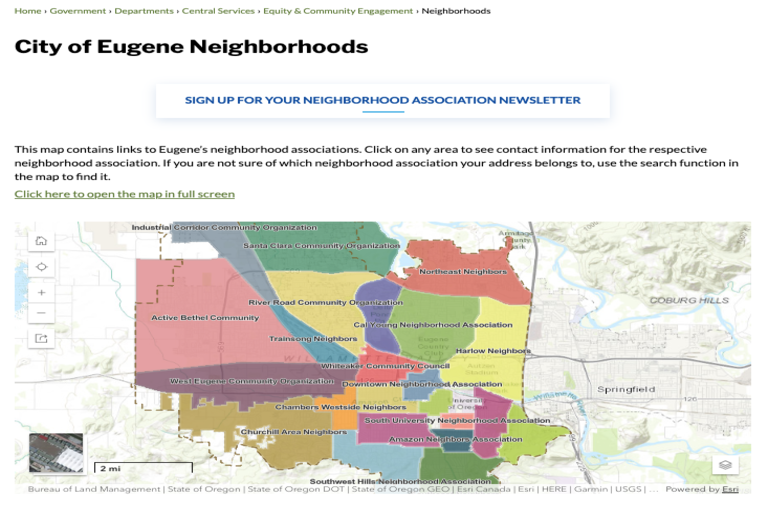
This map shows the geographic locations of Eugene, Oregon’s 25 neighborhoods and organizations. Many cities and towns have nighborhood associations. NAs are perhaps the single most important asset a city or town can have for moving towards sustainability.
NAs are at the heart of community sustainability. They are decentralized and self-managed. They can hold their own meetings, form their own committees and create their own agendas and events. They are aware of the resources on their own turf, and they empower participants. NAs can take action plans from the SWG and adapt them to their particular circumstances. They can provide feedback to the SWG. NAs can learn, share and coordinate directly with other NAs. NAs are a great community asset for many reasons.
Core to sustainability is people taking action in their own lives, with friends and neighbors. There would be multiple meetings on this topic. The SWG could set out a range of choices from modest to ambitious in regard to personal lifestyle changes. Anyone can add to those. These options are totally voluntary. The focus would be on reducing eco-footprints and building positive social relationships. Ambitious actions would be adopting plant-based food choices, reducing use of cars, creating mutual support networks among friends and neighbors to share tools, resources and even taking fences down to set up suburban eco-villages.
Apartment complexes could make best use of their own assets so residents can reduce eco-footprints, such as having flex cars available and garden space and other amenities to foster resident cooperation. In all these locations, people would be encouraged to form mutual support clusters. Again, all this would be totally voluntary.
Kailash Eco Village in Portland, Oregon is an excellent example of turning an apartment complex into a thriving eco-village over 18 years with all manner of cooperation, important skill building and uplift, reaching out to the nearby neighborhood and reducing eco-footprints. The next door complex is now in its own fifth year of transformation into another eco-village. Both complexes were in a deteriorated condition making the transformation even more impressive.
At my place in Eugene, I have built an edible landscape, replaced the driveway with food production, turned a south side patio into passive solar, turned the one-car garage into a bed room, built a very comfy passive solar ADU, installed a 6500 gallon rain water system, and bought a heat pump and solar hot water heater with incentives from the utility company. I did much of the work on these projects myself. My place is a permaculture land mark in the region for the cost of a mid-sized new car or mid-range kitchen remodel. I can speak from first had experience that sustainability can provide many new jobs, such as the rise of the permaculture general contractor.
East Blair Housing Co-op in Eugene owns eight tax properties and can manage them as a single unit to make best use of density and open space. There is a tool share, area for kids, community space, and a parking lot that was taken out and is now a popular party site with edible landscaping and a fire pit. Residents learn important organizational skills because they have to participate so the co-op can function. Many site tours have taken place at East Blair. Suburban property owners could adapt much of what East Blair is doing to their own homes and neighborhoods.
Additional examples of transforming suburbia can be found at N Street Coop in Davis, California; Maitreya Eco Village in Eugene and Enright Ridge in Cincinnati, Ohio. We have impressive suburban sustainability projects here in my own neighborhood and we have had many site tours to see them. No doubt, there are many other similar examples of sustainability initiatives all over the country. People should know about them.
Another gathering could explore the idea of expanding existing incentives in Benicia and likely other towns, that already encourage trading grass for low water landscapes, grey water use, native trees and rain barrels. Incentives could expand to encourage installing edible landscapes, turning grass into gardens, installing larger rain water catchment systems, passive solar retrofits, heat pumps, renting bedrooms, sharing cars and more. All good ideas considered.
The city could also adjust code and permitting to accommodate and encourage block planning. Block planning can facilitate making residential blocks more socially and environmentally friendly with performance compliance rather than prescriptive compliance to facilitate changes to set backs, landscaping, parking, business and infill. Block planning can enhance life on the block for everyone, reduce eco-footprints, build community cohesion and create jobs. The Primer explains more about block planning.
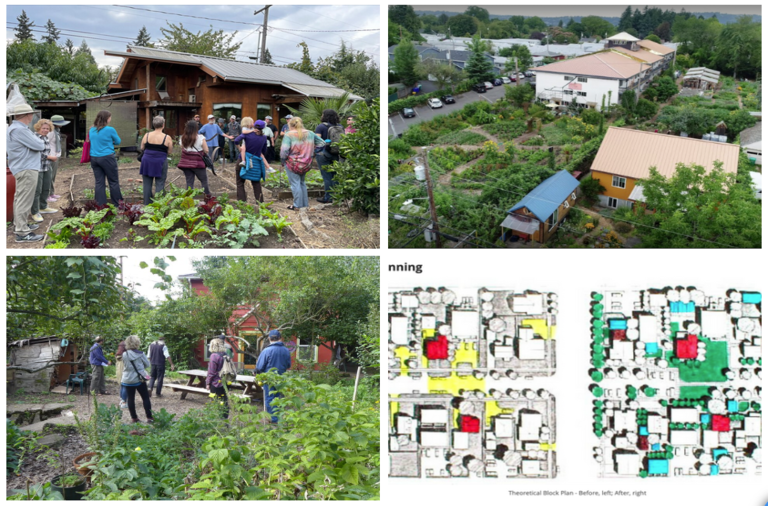
Several examples of what sustainability can look like. A site tour to the suthor’s 25 year old ¼ acre suburban transformation project in Eugene. An aerial view of Kailash Eco Village in Portland, Oregon. kailashecovillage.org A site tour of East Blair Housing Co-op in Eugene. eastblairhousingcooperative.com A graphic showing before and after, block planning. suburbanpermaculture.org/block-planning.
People who are already engaged in notable sustainability projects and lifestyles would be invited to show and tell what they know both in presentations and also on site tours. As new people begin their own sustainability adventure, they can also share the experience with the community.
Another important issue to explain is aesthetics – the ideal of making where we live uplifting to the senses, not only at home but in the community as well. Sustainability calls for more public and personal resources channeled towards public places. People should be far more engaged in looking after public property. Neighborhood associations are perfectly placed to help coordinate citizen participation on public property. We already do this in Eugene. I have a written agreement with the city to look after a 65 tree filbert grove on public property. The city does not have the time and budget to care for the grove. I do.
Further Along
Sustainability will benefit by reclaiming space now taken by cars, such as de-paving to create new green space. Mixed-use redevelopment on suburban strip mall parking can provide services, products and culture that may be lacking in a particular area of town so car trips become less necessary. Multi-story affordable residential designs could favor low-cost living with small eco-footprints such as quads with rents reduced for residents who don’t have cars. Access to these new centers can be improved by reworking nearby streets to make walking and bikes safe. New financial structures could facilitate local people investing in local projects that repurpose space now taken by cars.
Young people must receive special attention. Schools, Scouts, youth groups, and non-profits should create programs and curriculum that teach young people about community service, care for nature and sustainability. The Scouts already have a sustainability merit badge. Scouts can play an important role in the community. Many schools have gardens and teaching to encourage healthy food choices and learning science in the garden. A local youth corp could employ young people to work on community projects that assist sustainability and learn valuable life skills such as the Onondaga Earth Corps in Syracuse, New York.
New opportunities could be made for elders to share their knowledge that can apply to sustainability such as mentoring young people in schools and sharing their wisdom in many ways. A city staff person can be tasked to organize work parties channeling interest in community service into useful projects like we already have in Eugene.
And again, the more participation from throughout the community the better, such as schools, non-profits, faith groups, service organizations, youth and elder organizations, business and ad hoc. Engaging the media, radio, tv, and online is very important to help promote the public meetings, to share the results and report on the ongoing projects. Virtually everyone of the suggested projects and initiatives mentioned above exist already in the real world. One can search online or one can read about these examples and a long list of others at aprimerforparadigmshift.org
More Conversations
Another important community conversation would be about employment, products and services. The consumer culture we are immersed in offers many products and services based on excess consumption and vanity that do not fit sustainability. The Primer online identifies many examples. One can simply imagine many examples. What happens to those jobs and products as a society moves towards sustainability? The best hope is people with non-sustainable jobs realize those jobs and services are gong away over time and find other work. The community could provide new job training and support for these transitions. Ideally, those changes in work can take place by choice rather than by default.
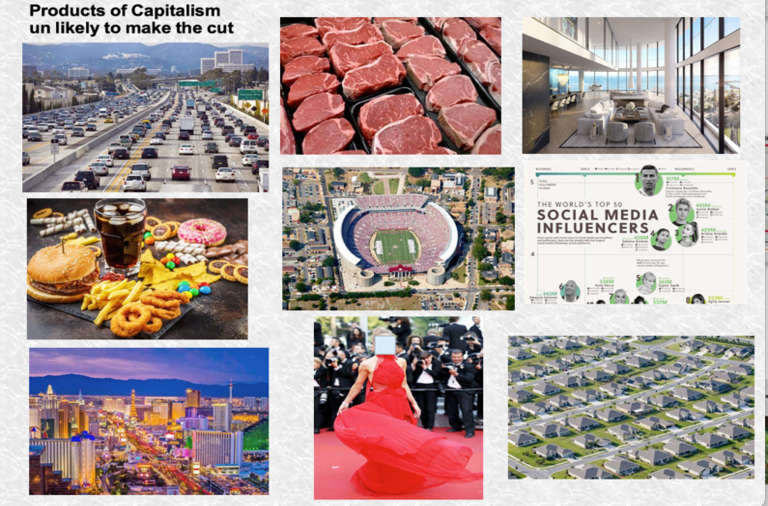
Several well known products and conditions of the consumer culture that will be far less a part of a sustainable society, culture and economic system.
Sustainability will provide new jobs but moving towards sustainability will still pose many challenges. A sustainable society will be far more frugal than what we have now. The best hope is people will prioritize time and money now spent on vanity and excess on sustainability instead. New and enhanced social and economic relationships based on cooperation and mutual support will be low- or no-cost in terms of money and will likely prove to be more desirable and certainly better for the environment and building community culture than time and money lost on excess and vanity. Money is great to have but many needs can be taken care of in other ways that boost community building while reducing eco-footprints.
Many new jobs will call on existing skills in planning, construction, manufacturing, retail and finance for reworking our homes, neighborhoods and communities. I did most of the work transforming my own property but if I had had more money than time, even my relatively simple projects could have employed a lot of people. Multiply what I did here at my place by many thousands, even in a small town, and that’s a lot of jobs that boost sustainability.
Another community conversation will be controversial. It will not be policy, at least not anytime soon, but broaching the topic is important. Depending on coming years, a situation may present itself where more assertive action is needed to discourage over-consumption. That action would be to start taxing non-sustainable products and services. There are already some efforts to tax carbon and there are product warning labels on other products. New York City’s admirable and so far very successful congestion pricing in lower Manhattan is a tax on driving. How would a far more expansive system of product taxing look? If such conditions call for such taxes, those conditions will provide the guidance for consumption taxes.
A sustainable society will have a lively economy. But it’s also important to understand that sustainability will not replicate and make green what we have now. Our way of life will need to downsize its eco-footprint and become more local. How much time do we have for such a transition? We simply don’t know. But the world is becoming increasingly chaotic. Any combination of seemingly unrelated conditions could come together as the “chaos factor” in totally unexpected ways with totally unanticipated results. Even if widespread disruption is avoided over the coming years, these social and environmental actions can deliver benefits that are still good for people and planet.
Conclusion
Individual towns and entire regions such as the Rust Belt, verily, the entire country during Covid and various financial episodes and a growing number of people “falling through the cracks” already provide us with a small preview for what may become a much more profound economic and social disruption where even the 1% will not remain unaffected. All manner of social, economic and environmental trends already are a wake up call. Failing to respond will not make those trends and conditions go away. Those trends and conditions are actively deepening in real time.
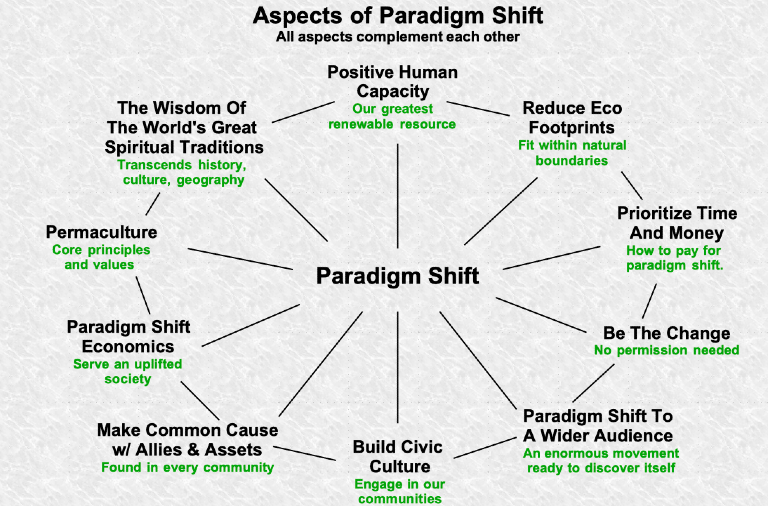
Positive human potential is our greatest renewable resource. The Primer and a host of related sources are here to help with this transition.
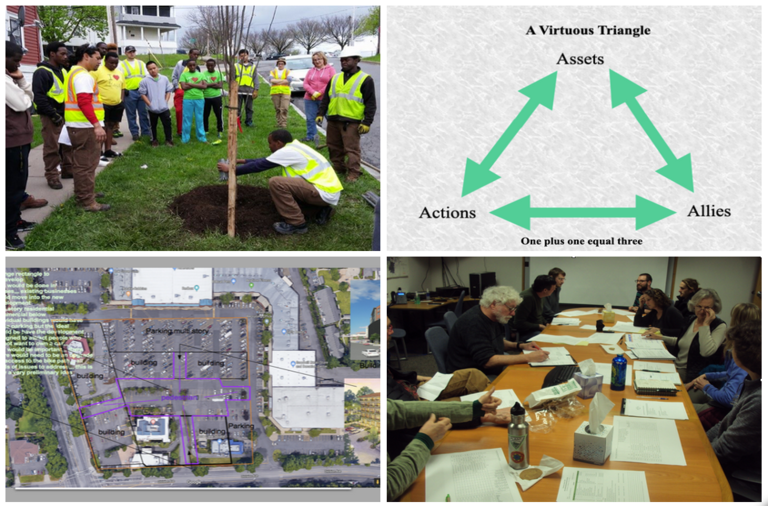
Aspects of sustainability. Young people and community service. The Virtuous Triangle, 1 + 1 = 3. City and citizens meet. Transforming a suburban strip mall parking lot into a mixed-use micro downtown.
Most people would say they would prefer quality human relationships, healthy fun and cooperative security over individual vanity, tons of stuff, electronic distractions and growing economic uncertainty. Sustainability and paradigm shift offer many healthy and creative opportunities that people can adapt to their own lives, homes, neighborhoods and communities. These ideas can start with initiatives taken by civic-minded people in any community.
The ideas described above are sensible no matter what. Every city and town can benefit by a community discussion about sustainability. All of the ideas and strategies mentioned above can benefit the community and verily, will likely prove themselves to be smart moves over time.
There is no downside to modesty of lifestyle, service to the community, care for the natural world, uplift to the spirit and being accountable for our actions. Positive human potential is our greatest renewable resource and we have many allies to work with for taking action at home, the neighborhood and community for moving towards sustainability.



Comments
Welcome to the new Resillience commenting system!
We have moved from the former Disqus commenting system to a new system as of September 10, 2026.
We made this change because of privacy concerns regarding Disqus. It's also part of a set of changes to bring more services to the Resilience community under a single login: commenting, (coming September 2026), and online courses (coming 2027). Unfortunately, your old Disqus comments may not reliably link to your account in this new system. Please contact us if you have any questions or concerns.