

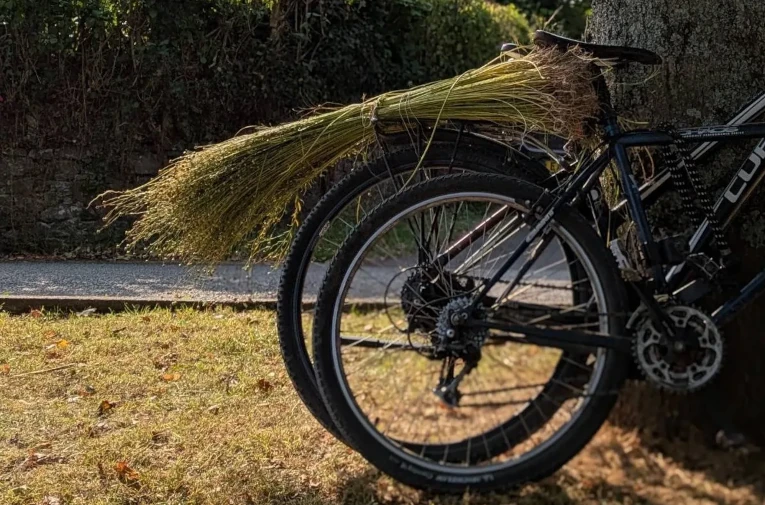
It’s been over two years since I undertook a big train journey across Europe to explore bioregional resilience and it’s relationship to flax. As you’ll probably be aware, on my travels I explored agriculture, small-scale processing, spinning infrastructure, textile cooperatives and connected with projects who prioritise community and the arts over profit.
A key learning was that infrastructure and inspiration, when supported by culture and creativity, can bring a seemingly impossible task alive within a region.
Returning, I set about the ‘seemingly impossible task’ of revitalising flax and linen production in the UK, something this substack is documenting. I’ve chosen to frame this work using the distinct but related themes of infrastructure and inspiration combined with culture, creativity and community.
Culture, Creativity and Community
After several years of field building – developing relationships both literally and metaphorically in the field – it feels like the work we are doing at Liflad CIC is gaining momentum. On the culture and creativity side, we’ve recently won heritage lottery funding, a pretty amazing achievement for a tiny organisation. We are very excited to co-deliver a multi year project with Transition Town Totnes called “Devon Grows Flax”. Work starts now on community building, heritage research and skill sharing, well-being through crafts, flax education in schools, creative exhibitions and development of a community cloth. More on this coming soon.
Infrastructure and Inspiration
We are also launching a new venture called Common Cloth Works, supported by a small foundation that encourages cooperative and ecological activity. Common Cloth Works will provide infrastructure and inspiration in equal measure. Based on a beautiful farm in South Devon, we will demonstrate the cultivation and production of agroecological textiles with the micro-manufacturing of flax fibre into yarn, cloth and clothing. This is a slow and challenging process but we have worked out a cunning plan for action.
It really is the dream outlined here coming alive but in a form I could not have predicted or imagined. We will work in partnership with our surroundings, experimenting with innovative methods to keep the farm ecosystem in balance through careful experimentation, using old and knew knowledge to develop replicable, low-impact production processes.
This Liflad substack will continue to document all our work and thoughts on bioregional production and developing different livelihoods. As Common Cloth Works is such a big project, I’m thrilled to announce it will also have it’s own Substack – whoop! As a collaboration there will be additional voices joining the output and much to share.
We’d love you to follow our exciting journey into the specifics and challenges of vertically micro-manufacturing the first bioregional, ecological UK linen in decades!


Comments
Welcome to the new Resillience commenting system!
We have moved from the former Disqus commenting system to a new system as of September 10, 2026.
We made this change because of privacy concerns regarding Disqus. It's also part of a set of changes to bring more services to the Resilience community under a single login: commenting, (coming September 2026), and online courses (coming 2027). Unfortunately, your old Disqus comments may not reliably link to your account in this new system. Please contact us if you have any questions or concerns.