

Most sustainable gardening advice doesn’t survive a real garden.
It sounds right: let things grow, help pollinators, step back, work with nature. But a real garden is not an idea. It is a place where things have to work.
You are trying to grow food, keep paths open, stop things taking over completely, and deal with weather, time, and whatever your body will allow you to do that week. That is where a lot of what is called sustainable gardening begins to fall apart.
I tried to do this.
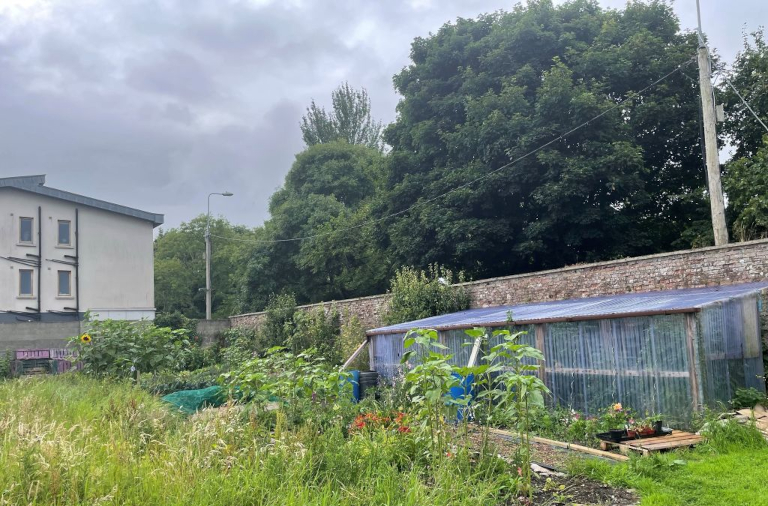
During lockdown, I was given access to a walled garden. It was an incredible piece of generosity. It gave us an outlet, a way to do something useful, something real. I thought if I approached it the right way — gently, sustainably, with good intentions — it would respond in kind.
It didn’t.
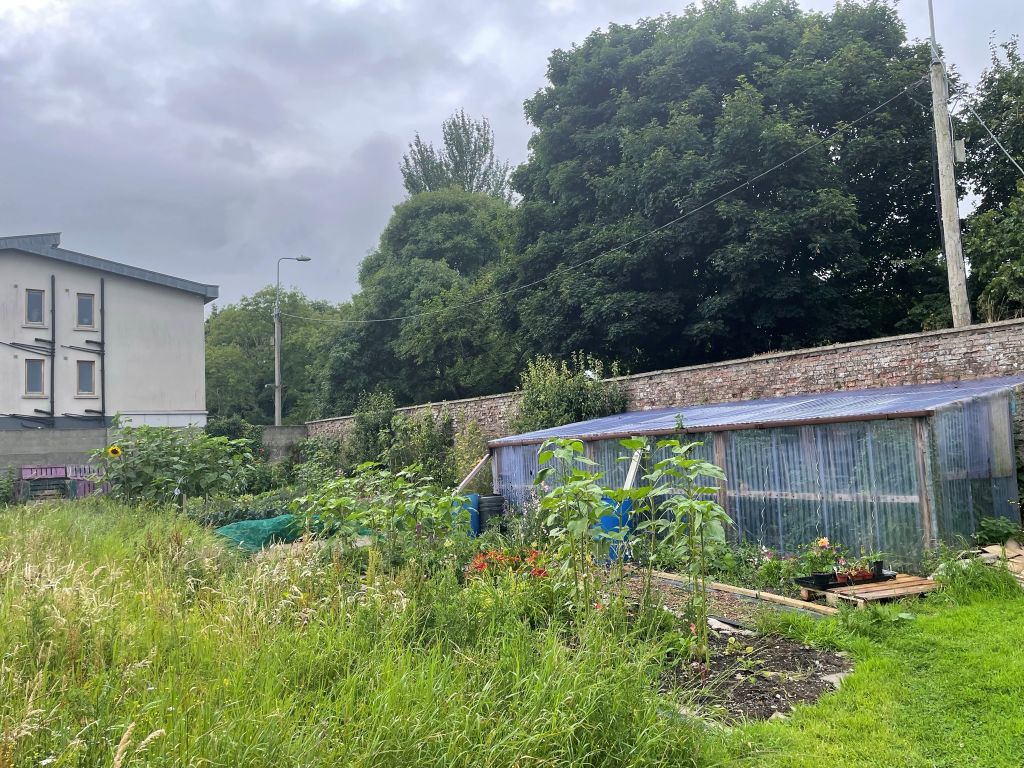
The garden pushed back, harder than I expected. Weeds didn’t stay in their place, crops didn’t behave, and things always took more time than I had. Then my back went, properly went. Work stopped whether I liked it or not. When I got back to it, I overdid it and injured my wrist as well. The greenhouse roof came off in a storm and left everything in a total mess.
At one point, I stood in the middle of it and said out loud, “feck this, I’m done.” I meant it, because this is the part that doesn’t make it into most advice: the point where the work stops working. Where the idea of it no longer matches the reality in front of you. Where everything feels like it is slipping backwards faster than you can hold it.
But I went back, not because I had a plan, or because I knew what I was doing. I went back because there was something in the place that held me there. Something that made it worth trying again, even when it wasn’t going well.
Slowly, by doing the work, something shifted — not the garden, not at first. Me.
I stopped trying to get it “right.” I stopped expecting it to behave. I stopped thinking in terms of control or abandonment.
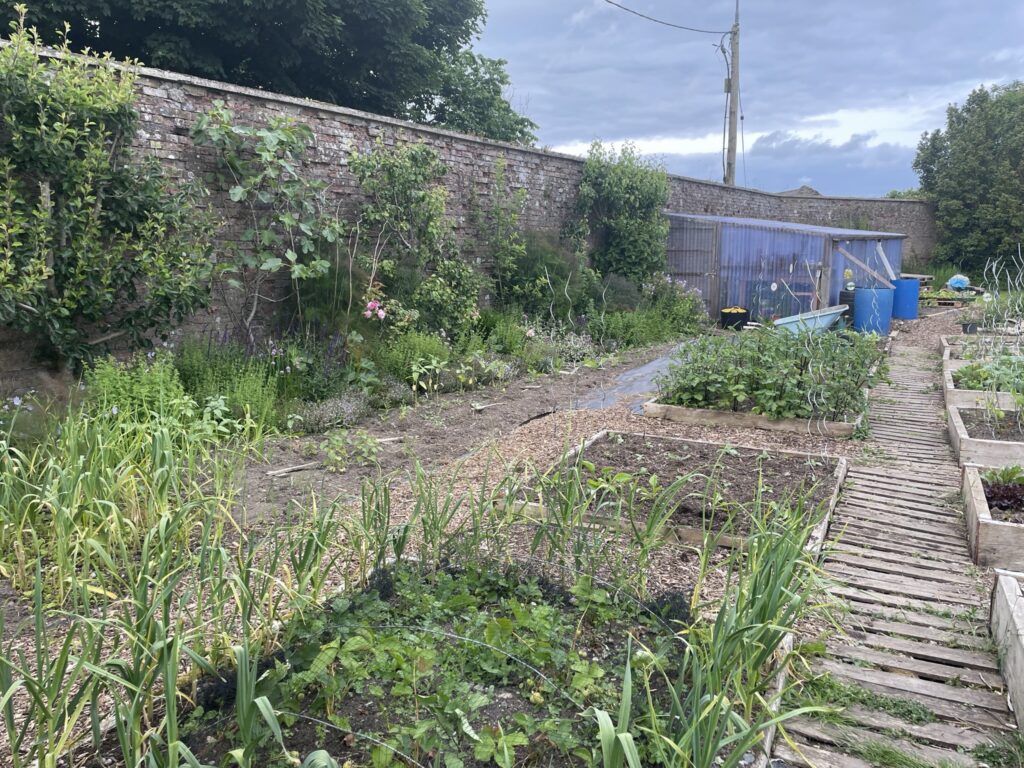
Instead, I started paying attention to what grew easily and what didn’t, to what came back on its own, to where the soil held water and where it didn’t, and to which parts needed work and which parts were better left alone. I pulled some nettles and left others. I grew food where I could and left space where I couldn’t. I worked parts of the garden hard and let other parts stay rough.
I listened to the garden, the soil, the plants, the earth. They told me what to do.
One year I learned this the hard way with onions. They looked fine above ground: upright, green, healthy enough. But when I lifted them, they were rotten underneath. The bulbs had failed completely. Later I was told that onions had been grown in that same patch for too many years and the soil had built up disease. That was a real lesson in the difference between theory and practice. You can read all you like, but sometimes the ground tells you something only failure can teach.
It was not neat. It was not efficient. It did not look like the kind of thing you see in advice columns, but it worked — not perfectly, not consistently, but enough to keep going.
There is a version of sustainable gardening that exists in theory, and there is the version that exists in a place where you actually have to live with the results. They are not the same.
Most people are trying to find a way somewhere between controlling everything and letting it all go, but there is very little honest discussion about what that actually involves. It involves failure. It involves limits. It involves doing work that doesn’t always pay off. It involves making mistakes, learning from them, and starting again more than once.
It also involves something else. If you stay with it, if you keep going back, if you pay attention, you begin to build something that is not regimented and not completely abandoned, but somewhere in between.
It’s not that you found the right answer. There are many answers, and maybe none are completely right. But some of them are better than others. You find something that works for you and your land because you kept working at it.
That is what most advice leaves out, and that is where the real work is.
Ed. note: You can find out more about Ciaran’s work and his book Nature’s Acre here.



Comments
Welcome to the new Resillience commenting system!
We have moved from the former Disqus commenting system to a new system as of September 10, 2026.
We made this change because of privacy concerns regarding Disqus. It's also part of a set of changes to bring more services to the Resilience community under a single login: commenting, (coming September 2026), and online courses (coming 2027). Unfortunately, your old Disqus comments may not reliably link to your account in this new system. Please contact us if you have any questions or concerns.
I've had a garden for almost all of the past 50 years. I've never had a year that wasn't mostly productive. There are always failures–I've said that every year something does unexpectedly poorly and something else does unexpectedly well. But I grow more than half of the food my household eats in my gardens and orchard. It's unquestionably worthwhile. For me the gap between fantasy and reality in gardening, something I thought Cieran was going to say but he didn't quite–is the fantasy that one works with nature, cherishes and eats the weeds, doesn't till…take this approach to the extreme and–well I had a neighbor 40 years ago who did that, He read One Straw Revolution, decided he didn't need to till or weed anymore and–that was his last garden. He just bought all his food in the grocery store. The reality is that forcing a given piece of land to produce what YOU want from it, means eradicating what was otherwise there. You can't be entirely non-interventionist and still eat from that land–well, eat much (some weeds ARE edible). There are reasons our ancestors chose and developed the crops they did–usually, though not always, good reasons. You can eat the root of Queen Anne's Lace (wild carrot) I suppose, but carrots are both tastier and more nutritious. Even hybrids generally yield well, though they create problems for seed saving…however there is such a thing as dehybridization, and creating a landrace.