

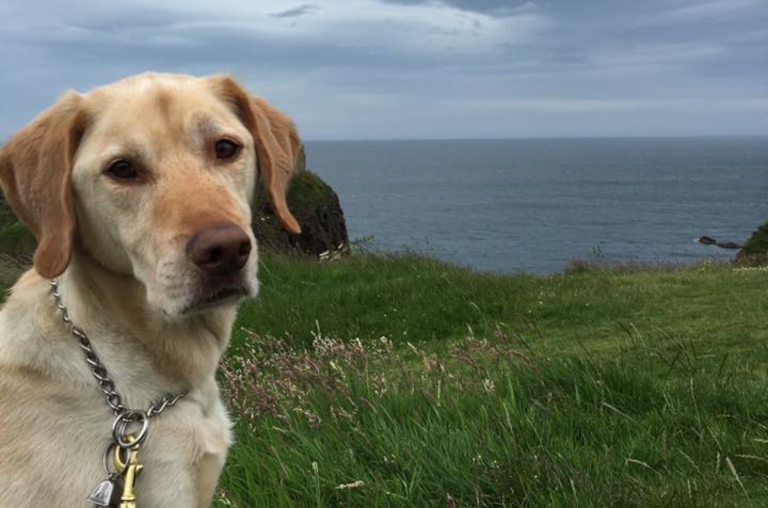
On Independence Day, 2012, I was introduced to Fathom, a gorgeous yellow lab-golden retriever cross. At age 19, I had only been fully blind for a year, and Fathom was my first Seeing Eye dog. Even his name seemed perfect for me, a student of environmental engineering at Swarthmore College; the fathom is a traditional unit of water depth, originally set according to the span of a person’s outstretched hands. As Fathom leapt into my lap and greeted me with a lick, I could hardly guess how deep our bond would grow or how far we would reach in our travels.
The Seeing Eye school began almost a century ago thanks to an enterprising blind college student named Morris Frank[1]. After reading about guide dog training taking place in Europe, Frank traveled by himself to Switzerland, where he was teamed up with Buddy, the very first Seeing Eye dog. After returning to the United States in June 1928, Frank proudly announced “I have signed my Declaration of Independence and enjoy it to the fullest with my dog Buddy”[2]. In the words of one editorial, “…the idea that the blind could again be men and women with an independent ‘life’ seemed fantastic”[3]. Yet Frank and Buddy would go on to travel some 150,000 miles together, from city streets and lecture halls to White House meetings with Presidents, demonstrating the transformative potential of their relationship. By the time Buddy passed in 1938, hundreds of fellow Seeing Eye dogs were working across the country, helping blind people from all backgrounds in finding a measure of independence.
In my own application to the Seeing Eye, I anticipated that a dog would “allow me to operate with greater independence”, decreasing the stress of becoming lost, helping me socialize more naturally with my peers, and opening the possibility of studies in unfamiliar cities. Fathom far exceeded my expectations. When we returned to the Swarthmore campus, we were sprinting down meandering paths that had once bewildered me, moving along faster than my sighted classmates. In the dining hall, Fathom helped me find both places to sit and friends to share meals with. And in the following summers, we traveled to Indiana and Tennessee for internships. I had never left the country before meeting Fathom, but his support gave me the gumption to then undertake two years of graduate studies in the UK. He would go on to guide me into my professional life in NYC and lead me on travels across four continents. With Fathom, I came to know the glorious feeling Morris Frank once described as “just a dog and a leather strap linking me to life”[4].
Following a decade of companionship, I returned to the Swarthmore campus with Fathom before welcoming him into retirement. As we strolled the familiar paths, I marveled at how Fathom had been both an agent of immense change in my life and a loyal constant throughout that change. When he was first guiding me to lectures and on morning commutes, I thought his significance was in leading me to my future. But looking back, I cherished the significance of his guiding itself. As a Seeing Eye dog, Fathom did not simply see the world for me, he changed how I viewed the world. Even as I was pursuing advanced degrees, many of my most valuable lessons were taught to me by Fathom.
Throughout class at the Seeing Eye, I was repeatedly advised “listen to your dog”. The full weight of this responsibility would not occur to me until years later when Fathom and I were walking down an alleyway along our London accommodations. Suddenly, Fathom stopped. Despite my mounting frustration and commands of “forward”, he refused to continue. “The passage is fenced off”, a man called from behind me, “Listen to your dog, mate.” A wave of embarrassment gave way to a clarified conviction. Genuinely listening to Fathom required me to go beyond simply responding to his movements. I had to show him how sincerely I respected his admirable intelligence and autonomy. Fathom reminded me to abandon erroneous certainties and approach our relationship with humility.
I “listened” to Fathom primarily through his harness handle. On my first day at the Seeing Eye, instructors explained the importance of maintaining a light, constant tension in the harness. After receiving an A in mechanical engineering, I considered myself an expert in tension. Yet I never guessed how tension could serve as an entire mode of communication. Not only did a well tensioned handle transmit Fathom’s infectious energy, but it allowed me to feel his every movement. Through the harness, I could sense him examining our surroundings, the tilt of his head as he looked to me for approval, the rhythm of his breaths on a hot day. Fathom showed me that to navigate the world, our connections had to be truly felt, not just measured.
At the time, I was learning engineering methods for controlling systems and optimizing outcomes, powerful techniques that I thought could alone solve society’s mounting problems. But I quickly realized my team with Fathom was a system that belied ambitions of control. We maintained a constant dialog as we walked together, with me providing a stream of praise, coaxing and occasional correction. Although I chose our destinations, our success involved a merging of perspectives and intentions. With resonance for larger systems, our partnership had to begin from a place of cooperation.
And our cooperation gave us the fortitude to take on new challenges. The first time I attempted taking Fathom onto an escalator, he stubbornly locked in his paws to the point his leash popped off. When we moved to London, however, we had no choice but to take escalators on a daily basis. Fathom’s understandable hesitations were swiftly forgotten in his excitement to show me on underground adventures. His tail wagging as we descended the escalator, he would guide me to the tube platform, where he would impatiently stare down the tunnel in anticipation, finally letting out a string of happy sneezes when he heard a train approaching. Fathom was my hero, and taking strength from his example, I learned to embrace experiences that had once intimidated me.
Even when he was out of harness, Fathom still provided valuable guidance. In our college dorm room, he would slip under my desk and nuzzle his face into my lap. On late nights in grad school when he decided I had been studying for too long, Fathom would press his head under my arm, forcing it away from my keyboard. And in the library, he was fond of rolling onto his back, pressing his paws against my leg, and demanding I take a break to give a belly rub. In his own gentle way, Fathom grounded me. When I was staking my worth on the grades I could receive and worrying over how employers might accept a blind engineer, Fathom told me I was worthy of love simply by virtue of loving him.
The loving spirit we shared altered my understanding of our endeavor. Fathom helped me find independence by any conventional definition, but the term independence no longer seemed adequate to me. As I explained in an interview towards the start of Fathom’s career, “I feel like he’s become an extension of me, a part of my soul almost. He’s like my brother and a son and a best friend and a traveling companion and a guide, all together in one”[5]. Perhaps the sensation was put best by Morris Frank when he explained how he and Buddy came together “as two halves that complemented each other to make a complete entity”. Even more precious than independence, I found my partnership with Fathom represented interdependence.
This interdependence extended beyond Fathom’s leather harness. A year and a half after we were teamed up, Fathom and I were touring the Lincoln Memorial when a couple introduced themselves. I was touched to learn that not only did the couple raise puppies for the Seeing Eye, but they had actually known Fathom when he was a puppy. A decade later, I described our Lincoln Memorial encounter in a talk I gave at the Seeing Eye, and I was stunned when another couple came forward to introduce themselves as Fathom’s own puppy raisers. They shared stories of how they had nurtured Fathom’s skills and exposed him to conditions we would later work through as a team. Rather than breaking from dependence on family, I discovered I had formed connections with a still wider family that supported me in becoming more fully myself.
After more than fifteen years of life and three years of retirement with my mom, my family recently had to say goodbye to Fathom. Even in his passing, Fathom inspired connections of uncanny beauty. As I prepared to write to Fathom’s puppy family to share the sad news, I received a note from them describing the adorable puppy they are now raising, the 19th they have brought into their family for the Seeing Eye. In an act of remembrance, I then returned to Swarthmore College with my current Seeing Eye dog, Rocco. My knowledge of the campus had been jointly held with Fathom, so it was bittersweet when we promptly became lost. Along the way, Rocco became intrigued by another dog ahead of us. I was amazed when I realized that it was in fact a current blind Swarthmore student traveling with her own Seeing Eye dog. These encounters left me awed by the sublime circular gift of life. As we mourn Fathom’s passing, other dogs are just embarking on their own transformative lives of adventure.
Thank you, Fathom, for gracing us with your loving spirit, and for guiding me with such wisdom and courage. I will love you forever. And I will continue to listen to your lessons.
[1] The Seeing Eye. (n.d.). “About Us: Our History”. https://seeingeye.org/about-us/our-history/
[2] Peter Brock Putnam. (1985). “Love in the Lead: The Fifty-Year Miracle of the Seeing Eye Dog”. E. P. Dutton.
[3] Gertrude Samuels. (April 21, 1957). “Buddy Showed the Way”. The New York Times.
[4] Morris Frank and Blake Clark. (1957). “First Lady of the Seeing Eye”. Henry Holt and Co.
[5] The Seeing Eye. (2014). “Seeing Eye® Graduate, Hayden Dahmm and His Seeing Eye Dog, Fathom”. YouTube. https://www.youtube.com/watch?v=UfdDa8jO1OM



Comments
We changed commenting systems on September 10, 2026 as part of a site-wide functionality and security upgrade. Your past comments have not disappeared, and you can still log in with your old Disqus account credentials if you wish. Contact us with any questions.