

Regenerative agriculture has risen to fame and glory. Even large corporations like Unilever, Nestlé and Carlsberg embrace it.
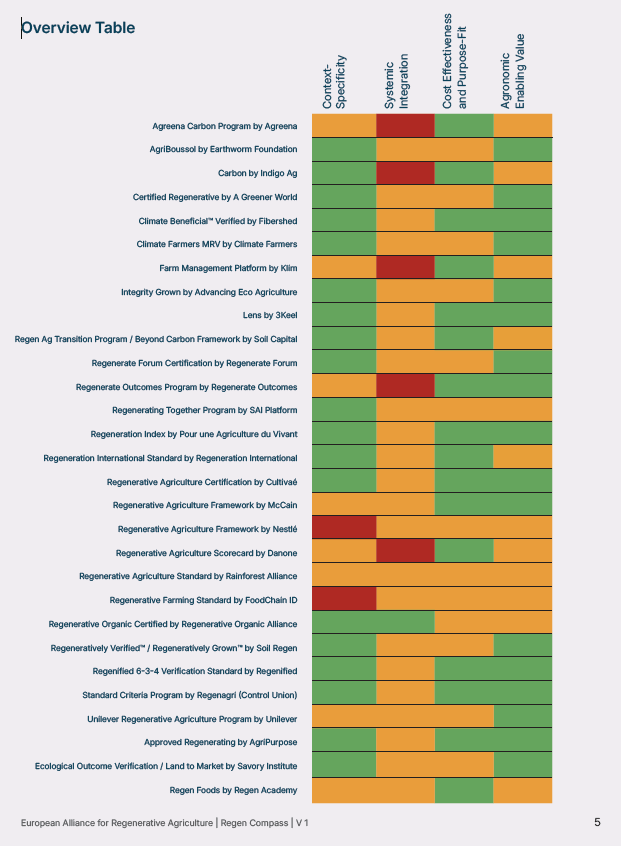
The European Alliance for Regenerative Agriculture (EARA) has created a ”compass” to assess various regenerative initiatives, 29 for the time being. The compass doesn’t work with detailed criteria for methods or practices but with four broad criteria:
- Is the system designed to adapt over time and across different locations (e.g. changing seasons, soil types, climates, local socio-economic conditions)?
- Does the system capture regeneration as a multi-dimensional process, integrating ecological, social, and economic outcomes?
- Is the monitoring, reporting, and verification system efficient, accessible, and right-sized for its stated purpose, ensuring opportunity for broad participation?
- Does the system actively help farmers make better on-farm decisions and provide useful feedback for innovation?
EARA uses a traffic light coding to rate the systems. The most problematic criteria is the second one, where only one of the systems, Regenerative Organic Certified, manages to integrate the various aspects of farming. Most systems are weak on this and focus on only one aspect or just a simple issue such as soil carbon. This is particularly the case for the company-specific systems.
There is much in the aspirations, dominant ideas and methods of regenerative agriculture that is laudable. I subscribe to most of them and practice most of what is considered essential parts of regenerative agriculture. In particular, I like that it is just as important to regenerate the conditions for farming as it is to farm.
Having said that, I am concerned about the hype around it. For the following main reasons:
1. We have heard it before and we have done it before.
2. The analysis doesn’t go deep enough.
3. The lack of coherent definition.
4. It is often more about marketing than farming.
I expand on this below. In many cases, I contrast regenerative against organic. This is partly because some proponents of regenerative go very far in claiming that regenerative is superior to organic in many ways. Even if I have been involved in organics for almost fifty years I am well aware that organic in no way is perfect, and I have written about it extensively. Still, I find many comparisons unfair. Nevertheless, it can help those not so knowledgeable in farming to understand the issues when regenerative is compared with organic.
1) There is almost nothing in the methods usually adopted by regenerative agriculture that is new. The value of crop rotations has been recognised for thousands of years. No-till is even older than tilling, basically all swiddening is done without tilling. Even the word regenerative was invented by the organic movement. Perhaps the most unique aspect is the grazing part of it. But, even that is largely based on Voisin’s work of seventy years ago. The current focus on carbon in soil is just another version of a focus on humus and organic matter which has been a cornerstone of the organic movement (and it was not invented by the organic movement either). There are many good things that have been lost in the current agricultural system, and we should try to reintroduce them. On the other hand, there are reasons why some practices are dropped and others emerge. Without a proper analysis of those reasons you can’t proceed beyond a certain point (see next point).
When you have been in the game for fifty years, you have seen these hypes come and go. Organic itself was all the rage thirty years ago. But, in the end, it was too limited, with high costs and rigid standards, in order to appeal to major food industries and most farmers. The alternative was ”sustainable agriculture”. It was often portrayed as being ”better” than organic in a similar way that some promote regenerative as superior to organic today. In the end, sustainable agriculture was embraced by everybody and meant nothing more than general good agricultural practice.
2. Agriculture is shaped by the surrounding society and the drivers of that society. A century ago, most farms in Europe practised a diverse crop rotation and integrated various livestock into the system. Despite the fact that it is biologically and ecologically sound, it is not economically sound in a (capitalist) market economy. The imperatives of specialisation, mechanisation and economies of scale (all three are aspects of the division of labour that is fundamental to the market economy, noted by Adam Smith 250 years ago). The organic movement provides a good illustration. Once organic became mainstream and started to sell to supermarkets and food industries, organic farmers had to specialise and could not keep the diversity. Those who didn’t had to develop very different marketing systems with CSAs, direct marketing, or being a visiting/educational farm etc. The discourse around regenerative agriculture is largely lacking this perspective.
Far too many of the proponents, especially in North America, pretend that regenerative agriculture is profitable (if you just do it right, which mostly means buying their course or advice). Apart from that those promises mostly are wrong even from the farmer’s narrow commercial perspective, there are also mechanisms on the system level which make such profitability claims dubious. Despite that farmers have increased their production and lowered the production costs for a century now, farming is still not profitable because there is a fundamental overproduction in farming. Any improvements in production will, if adopted across the board, lead to lower prices. The only way profitability in farming will improve under the current market system, at least for a while, is if there will be food shortages (and we don’t want that do we?), regardless of how food is produced.
3. Organic got stuck in extremely detailed prescriptions of what you should do and, even more, what you shouldn’t do. In the view of the public and most farmers it is defined by its standards even if there is a lot more to it, which is apparent if you read the IFOAM principles of organic. Regenerative, as it stands today has the opposite problem. Part of the problem is encapsulated in the following statement in the EARA Compass: Its core purpose is not to ask “Are you regenerative?“ but “Are you moving towards more holistic regeneration?“ . In the Compass is also written:
Can I be regenerative while I do conservation agriculture with herbicides?
Yes – as long as there are outcomes that prove you are on a regenerating journey and you intend to continuously reduce herbicide and pesticide use.
Some of the major proponents of regenerative agriculture have built their production system around glyphosate weed killers.
Some proponents of regenerative agriculture state that it compares favorably with organic because the focus is on outcomes and not on methods. I would say that this is a very simplistic perspective. To begin with, practices, methods and technologies are never neutral, they are always linked to outcomes and they shape the outcomes. This is even more so if you embrace the experimentation and observation which is emphasized in regenerative agriculture. “The path is the goal” as they say. And the distinction between outcomes and methods is not always very clear. To let cattle graze, or let the calf suckle the mother is both a method and an outcome (they can exercise a natural behaviour). To store more carbon in the soil might be considered as an outcome by one, but is a method to combat global warming according to others. Every farmer also knows that even if you did everything right, some years the outcomes might be terrible as a result of factors out of your control – a flood, a drought or market failures.
It is a strength of regenerative agriculture that it is context specific. But I feel that this often is reduced to ”what works, works”. Making nobody wiser.
4. There are, for sure, many serious and good regenerative farmers who will explore and develop regenerative farming for the better. They should have as much credit as possible for that. But by and large, today the regenerative narrative is largely driven by marketing. And there are many who want to be on that marketing train:
There are the big companies that want to surf the waves and build the image of their brands.
There are many marketing gurus, consultants and trend analysts that position themselves in this arena and make their living from it. Also some prominent farmers doubling as consultants, educators and speakers. No harm in that, but there is a difference between earning your living from talking about regenerative agriculture and from actually doing it. This is nothing special for regenerative agriculture but applies equally to other concepts such as organic, biochar, permaculture, syntropic, perennial farming etc. Been there, done that.
Some thirty years ago, one of the organic pioneers, Carl Haest, said about sustainable agriculture, “friend in the field, foe in the market”. That seems to hold also for regenerative agriculture.
UPDATE; Agroecology Europe just updated a position paper in regenerative agriculture:
While the first proponents of RA had several principles and good agronomic practices that are closely aligned to agroecology, in the EU policy making, RA is increasingly diverging from agroecology in goals and scope. This is largely due to its lack of a “beyond the individual practices and farm-gate” perspective, which has left it vulnerable to co-optation by global finance and big industry actors. Unlike agroecology, RA does not constitute a fully systemic approach to agri-food transitions at all levels.


Comments
We changed commenting systems on September 10, 2026 as part of a site-wide functionality and security upgrade. Your past comments have not disappeared, and you can still log in with your old Disqus account credentials if you wish. Contact us with any questions.
Yea it seems that as soon as one of the goals is "make money" then you can say goodbye to one or more of the bits that ensures truly sustainable outcomes ecologically.