

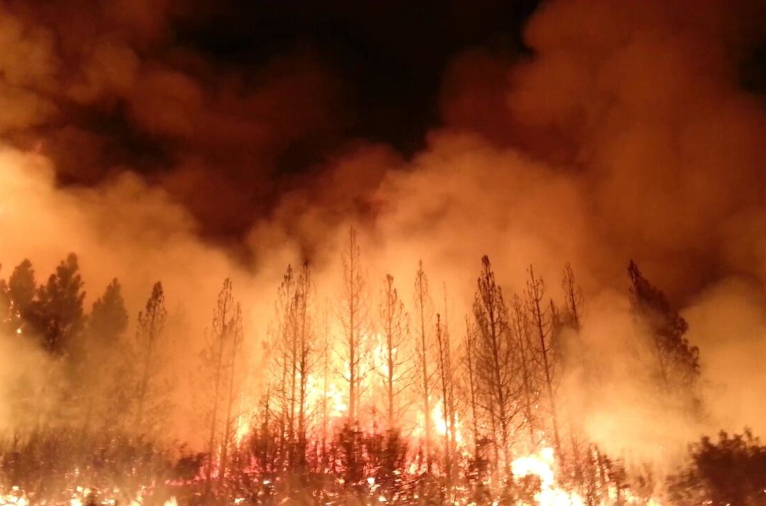
America’s public forests are in increasing danger. The Fix Our Forest Act (FOFA), which essentially opens up millions of acres of forest to logging in the name of wildfire prevention, is scheduled for mark-up in committee this week, inching it that much closer to a vote. The bill, structured to override public oversight, is bad enough. But to fully comprehend the threat it imposes, you must consider to whom such overrides will be handed—Donald J. Trump. For the next three and a half years you might as well call it the Trump Our Forests Act.
Trump has already made his intentions clear, whether through his executive order called Immediate Expansion of American Timber Production, the elimination of The Roadless Rule, or the gutting of wildlife protection efforts. But these are just the broader strokes. There are also finer maneuvers underway, such as abandoning the traditional practice whereby forest personnel paint-mark the trees selected for cutting, instead handing those decisions over to the timber companies themselves. Or the various subsections that keep popping up in the “Big Beautiful Bill,” like Section 60026, which gives timber companies an option to pay for hastened environmental review, or Section 60017, which defunds endangered species recovery efforts. Then there’s Section 50301, which arbitrarily requires the Forest Service to increase harvests by 250 million acres annually for nine years.
Trump has also, if you haven’t noticed, made clear his contempt for public process. That too, should be part of the calculous for Democrats considering this bill. Should a president who all but sneers at the public realm be granted congressional authority to override public oversight in the management of public lands?
It’s important to understand that despite Trump’s desire to open our public forests to more logging, his two main vehicles for doing that, the US Forest Service and the Bureau of Land Management, are somewhat limited in their authority as federal agencies. Many of Trump’s ambitions are therefore vulnerable to legal challenge by the citizenry, which is where FOFA comes in. By putting the NEPA (National Environmental Policy Act) overrides and judicial constraints into statute, Congress imbues them with greater legal authority, significantly raising the legal bar for citizen redress. FOFA won’t fix our forests, but it will fix the timber industry’s citizen-opposition problem.
Fear of (looking soft on) fire
Last year, during the Biden term, Democrats shot this bill down, largely because of those very overrides of citizen control. Yet now, under Trump, they appear on the verge of bringing the needed votes to pass it. What happened?
Well, one thing that happened were the fires in LA in early 2025, with the terrifying images of roaming flame-walls and torched buildings. Within days of those fires, FOFA proponents rushed a vote in the House, citing the fires as rationale for the bill, even though FOFA, which focuses on logging in the backcountry, would have done little for the people of LA. The fires they suffered were grassland and chaparral fires on non-federal land, not to mention the urban spread from building to building.
Though deceitful, the move was effective, putting Democrats that might oppose the bill in the position of looking soft on fire. And for their part, Democrats haven’t shown much willingness to counter the claim, even adopting it themselves. When the Senate Agriculture Committee considered the bill in May of this year, ranking Democrat Amy Klobuchar, D-Minnesota, introduced the bill by invoking, yes, the LA Fires.
This sort of mismatch between claim and reality appears throughout FOFA. It claims to be about fire reduction, yet allows harvest of a forest’s most fire-resilient trees, the larger, mature ones. Further, by destroying forest canopies such “mechanical treatments” increase sun penetration, inevitably heating up and drying out forests while reducing their wind breaking capacity. Common sense tells us this combination of heat, desiccation and wind leaves forests more vulnerable, not less vulnerable, to fire. It claims to be science-based yet ignores peer-reviewed science which draws very different conclusions. It claims to protect communities from fire yet opens up logging far from human settlements.
Rejecting FOFA doesn’t mean ignoring some of the difficulties our forests face. Decades and centuries of fire suppression and heavy logging have left much of them in an unnatural condition. especially commercial tree plantations, which tend toward overcrowding. Yet as biologists such as Brock Dolman have shown us, there are far less destructive and much more helpful approaches to forest restoration.
Fear of fire is understandable, with real people in real danger. In fact, there’s already a bill designed to help them, called the Community Protection and Wildfire Resilience Act, which provides actual funding to actual communities to do the things that will actually protect them, such as hardening homes, improving emergency escape and access, and focusing treatments immediately around the communities themselves, all while using the process to lower insurance premiums. That bill, however, was held back in favor of industry-backed FOFA.
While the human fear of fire is understandable, the political fear of fire—playing it safe with the political winds on a bill that strips citizens of their ability to contest logging on millions of acres of maturing forest—isn’t. For Democrats in particular, it’s to betray one of their most faithful constituencies.




Comments
We changed commenting systems on September 10, 2026 as part of a site-wide functionality and security upgrade. Your past comments have not disappeared, and you can still log in with your old Disqus account credentials if you wish. Contact us with any questions.