

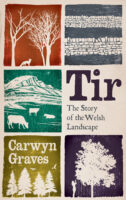
 The end of my last post left a few threads hanging, not least a promise to say something about Carwyn Graves’s wonderful book, Tir: The Story of the Welsh Landscape (2024, Calon). But let me approach obliquely from a more personal angle.
Sometimes I make the mistake of reading negative online comments about my writing. A comment I read under a YouTube interview I did a while ago went something along the lines of “what Smaje didn’t mention is that he keeps sheep, which have a brutal ecological impact”.
Now, it’s true that for about six of the twenty years I’ve worked these 18 acres, I’ve kept sheep – currently to the tune of three breeding ewes. I concede that sheep can have a brutal ecological impact, but I don’t think they especially have done in our case. Indeed, we recently had a visit from an avowedly sheep-hating professional ecologist who was in raptures about the ecological riches of our holding.
In other words, the answer to the question of whether sheep have a brutal ecological impact is, as to many other ecological questions, “it depends” (I’m not going to get into the issue here of whether sheep have a brutal climate impact, but I think the answers lie somewhere on the continuum between ‘it depends’ and ‘no’).
Unfortunately, far too much public debate about farming and ecology involves recycling over-generalised nostrums of this sort about what’s ‘good’ or ‘bad’ at a global level. Increasingly, not only sheep or livestock farming (on which note, Cat Frampton’s impassioned critique of DEFRA’s latest on scrub creation is worth a read), but farming in its entirety gets banished to the naughty step in this way. I even heard a young man in an interview recently stating “Farming needs to stop. It’s the single biggest driver of climate change”. I can’t honestly blame him for this confusion given the journalistic narratives that are swirling around these days, but we somehow need to raise the level of the discussion.
Into this dismal world, Carwyn’s book Tir enters like a breath of fresh air. I can’t even begin to convey the riches of the book or the astonishing amount of complexity Carwyn somehow manages to cram into its few pages – perhaps I’ll write a lengthier appreciation another time – but the book is an invitation into a different way of seeing. Not an overgeneralized screed about the evils of farming or human impacts worldwide, but a close look at the intertwined culture history and landscape history of a place, or in fact a set of places, enabling a long and local view of how their human and more-than-human ecologies have played out in the past, and may play out in the future.
The place(s) in question, of course, is Wales, which has been in the frontline of the ‘rewilding’ and anti-livestock media wars in Britain. These have centred on upland sheep farming, which is so often indicted for its inherently brutal ecological – well, you get the picture.
Carwyn navigates this issue skilfully in his book. For one thing, he de-centres sheep in Welsh agricultural history, uncovering a more varied past that included arable farming and mixed farming using cattle more than sheep, as well as smallholding and orcharding. At the same time, he doesn’t ignore the sheep issue or dodge its impact – but the long historical view he takes is informative.
People were resident in what’s now Wales, he points out, almost as soon as the Ice Age loosened its grip. There never was an unpeopled wilderness of ‘self-willed’ nature there, but instead a deep history of upland open grazing stretching back into the Neolithic, with sheep in evidence over the last 6,000 years. Carwyn readily identifies the problems caused by sheep in the uplands today, but these are problems caused by 20th century government policies familiar from agricultural ‘improvement’ worldwide – an emphasis on increased productivity of the few crops where there’s local comparative advantage, increased high-energy inputs, increased global market connection, increased farm size, decreased labour inputs and decreased agricultural and natural diversity.
And so we come to the present situation – overstocked monocultural upland sheep farms clinging to financial viability via government subsidies in the face of desperate global commodity prices, and the argument that it would therefore be better to ‘rewild’ them.
Carwyn points out that the word for culture in Welsh, diwylliant, has a more direct connotation of ‘unwilding’ than its English counterpart, and that Welsh concepts of culture reference a collective endeavour to which everyone contributes. Fundamentally they’re keyed to a knowledge of a richly enculturated and cultivated landscape, which he examines with reference to some of its key terms: cloddiau, cae, ffridd, rhos and perllan among others.
In this context, talk of ‘rewilding’ must sound “very much like ‘killing [a] culture’” (p.12), especially when it’s mouthed by privileged English environmentalists and heard in Welsh-speaking rural communities who didn’t ask for the high input, low food price, subsidy-fuelled agricultural ‘improvement’ that emptied the villages and filled the hills with sheep. Carwyn shows with great subtlety throughout his book how peopled local farmscapes producing diverse food for mostly local consumption can represent a win-win for both local communities and wildlife. The crisis we now face, he says, “stems from our abuse of nature – not our use of it in the first place” (p.187). He estimates that sheep stocking rates of about half current levels could be sustainable in parts of Wales like Ceredigion.
Here’s another parting of the ways from what I’ve heard described as the ‘clearance rewilding’ implied in the thinking of those who bandy around terms like ‘sheepwrecked’, and who believe – as one of my antagonists put it – that “nature does best without us”. I’m with Carwyn in his view that nature can do just fine with us, indeed that ‘doing without us’ is philosophically incoherent and denies the embodiment, animality, fragility and interdependence that I mentioned in my previous post. The alternative to clearance rewilding is what some are calling agri-rewilding, which in many places means choosing farming practices that are closer to those that preceded the yield-obsessed productivism of the postwar years. This doesn’t necessarily produce less food. It may even produce more. But it does produce less food commodities.
And so we come to the title of this post and my previous one. If we can speak of sheepwrecked landscapes, we must also speak of wheatwrecked, soywrecked, avocadowrecked, palmwrecked, coconutwrecked, vinewrecked, cottonwrecked, sprucewrecked and a whole other raft of x-wrecked landscapes. What unites them is food or fibre as commodity, abstracted as cheaply as possible from a local farmed landscape to serve other, mostly urban ones. Commodity-wrecked. C-wrecked. Making too big a deal about the specific commodity in a given place – such as sheep in upland Wales – risks missing the bigger picture of a general overproduction in the global agricultural and wider economy. But if we really want to name the culprits in these wider economies, pride of place would have to go to fossil fuels, cereal grains and grain legumes. Ultimately, it’s these that drive more local form of C-wrecking, including those in upland Wales.
There’s another kind of C-wrecking that Carwyn touches on briefly in his fascinating interview with a mountain shepherd called Erwyd as he discusses the abandoned mountain farmhouses of mid Wales.
It is sometimes lonely now in these places – I can go to them and remember the people who were there, and the voices and the busyness. They had a hard life, that is true, but yet again – they didn’t have the same pressure on them as today, and they had more leisure as well, and certainty, which a lot of people are missing now (p.108)
Certainty. I’ll want to come back to that in future writing. I think Erwyd is right. There’s a wrecked certainty in modernist culture, which it ironically broadcasts in the apparent certainty with which it deprecates the past and romanticises the present and the future.
Finally in relation to Wales, I had an interesting conversation with a farmer in Talgarth when I visited Black Mountains College recently. He said that a lot of farmers in the area were thinking of quitting commercial farming due to the desperate commodity prices and focusing instead on feeding their families and communities (referring back to my previous post, perhaps a straw in the wind for a new phase in the politics of agrarian transition, where the transition to a small farm future starts to fare a little better as farmers quit the global C-system). Other farmers, he told me, were thinking of selling up – at least the ones who had something to sell that wasn’t already owned by the bank.
High among the categories of buyers, he said, were corporations looking at tree-planting for carbon offsets. As per a recent debate on here, now that a certain kind of educated (but not necessarily well-informed) opinion has swung against farming (“farming needs to stop!”), it seems poised to repeat exactly the same mistakes as the earlier phase of agricultural C-wrecking in relation to its new enthusiasm for forestry monocultures devoted to carbon sequestration, to which the lifeless conifer plantations foisted on Welsh farmers in the previous era of landscape ‘improvement’ that Carwyn discusses in his book stand as a sombre warning. Hence, some other forms of C-wrecking to consider – carbon-wrecking, and culture-wrecking of landscapes and people.
All the same, Carwyn is quite upbeat about the future for both farming and wildlife in Wales. The present crisis, he says, is too urgent for us to spend time in large-scale landscape terraforming, but the good news is that the long evolution of small-scale, low-input mixed farming in Wales means that the key building blocks are already in place (pp.168-9).
I wonder how much you can say the same for places that have been more in the thick of colonial-modernist terraforming and the associated cultural remoulding – the soy, corn and wheat-growing areas of the USA, for example, or, well, most of my home country of England, just across the border from Carwyn. One of the criticisms I sometimes get for my vision of a small farm future is that the costs of reconstructing small farm landscapes within existing C-wrecked countrysides is too great. Which I fear could be true, although the costs would undoubtedly be less than persisting with our present C-wrecked urbanism. An interesting aspect of this, replicating the trickle of back-to-the-landers from previous generations, is whether the less ‘productive’ landscapes typical of Wales might be more appealing to the would-be smallholder than, say, the wheatwrecked farmlands of eastern England precisely because they haven’t been terraformed to an anachronistically large-scale, high-energy and monocultural agriculture. As is often the case, renewal may come from the margins.
As I was drafting this piece, I came across a pile of old magazines, one of which contained a scornful review by Jonathan Raban from 2010 of Phillip Blond’s Red Tory. Blond served as David Cameron’s house intellectual around that time as Cameron sought to rebuild the Conservative Party’s electoral prospects after thirteen years of Labour governments. In his review, Raban took special exception to the influence of Hilaire Belloc and G.K. Chesterton on Blond – Distributist ancestors to part of my own agrarian vision – offering the usual excoriations about their “homesickness for a rural and small-town life that never existed outside their Arcadian dreams of Merrie England”. Distributist ideas like widespread, mortgage-free property ownership might go down well at the pub in the BBC’s rural soap opera The Archers, said Raban, “but what meaning they might have for people on sink estates or in sprawling, ethnically diverse conurbations…is beyond comprehension”.
I’d venture to say that mortgage-free ownership of their own property might go down pretty well with many such people, especially after fourteen years of defiantly non-Red Toryism and grim austerity initiated by David Cameron, who quickly discarded Blond once he became Prime Minister. And so it was with the original Distributists – too conservative to embrace the genuine radicalism of their own vision in which government is generated bottom-up by self-possessed people with the means to make a livelihood, rather than top-down by a state which offers services in return for claiming the ultimate prerogative to rule (I’ll mention another book in passing here – an old one by John Hoffman called Sovereignty – that I read recently by chance and found informative on these points. I hope to say more about it as some point).
Raban is surely right that the Distributism of Belloc and Chesterton can’t serve unaltered as a model for present politics. But I’m wondering if it would be possible to write a book about England – not Merrie England, just England – with similar aspirations to Carwyn’s book about Wales. I think it might be harder to find a unifying thread. But if I were that author – and I’m kind of wondering if I should be – I’d be less dismissive of some of what Belloc and Chesterton had to say. It’s true of course that Merrie England has never existed – and I’m not sure if Belloc and Chesterton really thought it had – but we too easily create another myth of present and future merrie-ness if we set ourselves determinedly against learning any lessons from the past.
A final point, briefly. I’m conscious that all the books I’ve discussed in this post and the last one were written by men. I’ve got quite a pile of female-authored books in the in-tray and hope to make some amends in that respect soon. But more importantly, gender issues in one form or another have been occupying my thoughts lately, not least in relation to agrarian transitions. So I hope to write about that too.
Current reading
Peter Heather & John Rapley Why Empires Fall: Rome, America and the Future of the West
Caroline Lucas Another England



Comments
Welcome to the new Resillience commenting system!
We have moved from the former Disqus commenting system to a new system as of September 10, 2026.
We made this change because of privacy concerns regarding Disqus. It's also part of a set of changes to bring more services to the Resilience community under a single login: commenting, (coming September 2026), and online courses (coming 2027). Unfortunately, your old Disqus comments may not reliably link to your account in this new system. Please contact us if you have any questions or concerns.
Two points, both from early in this essay. One is on this idea of rewilding because the land "is better off without us." It doesn't have to be that way–at least if you take "us" to mean "humans." The recentinterview with Lyla June and Naidoo made this point, that is Lyla did–apparently she did a whole thesis on examples of ecologies that benefited from their human components. She also mentioned something I've been saying–even "white'"people (those with ancestry from Europe) come from wise cultures if you go back far enough. It's just that in our case that's so far back, so long ago that our ancestors were overtaken by the domination culture, that nothing has survived of that culture through so many generations.
The other point is about this notion of planting "efficient" tree plantations as carbon offsets. I just attended a workshop about GE trees which talked about this; there are several reasons why this is a horrible idea. One, because offsets are bullshit–if they actually do successfully sequester carbon, great but that doesn't undo the continued emissions from things that should instead be phased out. Two, because often a tree plantation replaces a healthy forest which was razed to make way for the "efficient" plantation; and maybe the previous forest was cut to make pellets to burn in power plants as "clean renewable fuel" eligible for subsidy despite the fact that it emits MORE CO2 than the coal it replaces AND comes from deforestation which is the second greatest cause of climate change after fossil fuels. Three because tree plantations are not forests and offer very little habitat, squelch biodiversity which is under terrible assault. And four, there is a push to use trees genetically modified to grow faster or be more flammable–thus increasing the risk of forest fires–and eucalyptus is the #1 species used (they're trying to give it frost tolerance). Latin America has been damaged by a takeover of Eucalyptus, which is a thirsty tree that sucks up water, and out competes native trees.
One of the criticisms I sometimes get for my vision of a small farm future is that the costs of reconstructing small farm landscapes within existing C-wrecked countrysides is too great.
I'm one of those critics. I've commented here before about the impossibility of a grand, collective, program to empty cities and set up their refugees as small farmers on what are now vast areas of industrially farmed wasteland.
But Smaje is right about the possibility of a trickle of back-to-the-landers taking up residence in rougher, wilder countrysides that still remain, in Wales and elsewhere, because they could never be transformed into the kind of large, commodity-producing farms required by industrial agriculture.
That trickle will probably be dominated by relatively wealthy people with enough financial heft to buy a small acreage and build the improvements needed to turn it into a working farm. Back in the 1970s, when the back-to-the-land movement really took off, it was still possible for young people with limited means to buy a little land and become a "homesteader" of sorts, but even then it required looking for land that few people wanted.
No more. The population of the US has gone up 70% since then and the total acreage of arable land has declined 15%. In real terms, the price of farmland has doubled since 1970. The cost of residential construction per square foot has risen only slightly (in inflation-adjusted dollars), but a building spree by people leaving the city for the country would likely drive lumber prices up dramatically. Since 1970, the inflation-adjusted wage index has remained about constant.
If leaving the city for a small farm in the country ever becomes a big trend, the cost of land and everything else needed by those leaving the city will skyrocket. Anyone thinking about leaving the city for the country should try to do it before everyone else does. It will only get harder and harder in the future. Get out while you still can.
I think there are ways to do this. Thinking of homes built from local materials, not commodity lumber. This would look like something peasants would do, and require training by those who still know how to do things by hand. It's only legal right now if you keep the dwelling small!
The solution to high prices is collective ownership.
But North America has been indoctrinated into the "rugged individualist" view of the world.
Retirement plans aren't going to survive de-growth. Better make yourself indispensable to a group of like-minded people before things crash.
Because, after the crash, old people will be sent up into the mountains in the winter to fend for themselves.
So true! No farms, no food. No food, no people.
Problem solved!