

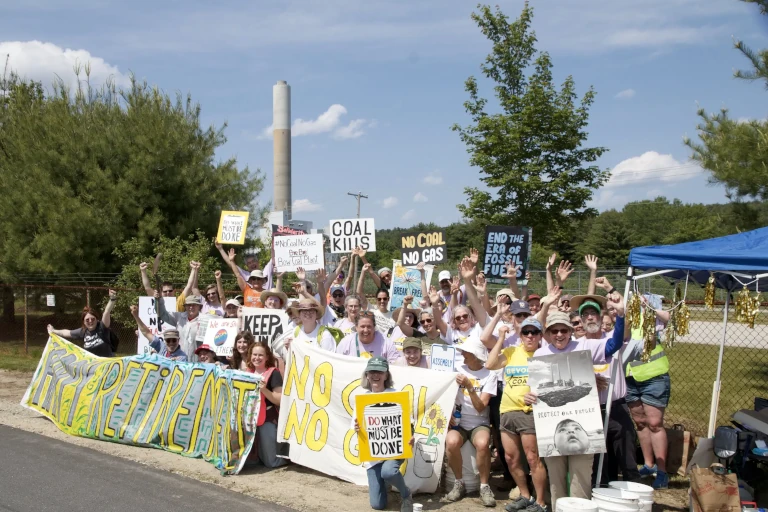
This article was originally published on Waging Nonviolence.
On March 27, Granite Shore Power, or GSP, announced that it will “voluntarily” stop burning coal at its Merrimack and Schiller Stations in New Hampshire by 2028. Major news outlets have been hailing the news as the “end of coal in New England” and casting GSP as a leader in the transition to clean, renewable energy.
Insofar as media have acknowledged the role of outside pressure on GSP at all, they have mainly cited a lawsuit by the Sierra Club and Conservation Law Foundation for alleged violations of the Clean Water Act. But activists know better: Nonviolent direct action gets the goods.
Those of us who have participated in the No Coal No Gas campaign, or NCNG, have been anticipating Merrimack Station’s closure for some time. (Schiller Station has not run since May 2020.) In fact, in June 2023, we threw a festive retirement party outside Merrimack Station’s gates, complete with cake and surveillance by the New Hampshire Department of Homeland Security and Emergency Management. Then, just three weeks before GSP’s own press release, we held a weekend retreat to reflect on everything our campaign has accomplished, plan for the future and strategize when, how and whether to declare victory.
It had become obvious to us that victory was imminent, if not a fait accompli. In partnership with the Sierra Club and 350NH, we have been monitoring the plant’s failed attempts to complete federally-mandated stack tests to measure its pollution emissions. At the same time, from conversations with local IBEW workers, we also know that employment at the plant has all but dried up, as union workers only come in to do repairs. What’s more, by monitoring our regional grid operator’s annual “forward capacity payments” — which are effectively taxpayer subsidies for coal — we know that funding for Merrimack Station is slated to end in 2026.
However, the most striking bit of evidence pointing to the plant’s demise is the fact that we have not seen any new coal deliveries in well over a year. We believe this is largely due to the campaign’s rather spectacular and widely reported coal train blockades. From December 2019 to December 2022, we stopped multiple trains in Massachusetts and New Hampshire. We stopped a single train no less than three times on its route, and we stopped another for hours by erecting scaffolding on the tracks. This strategy pushed rail carrier CSX, in one case, to split a very long coal train into segments in an unsuccessful and expensive attempt to “hide” from activists.
Halting resupply, even temporarily, is one tactic to convince corporate oligarchs that coal is a bad investment. Another approach, used by NCNG’s corporate research group, was to directly target Merrimack Station’s two private equity owners, Castleton Commodities and Atlas Holdings. We delivered coal to their corporate offices and even to the homes of CEOs, holding rallies and dropping banners. In 2021, Castleton decided to divest from the partnership.
Beyond pressuring for divestment, though, these tactics strive to show what’s possible. In this vein, we’ve also pursued civil disobedience at Merrimack Station itself. In 2019, 69 people in Tyvek suits were arrested as they carried buckets onto the property, vowing to carry the coal out bucket by bucket. In 2021, 18 of us began renovating the facility’s driveway, digging up asphalt and planting food for people and flowers for soil remediation. Like so much nonviolent direct action, these were not only attempts to interfere with business as usual; they were acts of collective imagination.
On the streets, in the courts, in our writing, art and advocacy, activists seek to expose, critique and upend systems of power. Like anyone who practices civil disobedience, we’re often told that there are “more appropriate” ways to enact change. But as one of our members, Nastasia Lawton-Sticklor, puts it, “disobedience. . .[is] an uncompromising vision of radical, as in from the roots, change.” This doesn’t necessarily mean that we see ourselves as some kind of extreme flank, “throwing ourselves into wild escalation to make lawsuits and the legislation seem inherently reasonable.” Rather, Lawton-Sticklor says, “I see this as an invitation to continue peeling back the layers of systemic power, to make visible the inherent compulsion for self-preservation that grounds systemic concession, and to keep going.”
A campaign and a community, not an organization
How does a climate campaign “keep going”? How do we sustain such pressure and diversity of tactics over a period of years? It actually has a lot do with NCNG being a campaign, as opposed to a more formal nonprofit organization.
While we certainly benefit from — and could not continue without — support from the Climate Disobedience Center and 350NH, NCNG is not embedded in or beholden to the nonprofit industrial complex like many other organizations are. As a result, our strategic decision-making is not driven by fundraising concerns or donor preferences. Rather, the campaign draws on capillaries of power running through multiple, shifting affinity groups and mutually beneficial relationships with other established groups and campaigns.
Since its inception in 2019, NCNG has had three precisely articulated goals: 1. Build unity and community; 2. Show what is possible; and 3. Shut down the Merrimack Generating Station. It’s worth noting that shutting down Merrimack Station was only ever our third — and arguably the least important — goal. We know, after all, that this coal plant is only one contributor to climate catastrophe and that our own actions are only one tiny part of a much larger, multi-pronged climate justice movement.
“Building community” does not simply mean that campaign participants become their own kind of cohesive in-group, although that has sometimes happened. Rather, the campaign seeks to establish and nurture relations among existing and yet-to-be communities.
We are college professors, ministers, farmers, artists, scientists, lawyers, students, parents, grandparents and shift workers. We bring connections to schools, churches, radical collectives and political formations. We help stitch together relations among existing nonprofits like 350.org and fellow campaigns like Fix the Grid; we encourage new affinity groups and support longstanding ones; and we have made our presence known to our regional grid operator ISO-New England. Sometimes we have done so in playful ways — for example, by delivering a wheelbarrow of coal to their security gate during a blizzard on Super Bowl Sunday.
Moreover, we have intently studied their arcane operations and then elected members to their Consumer Liaison Group in what became known locally as the “ballroom coup.” In this capacity, we have pressured ISO-New England to stop giving ratepayer money to legacy fossil fuel plants. We have enlisted hundreds of friends and supporters in writing public comments urging the Federal Energy Regulatory Commission to reject these forward capacity payments.
In turn, we show up for others’ struggles. Perhaps because we did so much intensive organizing during the height of COVID — when so much work and sociality had to move online — we have been able to draw in like-minded activists from around New England and beyond, and to connect with other activist efforts.
NCNG participants routinely show up for each other’s actions on, for instance, LGBTQ+ rights or the Free Palestine movement. We sometimes even put the campaign on pause to lend support to major actions, as we did during 2021, when many of us traveled to Minnesota in the fight against Line 3, incurring arrest and continuing to provide remote legal support to fellow co-defendants. Showing up for other groups’ struggles is critical, not only because our issues are all so intertwined, but also because in doing so, we learn. We share our skills and develop new ones. We engage in the critical, sustaining activity of thinking together.
New England after coal
On April 4 we held a mass call on Zoom to celebrate Merrimack Station’s closure announcement, and to sketch out our next phase. Continuing to show what is possible, we are looking to shut down all of New England’s so-called fossil fuel peaker plants — those facilities that, like Merrimack Station, run only during times of peak electricity demand, generally during periods of extreme cold or heat. As the Christian Science Monitor reported, Merrimack Station ran for only about 500 hours last year.
Peaker plants are expensive and dirty, and arguably unnecessary. In many places they are being replaced with battery storage. They could also be eliminated, we believe, with better demand response, which means encouraging consumers to shift their electricity use to times when demand on the grid is lower. We feel that leadership from our utilities and grid operator has been lacking in this regard, so we are doing what they won’t: building a ratepayer collective that will practice demand response on the New England grid ourselves.
As our demand response cohort puts it, this means “We will stay grounded in community and mutuality because we are more than individual ‘consumers.’ We have the power to choose to work collaboratively to shift our relationship to energy use, to become more intentional. And this means that together we have the power to transform how the energy markets in our region work.” In short, by building an alliance of ratepayers “ready to support each other in the face of snowballing economic, environmental, health and social crises,” we will be laying the foundation “for joyful, community-centered conservation demand response and a just transition.”
This, maybe, is what “victory” in the climate fight really means: that we are learning what we can achieve together, with or without the necessary actions that our governments, economic leaders and regulators seem categorically or politically unwilling to take. Something that has always stuck out to me is a series of questions I’ve heard posed by Marla Marcum, one of the founders of the Climate Disobedience Center (and our campaign). Many times, after a nonviolent direct action, we will be debriefing, and Marla will ask, “Regardless of whether this particular action succeeds in shutting down this particular coal plant, what has it done for us? What have we learned? How have we grown stronger? What does this growth make possible?”
When we fight, we really do win. And what we win is the ultimate bulwark against climate grief and despair. We find each other.





Comments
Welcome to the new Resillience commenting system!
We have moved from the former Disqus commenting system to a new system as of September 10, 2026.
We made this change because of privacy concerns regarding Disqus. It's also part of a set of changes to bring more services to the Resilience community under a single login: commenting, (coming September 2026), and online courses (coming 2027). Unfortunately, your old Disqus comments may not reliably link to your account in this new system. Please contact us if you have any questions or concerns.
This is exactly what the climate movement needs – civil disobedience and broad alliances. The corporate goal of burning the planet to a crisp in the interest of boosting profits can never be stopped by logical debate – only force can bring change. And, in our dreary, depressed, soul killing culture of distraction, civil disobedience should involve fun.
I don’t think I understand. There is no mention of people reducing their energy use that I saw in the article. It’s obvious that the north east portion of America cannot live on solar panels with a capacity rating of about 10% And wind farms with a capacity reading of about 30% with no back up power resources, such as batteries or major dams. So if you shut down a coal or gas powered powered plant, But you don’t put in another energy system and people keep using the same amount of energy, you’re just gonna pull energy from the grid that is supplied in another state where they just built the new gas plant. The harder thing would be to convince most of the people in New Hampshire and adjacent sates to stop using so much energy. I love just like the previous poster noted, the energy and dedication that the coal and gas protesters have. But how do we go out and protest If what we say is please reduce all energy consumption to about 30% of current use. Will anybody do it? If will shut down a coal power plant, will a nuclear power plant immediately gets put in his place, if that’s your idea of clean energy. We shut down a coal plant in America and then heavy industry, Which can’t tolerate intermittent energy sources like wind or , just moves to India and China, where they use coal. And then we buy their products which we plug into our wall sockets. William Ophuls‘ phrase “electrifying The Titanic” Is what I think is going on. Until the protesters acknowledge their utter dependence on fossil fuels, And acknowledge the amazing self sacrifice that will be required of everybody to get off them, and stop pretending that all we have to do is electrify everything and business can go on, then I will Feel that the protest will be fruitful. Art Berman Correctly calls, , Efficiency, innovation and technology stowaways on a Massive ship powered by diesel engines Working quietly beneath our feet. But what about small modular liquid thorium Reactors You might say. Sure make them work, Let’s see how many of them it would take to replace all the fossil fuels. You gotta have them available available before you Start shutting down gas and coal plants. You are gonna need all the fossil high heat for manufacturing, The diesel for the massive trucks and mining, the bunker fuel to transport the materials across the world in order to build any of those small nuclear reactors in the first place. And until those nuclear reactors produce 50% or more of all the power in the world world they won’t be able to self Replicate. So as long as nuclear remains a niche product with only a small fraction of world primary energy, it remains a byproduct of fossil fuel use rather than a primary energy source, because without fossil fuels, you could not possibly make nuclear power. So when they say nuclear power from the website, our world and data, accounts for 4 to 5% of world primary energy use, that is actually false in my opinion. Fossil fuels and wood are 100% of the primary energy use. Because they are absolutely necessary feed stocks into any other energy source that we call upon. And none of the other energy sources, Such as hydroelectric, nuclear, wind, solar can reproduce themselves from the energy that they produce. So if fossil fuels were removed tomorrow, all of these sources of so-called energy would fail within a short period of time. Fossil and biomass can produce all the necessary energy for their production and Can on their own support modern civilization. So to me , it looks like all these other “energy sources” are derivative Fossil fuel and biomass use . So Get going on that if that’s your plan. unfortunately, there is going to be an uptick in fossil fuel use in order to build out the next energy infrastructure. So maybe the protesters should prioritize fossil fuel use for heavy industry that produces “renewable low carbon “technology and infrastructure while Telling the general population to tighten their belt and lay off the use of electricity and Liquid fuels for frivolous uses such as flying on vacations, driving around to Walmart, watching TV and running the lights all day. But that is an uphill battle. My own family thinks I’m a crank and that I have have ridiculous ideas. If I can’t convince them, how can I convince anybody? I would more than be happy with my whole extended family of 10 people living at our. 2000 square-foot house, playing cards and singing songs rather than watching TV. Skipping the driving and flying. Walking to the store to buy local produce. Mending our own clothes. Having one computer that we use only when the sun is shining Or if there’s enough battery power left. Getting rid of the Internet and cable TV and going back to watching movies on Sunday at the theater downtown with all our friends. Riding the train To the next town rather than driving. Eating home-cooked food instead of eating out. Giving up high-tech medicine, going back to the 1950s and 60s levels technology. Checking out books from the library rather than having them sent to the house by Amazon. Schools using chalkboards rather than computers. This lifestyle sounds fantastic to me. If you were to go protest and stand in front of a coal plant, And say we are going to get rid of this coal plant and we don’t need the energy because we’re going to adopt these habits from the past and be happier at the same time, I will be right out there on the protest line, wearing the same jeans I wore 25 years ago with mended holes on the knees. I think this is what everyone’s gonna do anyway, but they’re gonna have to be convinced that the coming energy transition is not a world of plenty but a world of scarcity, and then they will become creative and they will start rationing, and they will start hanging out together again and families won’t tolerate their kids flying to all parts of the world and living thousands of miles away , And life will become more local and slower. Old people won’t live live on their own anymore, they’ll be bunking with their family. Nursing homes will shut down. Maybe in 150 years when small modular nuclear power produces 90% of the worlds energy And can make up for the lack of fossil fuels, perhaps will go back to George Jetson, and dreams of Star Trek.