

Amid a tumultuous legislative session, Congress has extended the current Farm Bill through fall 2024. The extension will provide some certainty to farmers while also giving lawmakers an additional year to deliberate the merits of the five-year, $700 billion funding package. This extra time allows lawmakers to more thoroughly consider innovations and investments that will shape the future of American agriculture – including “agrivoltaics,” a new practice that melds farming and solar energy.
In the five years since the last farm bill was passed, utility-scale solar energy generation in the U.S. has more than doubled, and the Inflation Reduction Act is providing further support for renewable energy development in rural communities through the Renewable Energy for America Program, or REAP. The rapid expansion of solar energy is expected to continue: the U.S. Department of Energy projects that installed solar capacity will increase by at least a factor of seven by 2050. Efforts to increase solar capacity are part of the Biden administration’s plan to speed up the renewable energy transition through funding for new energy transmission projects and a proposal to limit environmental reviews for renewable energy projects.
While applauded by some, the explosive growth of solar energy also sparks concern about the loss of prime farmland. The American Farmland Trust projects that over 80% of new solar projects built by 2040 will be sited on agricultural lands. Solar development is not expected to be evenly dispersed, leading to increased costs for farmland in certain communities and potentially pushing some farmers out of business. These concerns have spurred the development of an emerging land-use practice with a more synergistic approach: agrivoltaics.
Agrivoltaics is an emerging dual-use approach where land both generates power from solar panels and maintains agricultural production. Agrivoltaics allows for crop production, livestock grazing, and pollinator habitat beneath and in between rows of solar panels. In addition to allowing for dual land use, in some cases agrivoltaics improves crop yields, soil carbon, and irrigation efficiency. Agrivoltaics projects can be found in many countries around the globe, from China and Japan to Germany, Italy, and Kenya.
With recent support from the U.S. Departments of Agriculture (USDA) and Energy (DOE), researchers at institutions across the country are studying the potential of agrivoltaics. Further, members of Congress are showing their support for agrivoltaics through the use of marker bills, proposed legislation that signifies a legislator’s interest in a topic for consideration in the Farm Bill.
Earlier this year, three marker bills on agrivoltaics were introduced in the U.S. Senate. Senators Heinrich (D-NM) and Braun (R-IN) introduced the “Agrivoltaics Research and Demonstration Act of 2023,” a funding bill that would create a legal definition of agrivoltaics, allocate $75 million to agrivoltaics research over five years, and direct the U.S. Secretary of Agriculture to develop a five-year plan to support agrivoltaic systems that do not displace agricultural production.
Another marker bill, the “Pollinator Power Act of 2023” introduced by Senators Merkley (D-OR) and Booker (D-NJ), would direct the USDA’s REAP program to help fund up to 55% of the creation of a pollinator habitat on a solar project and give funding priority to projects that include pollinator-friendly habitat in their design.
Finally, the “Protecting Future Farmland Act of 2023,” which blends aspects of the earlier bills, was introduced by Senators Grassley (R-IA) and Baldwin (D-WI).
These marker bills represent a promising step toward balancing solar energy growth and agricultural production in rural communities. And their bipartisan support is important, given the general climate of conflict and polarization about addressing climate change in the Farm Bill.
One key legislative action is to give agrivoltaic projects priority for REAP funding. This provides a strong incentive for applicants to consider adapting agrivoltaics in their solar projects, given the high demand for REAP funding. Incorporating agrivoltaics into solar projects may help to reduce opposition to solar energy in rural communities like Pinal County, Arizona where the board of supervisors recently considered removing solar energy as a permissible use amid growing opposition from residents and farmers alike.
Funding for agrivoltaics in the Farm Bill would also allow the federal government to catch up with state governments in the regulation and promotion of agrivoltaics. Several states have enacted unique policies on agrivoltaics, such as pollinator-friendly scorecards, feed-in-tariffs, smart solar scorecards, and tax incentives, and agrivoltaic projects are increasingly prevalent in those states. With federal support through REAP, agrivoltaic installations may become more evenly distributed throughout the United States.
There is no doubt that the 2024 Farm Bill will occupy a critical period in America’s clean energy transition as several states make efforts to achieve targets set by Renewable Portfolio Standards and developers take advantage of the subsidies present in the Infrastructure Investment and Jobs Act and Inflation Reduction Act. By incorporating agrivoltaics into the upcoming Farm Bill, Congress can help ensure that solar development is complementary to –rather than competitive with — America’s agricultural interests.



Comments
Welcome to the new Resillience commenting system!
We have moved from the former Disqus commenting system to a new system as of September 10, 2026.
We made this change because of privacy concerns regarding Disqus. It's also part of a set of changes to bring more services to the Resilience community under a single login: commenting, (coming September 2026), and online courses (coming 2027). Unfortunately, your old Disqus comments may not reliably link to your account in this new system. Please contact us if you have any questions or concerns.
Yeah, I’d more interested in information about how this can work, on the ground, rather than discussion of the bills that could enable it. Both agriculture and photovoltaics require sunlight, and watts fall on a given section of land at a given rate– X watts can’t power both plant growth and electricity production at the same time. But in some circumstances, shade can be a plus. What are those circumstances–is the solar farm still efficient enough if the panels are widely dispersed–what have been the results of experiments so far?
There are papers out there on this. Obviously it’s ongoing research.
https://www.sciencedirect.com/science/article/pii/S2772783122000358
Quite nonsensical research: “agrivoltaic sheep have an emissions burden that is roughly 25% better
than conventional sheep, which is due to the absence of corn and soybean
feed in the agrivoltaic system.”
There is nothing inherent in either agrivoltaics or conventional sheep production that you should use use corn and/or soy
The problem is that our industrial food system stresses the production of just a handful of crops — and all of them are annuals, that die every year.
Annuals are typically “pioneer species,” that have adapted to thrive in disturbed soil. In nature, they spring up where floods, landslides, etc. have disturbed the soil and have wiped out the slow-growing perennial plants that were there before the disturbing event.
Besides requiring disturbed soil (which is why we till soil), annuals are optimized for direct sunlight, for areas where the shading perennials have gone away.
So, two factors mean we will never grow 90% of food that we eat under solar panels, as produced by corn, wheat, soybeans, rice, etc.: no disturbance, and no direct sunlight.
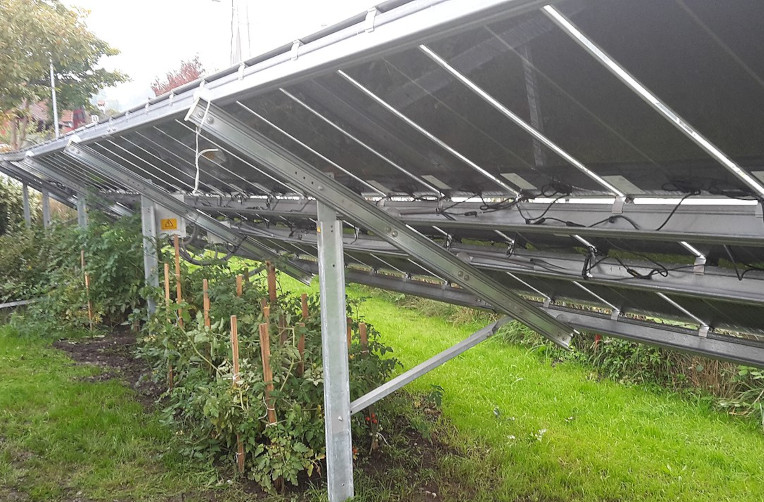
The photo with this article appears to show carefully-tended tomato plants, raising the issue of labour. You don’t just drag a tractor through the solar panels a few times and wind up with a lot of food!
To me, this is just green-washing. Growing food under solar panels will never amount to more than a few percent of the food that was grown there before the solar panels.
I believe that there are SOME beneftis of agrivoltaics in very sunny climates where some shadow may be of benefit for plant growth, but I find that there are many exaggerated statements about the benefits (grazing with sheep is an obvious multiple use but it is really more of a cheap solution for maintainance of the grounds than agriculture production). In many cases it seems to be more an lever for solar companies and land owners to counter mounting resistance to solar power farms established on agriculture lands. Which is also stated in the article- Caution is warranted….