

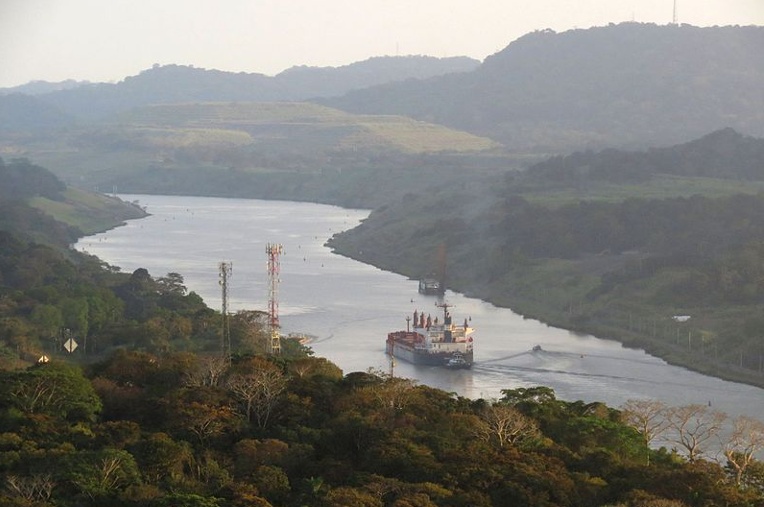
You’ve almost certainly read about the backup of ships waiting to transit the Panama Canal, which carries 6 percent of all commercial ships worldwide. While the worry among faraway readers may be concerns about supply chain disruptions that could lead to holiday shopping shortages, the problem in Panama is more immediate. The proximate cause of the backup is severe drought. That makes sense on its face because the canal is full of water and that water has to come from somewhere.
In a tropical country with copious rainfall—260 cm (102 inches) on average for the whole country in 2021—one wonders what passes for drought. (For comparison, I used to live in Portland, Oregon, a rather damp city with 44 inches of annual rainfall.) But inadequate rain during Panama’s rainy season has left two artificial lakes which feed the canal low on water. These lakes must supply 200 million liters (53 million gallons) of fresh water for each ship that transits the canal, water that is lost to the ocean. During the Panama Canal Authority’s fiscal 2022 year more than 14,000 vessels transited the canal. This matters doubly because these lakes also supply drinking water to half of all Panamanians.
The result is that the Canal Authority must ration water to the locks, decreasing the depth of the water and keeping many ships from carrying full loads that would cause the ships to hit the bottom of the locks. It has also had to limit the total number of ships making the trip in order to conserve water.
The problem is not going away soon. The authority has said that restrictions on the number and draft of vessels will remain in effect through 2024.
The canal is just one more example of infrastructure built with the idea of a stable climate in mind. Elsewhere just last year, shipping on the Rhine River was disrupted by low water levels as was a main shipping artery in China, the Yangtze River. The Mississippi River experienced low water levels in 2022 and may again experience low water this year just as the grain harvest comes in, a harvest that depends on the river to carry much of its produce.
There has been talk of building a second canal across Nicaragua on and off since 1825. Such a canal would face the moving target of climate change. New infrastructure can no longer be built relying merely on records from the past. It will have to grapple with changes in the future that cannot be easily forecast as climate change makes long-term weather patterns ever more unpredictable.
Photo: Panama Canal at Gamboa (2012) by Katja Schulz via Wikimedia Commons https://commons.wikimedia.org/wiki/File:Panama_Canal_at_Gamboa_-_Flickr_-_treegrow.jpg




Comments
Welcome to the new Resillience commenting system!
We have moved from the former Disqus commenting system to a new system as of September 10, 2026.
We made this change because of privacy concerns regarding Disqus. It's also part of a set of changes to bring more services to the Resilience community under a single login: commenting, (coming September 2026), and online courses (coming 2027). Unfortunately, your old Disqus comments may not reliably link to your account in this new system. Please contact us if you have any questions or concerns.
Changes made in infrastructure need to take into account both climate change impact as well as consumption patterns. According to a 2021 article, ships moving through the canal are carrying grains (largely soybeans) from the US to China and LNG from US ports to Asia, and exports from China to both the US and Europe. https://ajot.com/news/connecting-the-world-through-the-panama-canal
The need for the expansion to the Panama Canal was largely driven by larger container ships and more stuff purchased from China. As China’s economy slows and as other nations stop buying so much consumable goods from Asia the volume of trade will also change. As we move away from fossil fuels and industrial agriculture we won’t need to ship as much stuff through the Panama Canal.