

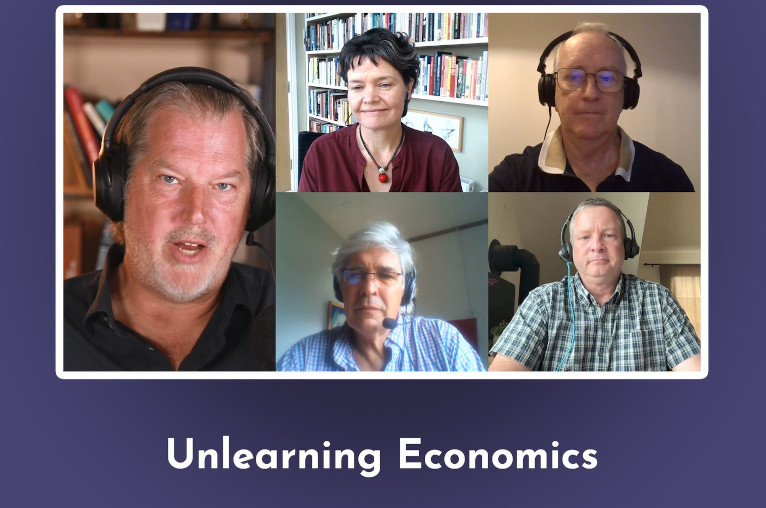
(Conversation Recorded on July 18th, 2023)
Show Summary
On this Reality Roundtable, Nate is joined by Jon Erickson, Josh Farley, Steve Keen, and Kate Raworth – all of whom are leading thinkers and educators in the field of heterodox economics. In this lively discussion, each guest begins by sharing one fundamental aspect of what conventional economics gets wrong and how it could be improved in our education system. What basic assumptions about humans have led to a misunderstanding of the average person’s decision making? What areas has economics turned a blindspot to as the foundation of our economic systems? Who is finding the models and systems that economists have created useful – and how does economics as a discipline need to change in the face of a lower energy future? In short, what we teach our 18-22 year olds around the world matters – a great deal.
About Jon Erickson
Jon Erickson is the David Blittersdorf Professor of Sustainability Science & Policy at the University of Vermont. He has published widely on energy and climate change policy, land conservation, watershed planning, environmental public health, and the theory and practice of ecological economics. He advised presidential candidate Bernie Sanders on economics and energy issues.
About Josh Farley
Joshua Farley is an ecological economist and Professor in Community Development & Applied Economics and Public Administration at the University of Vermont. He is the President of the International Society for Ecological Economics.
About Steve Keen
Steve Keen is an economist, author of Debunking Economics and The New Economics: A Manifesto. He is a Research Fellow at the Institute for Strategy, Resilience, and Security at University College in London.
About Kate Raworth
Kate Raworth describes herself as a renegade economist focused on making economics fit for 21st century realities. She is the creator of the Doughnut of social and planetary boundaries, and co-founder of Doughnut Economics Action Lab, based on her best-selling book Doughnut Economics: 7 Ways to Think Like a 21st Century Economist. Kate is a Senior Associate at Oxford University’s Environmental Change Institute, where she teaches on the Masters in Environmental Change and Management. She is also Professor of Practice at Amsterdam University of Applied Sciences. She is a member of the Club of Rome and currently serves on the World Health Organisation Council on the Economics of Health for All.
Watch on YouTube
Show Notes & Links to Learn More:
00:00 – Jonathan Erickson works, info, & TGS Episode. Josh Farley works, info, & TGS Episode 1 + 2. Steve Keen works, info, & TGS Episode. Kate Raworth works, info, & TGS Episode.
02:30 – 235 million university students globally
04:53 – Paul Samuelson
07:03 – George E.P. Box
08:39 – Homo economicus
10:20 – Marginal Benefit equals Marginal Costs
10:56 – Robert Frank, Economic Naturalism
11:54 – Normalcy Bias, Asymmetric Insight, Hindsight Bias
13:02 – How Well Do Economists Forecasts Recessions | IMF
14:36 – Teaching that humans are inherently selfish increases selfish behavior
15:17 – Thorstein Veblen
16:07 – Evolution is driven by both competition and cooperation
16:36 – Is It Good to Cooperate? | Testing the Theory of Morality-as-Cooperation in 60 Societies
17:25 – Charles Darwin discourse with economists
19:09 – E.O. Wilson, Consilience
21:02 – Demand Curve, Hicksian-compensated demand curve, Market demand curve
21:21 – Sonnenschein, Shafer – The market demand curve can be represented by any polynomial
22:22 – Max Planck
22:56 – Scientology
24:07 – William Nordhaus, Nobel Prize Paper
25:32 – Correlation between energy and economic growth
26:38 – Leontief Model
26:55 – Neoclassical Economics
27:52 – Bachmann et al. 2022 Paper
29:20 – Cobb-Douglas Production Function
33:10 – Data on energy and GDP correlation globally and by country
36:20 – Galileo and Kepler correspondence
37:10 – Work potential in a barrel of oil in Kilowatt hours
37:50 – Annual change in private debt against change in unemployment correlation
38:42 – Schelling
29:10 – Every product is supported by oil
46:09 – Optimal Utility Maximization
48:20 – Record food profits 2022
48:31 – Betting on the future of food: A quantitative model of food prices
49:31 – 2 year time lag between oil investment and production, 1 year for food
50:45 – Small increase in the price of essential resources causes all prices to skyrocket
51:40 – Ecological impacts of economic activities
52:49 – In essential resources you make more money by producing less
53:14 – Enron collusion to withdraw power from the California system, skyrocketing prices
53:38 – Brazil electric crisis managed by rationing
55:38 – Adam Smith
56:39 – Universal Basic Income
57:24 – Universal Healthcare
57:31 – 20% of US GDP goes to healthcare
57:44 – 6.7% of US income goes to food for home consumption
58:32 – Agriculture is the biggest threat to global ecosystems
1:02:33 – Monsanto and GMO seed rights of use restrictions
1:02:45 – Publicly developed innovation brings more return on investment than privately developed
1:04:03 – Understanding the Private-Public Divide
1:04:11 – Payback Period
1:04:20 – Dynamic Economic Systems: A Post Keynesian Approach – John Blatt
1:04:59 – Ecocore.org
1:05:09 – Adam Hardy
1:06:58 – The Inefficiency and Unfairness of Tradeable CO2 Permits
1:07:15 – Henry Shue
1:07:29 – Pareto-optimality
1:08:04 – Law Diminishing Marginal Returns
1:10:09 – Alan Kirman: The Intrinsic Limits of Modern Economic Theory: The Emperor has No Clothes
1:18:50 – Diversity in the field of economics
1:21:41 – Elinor Ostrom – Core Design Principles
1:23:29 – Physiocrats
1:31:41 – International Baccalaureate
1:32:15 – Ecological Economics
1:33:58 – Education as an inoculation of consumers
1:34:13 – Next Systems Reader
1:36:36 – Minskey on SourceForge
1:37:04 – Leadership for the Ecozoic
1:38:30 – Doughnut Economics





Comments
Welcome to the new Resillience commenting system!
We have moved from the former Disqus commenting system to a new system as of September 10, 2026.
We made this change because of privacy concerns regarding Disqus. It's also part of a set of changes to bring more services to the Resilience community under a single login: commenting, (coming September 2026), and online courses (coming 2027). Unfortunately, your old Disqus comments may not reliably link to your account in this new system. Please contact us if you have any questions or concerns.
I shared this video at The R-Word.
And then I made a comment about it there. Here’s what I said.:
“Nearing the end of this discussion, Kate Raworth asks (paraphrasing) “What if we were to take Elinor Ostrom’s observations about the well-functioning of the commons and apply it within The State?”
Wow! That was worth the full price of admission!
It helped me to more deeply understand what The State really is, which is an engine built for the purpose of maintaining the present class system, in which there are very distinct “social classes” (also “economic classes” whose “winners” happen also to be the protectors and maintainers (reproducers) of what is sometimes called “the political class” and which also is sometimes called “the ruling class”. Of course, not everyone in the “political class” is in the “ruling class,” per se, but as we can readily see, by the typical definition of the political class in functional terms, they may as well be.
I’m becoming more of an anarchist each day!”
https://rword.substack.com/p/unlearning-economics-jon-erickson/comments
I suppose I’m drawing on what is sometimes called “historical materialism” type theoretical methodology here. That is, it seems to me that when historical materialists ask “What is the state?” they mean mostly, “How has the state tended to behave historically?”
Raworth’s question, which I highlighted, seemed very counter-intuitive to me, in the sense that what we now know as “the state” has always behaved in such a way as to eliminate (or seek to eliminate), not boost, the practice of commoning. In this sense, the modern / contemporary state is a pure representative of capitalist ideology. Capitalism is… in a word … anti-commoning. So the state is anti-commoning.
Could a commoning state emerge? Perhaps?!? But it would not be a modern state.
While this is not a recent story, it’s one fine example among hundreds of similar things which have been happening for decades, at least.
How a Koch foundation influenced a university economics department
By Valerie Strauss
https://www.washingtonpost.com/news/answer-sheet/wp/2014/09/12/how-a-koch-foundation-influenced-a-university-economics-department/
A very interesting podcast. Many people believe they are captured by our economic system. We can’t free ourselves of the necessity of a good job or higher prices for essentials. We can’t do anything about corporations that control the market or the current economic system, which concentrates wealth in the hands of the few and encourages corporations to maximize profits and socialize costs
I’ve taken a different approach that I used to simply call “sustainable living”. It involves several practices that allowed us to have more control over our personal economics.
I recommend firstly, reduce or eliminate debt. The more debt we carry, the more dependent we are on the vagaries of the economy. The biggest debt most people have is their home mortgage. So ignore the bank when they calculate how large a mortgage you can afford (usually monthly payments are 40% of your disposable income) and buy a smaller home that requires a smaller mortgage. Save as much as possible and try to make a down payment of 25 to 30%. This will allow you to make extra principle payments and greatly reduces the amount of interest you pay over the life of the loan. The second debt is now likely college loans, which would take much more discussion on how to avoid them. The third debt category is credit cards. Use them as little as possible and always pay off credit card balances every month. Save before you spend and delay gratification. This allows us to actually see the difference between needs and wants.
Secondly, become more self-sufficient at home. Grow, cook, and preserve food at home. Buy the most reliable appliances and vehicles. Make and repair clothing. Invest in high quality hand tools and learn to use them. Avoid buying cheap crap that breaks.
Thirdly, save money by spending less on energy. We did this by investing in energy efficiency and then eventually renewable energy. When we reduce our home or vehicles energy use we save money on energy bills. Reinvest these savings in more efficiency measures and eventually install solar panels and become your own energy producer. The return on investment for renewable energy is roughly now 10 years. Solar energy is an upfront investment so once you install the system your energy bills drop immediately. We purchased our PV system in 2017 and our monthly energy bill has been $10/month. Later we invested in new windows and now our home uses even less energy and our PV system generates enough energy to power an EV. As we enter retirement we will have low fixed energy costs and the market prices won’t have a significant effect on us.
All of these changes give us more control over our family budgets, and make us more resilient to swings in the market or economy. It may be difficult if you lose your job, but if your mortgage is paid off or you have paid off a significant amount of the principle your bank is more likely to work with you until you find a job. If your living costs are low and you don’t have enormous debt hanging over your head, you can get by with lower income.
I realize that the price of a home or college education today is significantly higher than it was 25 years ago when we bought our first home. That may mean that we have to find new and creative ways to achieve home ownership. Maybe extended families will need to stay together under the same roof, supporting each other in raising children and caring for us in our elder years. We don’t need to accept what the corporate mouth pieces, the advertisers, or the social influencers tell us is the best life for us to lead.
I always have to remind you how low-payed and poor most Americans are.
There’s an old joke: How did you become financially secure? Answer: I inherited $10 million from my grandpa. Why can’t you do that?
I’m glad you and your husband are lucky winners , Jody.
But most people worked as hard as you, and didn’t get the good breaks you got.
This is an attitude that allows society to punish the losers.
The market allows only 10% or fewer to succeed.
Biden can give burned out people $700 and say Rebuild.
But there’s an army of predators, such as banks and insurance companies standing between them and recovery. And the entire life they built is totally gone.
You don’t really know my life’s story, Red Hornet. Your comment implies that even though people may work hard, they succeed because of luck. That also implies that people fail because they had bad luck. Personally I don’t believe in luck, or that fate simply favors some over others. I believe in karma, that life is just, that every action has a reaction. I have faith the universe is just. I don’t think God punishes people for failing. I think God gives us opportunities to succeed. The true suffering, as Buddha taught, was because people don’t get what they think they deserve. Life brings what it brings. We can have faith, and do our best, or we can blame fate. Pray to God, and row away from the rocks….and remember to give thanks when the storm passes.
I wish Jody hadn’t answered me. Not that she’s right, but now I feel totally disappointed in her. I wish my mentor Rev.James Wilson Trent were still alive so I could discuss this with him. Sadly he died in heart surgery 2 years ago at age 73.
He spent his entire life doing everything he could to help those less fortunate than himself. And I will confess I’m very poor now because I tried to do likewise.
I never tried to “grab all the gusto I could get. “
Red Hornet, let’s stick to issues rather than personalities.
Jody is an exceptional human being for whom I have high expectations.
I hope you told Jody too.
Limiting to about 3 posts a day.
I’m sorry Red. I didn’t mean to offend you.
You are an ideal for me, with your idle curiosity and industrious nature.
But it scares me sometimes when I think religious beliefs are prejudicing the scientific method and free inquiry.
It’s not that I think you’re ignorant or closed minded or even selfish. I can see you’ve explored other belief systems.
“We shall overcome because the arc of the moral universe is long but it bends toward justice.” MLK (not unusual)
So you’re entitled to believe. But I’m entitled to doubt. If we could be sure things turn out alright why would we try to interfere?
I’m still glad you have low debt and some useful assets. I’ve been there and I remember how over confident and hubristic I became.
What hurt me most is that you seemed to deny how vulnerable all people are, without exception.
You contribute plenty to YCC by broadening the worldview and bringing details.
Too bad you’re not working as a professor.
Jim Trent was an older boy in college who went on to seminary, married my college kindred spirit, and wrote “Inventing the Feeble Mind:
A History of Intellectual Disability in the United States” and several other influential books and articles. He taught at Gordon College.
I served as a reader and sounding board for him for many years.
I tried to eliminate all debt by declaring bankruptcy in 2006.
It was an impossible struggle these last 18 years.
All started when a tree fell on me and broke my right hip. (age 49)
It could happen to anyone.
Then I had to care for my Lewy Dementia victim mother, until last week when she died with no insurance and no money. Cremation cost $1500 and has put me slightly in debt. That will take awhile to pay on my low income. I was enjoying some spaghetti and canned beans this evening. Ate out on the front porch with the A/C off. Every little bit helps.
Here in South Australia we have the highest solar uptake in the world. We also have one of the highest prices for electricity in the world. We have solar panels 6kwH system but our bills haven’t reduced that much. The energy retailers throttle the amount of power we can export most sunny days because it destabilises the grid. Two months ago our power bills were increased by nearly 30%. So we get a measly 5c/kw feed in tariff and pay 15 times that for what we use plus $1/day for connection fees. Batteries are still too expensive. Sometimes no matter what you do you are still stuck in the system.
That is awful! The utility companies in my state (Indiana) tried to get legislation passed that residents with solar panels had to sell 100% of their energy production to the electric company for about 5c/kwh (or what they say it costs them to buy it wholesale). Then we had to buy it back at retail prices. The legislation didn’t pass but they did remove net metering options for new solar panel systems.
It comes down to a battle between the power companies who have a monopoly on selling electricity and residents who want to generate their own power. Sadly the government often sides with the utility companies.
Have you done a thorough review of your home’s electricity usage? We found it important to cut back electricity usage as much as possible before we installed solar. We made several changes that really helped. Attic insulation and proper soffit ventilation made a bid difference in summer and winter. We also changed all the lights to LEDs. We also replaced windows, which really helped but was the most expensive change. One of these days I hope batteries will become more affordable.
more – https://www.google.com/search?q=koch+grants+economics+department&sca_esv=557255143&rlz=1CALBTX_enUS1062US1062&sxsrf=AB5stBhgdnMRJRI1wgbPzoy4TYFQJYRNYQ:1692141022742&source=lnms&sa=X&ved=2ahUKEwiY3cfE5N-AAxV9ODQIHS3QAq8Q0pQJegQIAxAC&biw=1366&bih=612&dpr=1
Yup. Lots of Big Money folks, the Koch’s included, have for a long while been funding “economics departments”. Google (or use another search engine) using the terms koch grants economics department.
https://www.google.com/search?sca_esv=557255143&rlz=1CALBTX_enUS1062US1062&sxsrf=AB5stBgUDGVyPVJf3wTzgZRv5lOCgbFY8A:1692140618014&q=koch+grants+economics+department&tbm=vid&source=lnms&sa=X&ved=2ahUKEwjTg8mD49-AAxUxMjQIHWJhAxsQ0pQJegQICBAB&biw=1366&bih=612&dpr=1
Is there anything billionaires (and multi-millionaires) don’t control in the USA, and elsewhere?
Have you read the book “Democracy in Chains” by Nancy McLean? I highly recommend it because it deals with what Koch brothers did at VU. Likely similar to what they were up to at WVU.
https://history.wisc.edu/publications/democracy-in-chains-the-deep-history-of-the-radical-rights-stealth-plan-for-america/
No, but I found it available via my library on Kindle, so I downloaded it.
I’ll be interested in hearing what you think.
I’m 30% of the way in, not sure I’ll finish it as it way more historical detail than I need. I did learn one interesting thing early on, though, I hadn’t realized that slavery was making the slaveholders RICH, more so than anyone in the North. This must have been a small minority of white families, so why did the rest support slavery and fight a war to defend it? Maybe because slavery made the poor white ABOVE someone. I’m also seeing how crucial the Kochs were in funding the long campaign to install radical neoliberalism. They might not have had any other contribution, but in a capitalist system, money alone can change everything, against the wishes and interests of the vast majority. That’s what billions are good for, once you have more money than you can possibly spend–you can transmute some of it into power. I did read Jane Meyer’s book about the Kochs, so I have much of the recent history.
I think you are right about why poor southern whites supported slavery. I’d even go so far as to suggest that poor southern whites were even more racist than many of the wealthy plantation owners.
Money certainly conveys political power, one of the main reasons why I think we would be better off taxing billionaires out of existence. Another thing we need to curb is the political power and size of corporations. They also have too much power to control what nations do. The tobacco industry, the pharmaceutical industry, the fossil fuel industry….all press society to continue business-as-usual. Corporations will do whatever it takes to protect their business model and prevent change that will reduce their sales.