

A friend of mine who was trained as a physicist used to joke about a future in which each of us would carry handheld fusion reactors that plug in anywhere to provide copious amounts clean energy for our homes, automobiles, offices and factories.
The reality of fusion power, however, is one of huge scale and vast obstacles according to Daniel Jassby, a former research physicist at the Princeton Plasma Physics Lab. (All of what follows assumes that the remaining obstacles to producing net energy from fusion will be overcome. Addressing that issue would require a seperate and lengthy essay.)
Perhaps the most unexpected revelation Jassby offers runs entirely contrary to the clean image that fusion energy has in the public mind. It turns out that the most feasible designs for fusion reactors will generate large amounts of radioactivity and radioactive waste.
As Jassby explains, inside the Sun, which is powered by fusion, normal hydrogen atoms, each consisting of nuclei containing one proton, are fused together and produce helium plus energy. Here on planet Earth, fusion reactors “burn neutron-rich isotopes [that] have byproducts that are anything but harmless: Energetic neutron streams comprise 80 percent of the fusion energy output of deuterium-tritium reactions and 35 percent of deuterium-deuterium reactions.” (Deuterium is a hydrogen atom consisting of one proton and one electron in its nucleus. Tritium is a radioactive form of hydrogen having one proton and two neutrons.)
Jassby details the consequences:
[T]hese neutron streams lead directly to four regrettable problems with nuclear energy [both fission and fusion]: radiation damage to structures; radioactive waste; the need for biological shielding; and the potential for the production of weapons-grade plutonium 239—thus adding to the threat of nuclear weapons proliferation, not lessening it, as fusion proponents would have it.
He explains what this means for the operation of fusion reactors:
[I]f fusion reactors are indeed feasible—as assumed here—they would share some of the other serious problems that plague fission reactors, including tritium release, daunting coolant demands, and high operating costs. There will also be additional drawbacks that are unique to fusion devices: the use of a fuel (tritium) that is not found in nature and must be replenished by the reactor itself; and unavoidable on-site power drains that drastically reduce the electric power available for sale.
So, you may be asking: Why don’t scientists just use ordinary hydrogen instead of deuterium and tritium isotopes? Our attempts to re-create the Sun’s power on Earth face “much lower particle densities and much more fleeting energy confinement,” Jassby explains. That’s why scientists use deuterium and tritium “which are 24 orders of magnitude more reactive than ordinary hydrogen.” That’s 1024 times more reactive and therefore 1024 times EASIER to fuse under the considerably less favorable conditions we can create here on Earth.
“This gargantuan advantage in fusion reactivity allows human-made fusion assemblies to be workable with a billion times lower particle density and a trillion times poorer energy confinement than the levels that the sun enjoys,” Jassby explains.
The neutrons which are liberated in this type of fusion have to go somewhere. Over time, just like in nuclear fission plants, these neutrons damage the reactor vessel wall. One design addresses this issue by encapsulating the fusion fuel in a “one-meter thick liquid lithium sphere or cylinder.” This will create tons of radioactive waste that has to be removed annually. Without this approach the vessel walls will have to be replaced periodically and then transported to waste disposals sites. Scientists are working on better reactor vessel materials.
This problem is less pronounced using just deuterium as fuel. But deuterium alone is 20 times LESS reactive than a deuterium-tritium mix making it harder to successfully create deuterium-only fusion. In addition, deuterium-only reactors make ideal breeding environments for plutonium-239, atomic bomb material that can be made by introducing uranium-238 into the reactor.
(Uranium-238 is much cheaper and far more plentiful than uranium-235—which makes up only 0.7 percent of mined uranium and which is the only naturally-occurring fissile material. Bombarding uranium-238 with neutrons is a good way to make plutonium-239, a fissionable product suitable for atomic bombs.)
To power the enormously energy-intensive process of fusion, a fusion plant will use a lot of energy just to run itself. That means scale will matter. In order to accommodate this so-called parasitic power drain AND produce enough excess electricity to sell to pay for the costs of constructing the plant and for its ongoing operation, fusion plants will have to have a capacity of at least one gigawatt (one billion watts). One gigawatt can supply electricity to 300,000 to 750,000 homes depending on how the calculation is done. And, even much larger capacity per plant will be desirable because it will decrease the percentage of power production devoted to sustaining the fusion reaction and servicing the plant infrastructure. In short, making fusion plants big will be the only way to make them economical. So much for my friend’s fantasy of handheld fusion power units!
In a second article, Jassby addresses the International Thermonuclear Experimental Reactor (ITER) located in France. The project is a cooperative research venture designed to study and perfect fusion. It will not produce any electricity itself, but rather set the stage for so-called demonstration plants which could be built in the second half of this century.
This experimental reactor has the drawbacks listed above. The timeline it offers for practical fusion makes one wonder just how useful fusion energy, if made economical, will be in addressing urgent concerns about reducing carbon emissions. Of course, there is the obvious issue of having to build such plants using existing energy sources which are mostly based on fossil fuels. And, just to operate its experiments, ITER will require 600 megawatts of power, a window into the parasitic power requirements of fusion reactors.
The fantasy of cheap, unlimited fusion power arriving soon with no serious side-effects prevents us as a society from grappling with near-term energy depletion and our ongoing dependence on fossil fuels in the accelerated manner required to prevent a major energy crisis. Hope that fusion energy will somehow solve our energy and climate problems is not a real plan. It is just another illusory and far-in-the-future technical fix offered to convince us that we don’t need to alter our way of life in any substantial way to address the serious problems we face.
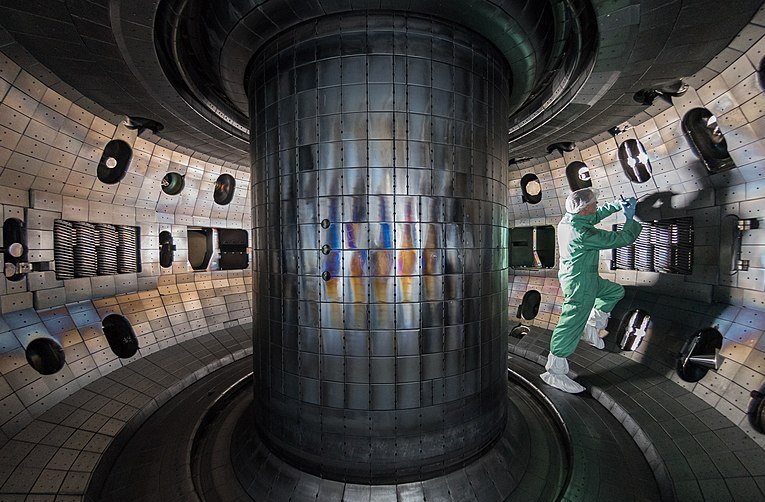
Photo: A worker inside the DIII-D vacuum vessel during a maintenance period in 2017 (DIII-D is a tokamak that has been operated since the late 1980s by General Atomics (GA) in San Diego, USA, for the U.S. Department of Energy)
Author: Rswilcox. Via Wikimedia Commons: https://commons.wikimedia.org/wiki/File:2017_TOCAMAC_Fusion_Chamber_N0689.jpg




Comments
Welcome to the new Resillience commenting system!
We have moved from the former Disqus commenting system to a new system as of September 10, 2026.
We made this change because of privacy concerns regarding Disqus. It's also part of a set of changes to bring more services to the Resilience community under a single login: commenting, (coming September 2026), and online courses (coming 2027). Unfortunately, your old Disqus comments may not reliably link to your account in this new system. Please contact us if you have any questions or concerns.
“Negawatts” (electricity we don’t use) are the best, as energy guru Amory Lovins says
“Minerals expert Simon Michaux … reports that U235 theoretical recoverable reserves for the current fleet of fission reactors would supply at most for 200-300 years.”
I assume that’s for terrestrial reserves only. Fueling the current fleet for 300 years from seawater uranium would represent less than 1% depletion. But our current legacy-tech reactors will be gone long before that point anyway.
“Fast breeding/ high temperature experimental reactors in order to utilize U238 or Thorium have thus far been a complete flop.”
That would not apply to molten salt fast reactors–since none have been built yet.
“I had great hope from a few years ago for the new molten fuel high temp reactors breeding Thorium such as the Thorcon but progress seems to have totally stalled.”
Yes, because there is still no regulatory framework or licensing pathway for them. This is the same impediment currently blocking development for Elysium, Moltex, Terrestrial, Southern, and other molten salt developers. The Seaborg, Samsung Heavy, and KHNP consortium is looking to do an end-run around the regulatory bottleneck by developing a floating marine molten salt reactor that is not country-specific.
The Nuclear fusion scientists are bald face lying to us all (in order to keep the government grants rolling in) about the prospect of a net energy gain from their reactors.
https://thebulletin.org/2017/04/fusion-reactors-not-what-theyre-cracked-up-to-be/
https://www.dianuke.org/why-has-nuclear-fusion-always-been-20-years-away-watch-myth-busting-documentary/
This is considering based just on the direct operating energy and not to mention the immense embodied energy, time, and capital, in the hardware of these Super Machines. The scientists constantly quote the energy gain just for the reaction. Q Plasma. Not the total energy that was required to create and support the reaction. Q Total. Which is 2X higher for ITER. The recent laser fusion reaction resulted in heat on the order of 0.01% of the electricity that was used to charge the capacitors for the firing and completely destroys most of the hardware in the burst. They also neglect the conversion efficiency of converting the resulting heat into electricity with steam turbines which loses another 2X at best.
ITER is actually predicted in theory to output 0.25 of the electricity it consumes in total. And only while it is running for a few minutes at a time and until every 6 months when it would have to be torn down by robots completely to replace the highly radioactive 2 meter thick steel heat shields all the way inside the magnet windings at the very core, due to neutronic embrittlement.
The scientists know this full well but continue to stand in front of governments all over the world and state that it will achieve 10X.
Naturally occurring Tritium for half of the fuel source is very rare and diffuse. Currently supplied in small experimental and medical quantities only by fission reactors.
Fission reactors mainly burn U235. Minerals expert Simon Michaux has completed exhaustive studies on all of our essential mineral future requirements and reports that U235 theoretical recoverable reserves for the current fleet of fission reactors would supply at most for 200-300 years.
https://youtu.be/MBVmnKuBocc
Energy expert James Fleay in a recent interview stated current known reserves to be 90 years. But Nuclear is only 10% of electricity. And, electricity is only 20% of total primary energy. Of which we would still need about half of the current 18.5 terawatts we are currently blowing through even if we could achieve the full electrification of all of the $200 trillion of built out infrastructure (we probably can’t- there are not enough minerals available- see Michaux). Nuclear would have to scale up 25X to supply this on its own. Even a 10 X increase in nuclear would exhaust the theoretical maximum U235 reserves in 30 years. Fast breeding/ high temperature experimental reactors in order to utilize U238 or Thorium have thus far been a complete flop.
https://energypost.eu/slow-death-fast-reactors/
I had great hope from a few years ago for the new molten fuel high temp reactors breeding Thorium such as the Thorcon but progress seems to have totally stalled.
https://thorconpower.com/design/
So, it is easy for me to see that the main source of fusion energy for the Earth, will come from our Sun. As it always has been. And will drift back down through failing complexity at the trailing edge of the Carbon Pulse, to be harvested mainly by photosynthesis once again. As it always has been.
Scientific/technological illiteracy is a huge problem. (a bigger problem is the existing nuclear waste)
“Deuterium is a hydrogen atom consisting of one proton and one electron in its nucleus.”
Autotypo. That was, of course, supposed to be one proton and one neutron.
“Why don’t scientists just use ordinary hydrogen instead of deuterium and tritium isotopes? Our attempts to re-create the Sun’s power on Earth face “much lower particle densities and much more fleeting energy confinement,” Jassby explains.”
The problem is even more fundamental than that. Even if we could continuously duplicate the conditions in the peak energy-producing core region of the sun inside a reactor with an energy input of zero, that would still only net us an energy production density of 276.5 watts of heat per cubic meter of plasma–way too low for our purposes. Tonne for tonne, you could get more intense heat production from a warm pile of compost.
“In addition, deuterium-only reactors make ideal breeding environments for plutonium-239, atomic bomb material that can be made by introducing uranium-238 into the reactor.”
A D-D fusion reactor would have an operating temperature of around 400-500 million deg. C. Uranium vaporizes at less than 5,000 deg. C. This hardly seems “ideal”. First there’s the problem of how to inject the U into the reactor, then the problem of all the energy it steals–basically acting like a super-coolant quench for a reactor which will stop working if the temperature drops–then there’s the problem of containing and controlling some very heavy atoms after you thermally accelerate them to around a quarter-million m.p.h., then figuring out what to do with all that thermal energy after you pull the uranium and plutonium back out. Producing neutrons by conventional means has always been the relatively cheap and easy part. Plutonium separation is the difficult hurdle.
“So much for my friend’s fantasy of handheld fusion power units!”
I expect he had in mind an entirely different kind of fusion. My guess would be pinch-plasma proton-boron11 (which is technically classified as fusion, even though the energy comes from splitting the boron into three equal fragments).
“Hope that fusion energy will somehow solve our energy and climate problems is not a real plan.”
Trivially true, because hope is never a plan. The same would also be true of hopes for managed degrowth.
“It is just another illusory and far-in-the-future technical fix offered to convince us that we don’t need to alter our way of life in any substantial way to address the serious problems we face.”
That’s hardly a thing. Maybe a speck fraction of the population feels that way about fusion. They are greatly outnumbered by the people who think it will be relatively cheap and easy to displace fossil fuel emissions almost entirely with wind, solar and batteries. They are wrong, of course, but that’s not an argument against wind, solar, and batteries. It’s an argument against trying to tackle a huge task with too few tools. At this point, it looks like we will need everything–renewables, batteries, synfuels, demand response, grid distribution upgrades, carbon capture, carbon removal, multiple forms of nuclear, efficiency gains, waste reduction, and the downscaling of the more frivolous uses of energy where feasible, and probably some geoengineering on the back end after all of that still proves insufficient. I don’t see the mainstream forms of fusion being able to compete in this century, but there are alternative forms of fusion being pursued, and I wouldn’t have any problem giving them consideration–after they reach demo phase and we have some performance data to evaluate.
Using less energy through efficiency improvements is so much better. Switching from incandescent to LED lights has saved us a huge amount of electricity. Each time we cut consumption by a GW that is the equivalent of a nuclear power plant, except that we didn’t build it and we saved all the waste that it would produce.