
The shape of human civilization in the future will depend a lot on how we manage the global energy economy over the next few decades. I think the most likely scenario is that we’ll carry on using a lot of fossil fuels, which will create climate chaos and therefore civilizational chaos. The likeliest path out of that will be agrarian localism or a small farm future, because in most places most other choices will have been foreclosed. Another possible scenario is that globally we’ll find some way to pull back from the present brink of climate chaos politically, and cut global energy use dramatically. In the absence of cheap and abundant energy I believe that will also lead to agrarian localism. Two possibilities, then – what we might call the hard and soft paths to a small farm future.
Another possibility is that we successfully transition to low carbon energy supplies at roughly similar levels of abundance, price and versatility to the existing fossil energy economy. No small farm future in this eventuality. I think it would lead to other grave problems in the longer term, but from where we currently are they look like nicer problems to have.
So a big question is whether it’s possible to make that low carbon transition. Actually, it’s more than ‘a big question’ – I think it’s the fundamental question of our epoch. It doesn’t augur well that we give so little attention to it in our political culture and that, when we do, so many people seem to assume an affirmative answer is a foregone conclusion.
The question of food futures that I discuss in my forthcoming book Saying NO to a Farm-Free Future is a sub-category of this larger energy question, albeit a critical one. If we can engineer a step-change in the availability of low-carbon electricity worldwide over the next couple of decades, then it may prove possible to manufacture a lot of food in factories using hydrogen-oxidising bacteria. I’m not sure it would be a great idea for other reasons, but a key technical hurdle to its very possibility would have been overcome.
How big is that if? Well, I’m not an energy expert, but while I was writing my book I spent a while casting around for people who’ve addressed it and came up with names like Simon Michaux and Vaclav Smil, whose answer – to put it technically – is that it’s a pretty darned big if. This influenced my approach in Saying NO.
Since signing off on the manuscript, I’ve come across some critiques of Michaux’s analyses – for example, this one by Nafeez Ahmed (which has the added bonus of showing me I’m not the only person who hurls long, convoluted analyses off into cyberspace). And also some arguments that I came across via Auke Hoekstra on Twitter that transitioning the global energy economy to 100% renewables by 2050, or even by 2035, may be possible – as discussed in this review paper, of which Hoekstra is a co-author.
So maybe I was wrong. Maybe an abundant clean energy, farm-free future awaits.
A read-through of the 100% renewables paper doesn’t convince me of that, though. Now, as I’ve said, I’m not an energy expert and a lot of this paper is pretty techy, but here’s a selection of issues raised in it or in papers it cites where it strikes me that the authors may be downplaying the extent of the challenge:
- There are ‘seasonal mismatches’ between energy demand and renewable supply that are ‘largely unsolved’ although ‘some pathways have been proposed and additional research needed’
- Many projections of a renewable transition don’t fully specify or don’t even include industrial transition, especially relating to petrochemicals
- The great majority of studies focus on the Global North and not the Global South – where there are more people and less money for transition
- Although less electricity capacity is usually needed for a given job than via the fossil route, this is more than offset by the demand for economic development and energy increase in the Global South
- There are likely to be supply chain bottlenecks, time lags and ‘material challenges’ as the transition is scaled up
More on some of those points in future posts, I hope. Two other arguments in the paper that caught my eye were that heating/cooling at the individual building level was inefficient, with district systems being preferred, and that mini/micro offgrid systems would need to be integrated into larger electricity grids to deliver energy growth. I’d be interested in readers’ comments on those points.
Overall, this looks like a young field, still at the stage where a subset of university-based scholars are talking up an emerging field, making a case for more research, modelling possibilities, foreseeing difficulties and juggling with options for overcoming them. Which is all fine, except that if you’re proposing to fully transition the entire global energy infrastructure within twelve or twenty-seven years from now, and you haven’t even agreed the outlines for how in theory you might be able to do it, it makes the prospects for that transition on the ground in the real world seem … questionable.
An important aspect of energy transition is the much-discussed Energy Return on (Energy) Invested (EROI or EROEI). While critics of renewable energy often highlight its low EROEI relative to fossil fuels, the 100% renewables paper pushes back against this in a few ways. On Twitter, Hoekstra is less guarded, describing EROI as an ‘utterly useless’ concept. Maybe so for a mechanical engineer, but not so much for a farmer or a finance minister, I’d suggest. This explainer from Nate Hagens lays out pretty well the contexts in which EROI is and isn’t useless. The important aspects are economic and, ultimately, sociological, more than physical. Hagens argues that the upfront costs (immediate and historic), the high time discount and the intermittency of renewables counts against them in terms of full-system adoption.
That ‘full-system adoption’ phrase is important. A lot of the renewable transition case is implicitly based on marginal costs. In other words, if you’re planning to build some new electricity capacity to add a few more gigawatts to your existing grid, it may well be the case that a renewable option such as wind or solar is the cheapest way to go. But that’s not the same as saying that switching the entire generating capacity to renewables is cheapest. Hagens mentions this paper that shows a global transition to renewable energy over the next thirty years would be costlier in EROI terms than business as usual.
That could be a significant problem from a business point of view in terms of where the smart investment money is going to go. It’s probably an even more significant problem geopolitically. Take the big global players – the USA, Western Europe, Russia, China, India, Japan and a few others – who at best enjoy wary allyship and at worse are only a flashpoint or two away from outright war with each other or with other rivals. Suppose one of them were to tell another that they should take an upfront hit and transition their energy economy to renewables, no matter that its population would feel the economic pain in the near-term and only reap the full dividend long into the future. Tom Murphy has a good post about the economics of this. The answer would be ‘you first’.
Some might think that’s just a matter of ‘soft’ human reality that’s remediable, unlike ‘hard’ physical reality. But that’s where our vaunting of science over society goes wrong. Hoekstra says that “as soon as EROI is much higher than 1 it stops being an issue”. Well, how much higher? An EROI of 1.1 is the equivalent of buying 550 litres of fuel every time you fill the 50 litre tank of a car, and throwing 500 litres away. I imagine that could prove a pretty big issue in a lot of people’s lives. Presently, according to the data Hagens presents, globally we’re at an EROI of about 11, which would likely go down to 3 in a 100% renewables scenario. Hagens doesn’t think society as presently constituted could function at that level. Sounds plausible to me, but I wouldn’t know. I’m just a jobbing social scientist turned homesteader. But if it’s true that at present we’re essentially throwing away one unit of unusable energy for every eleven units of usable energy we get, whereas in future we’ll be throwing away one for every three that we get, that doesn’t sound like useless information to me.
Now, it’s possible that some new tech will emerge that changes the transition picture. Again, I wouldn’t know (jobbing social scientist, homesteader…) So if you told me there’s joyful news and we’re on the point of replacing lithium with sodium-ion batteries which will lower the discount rate on renewable electricity, or whatever, I’d be none the wiser. But I do harbour the suspicion that being none the wiser is partly the point with some of the narratives around this tech. It looks a bit like a bait and switch tactic that diverts attention from grosser human realities and towards tech arcana where it’s easier to nerd out on the possibilities. Or pull the wool.
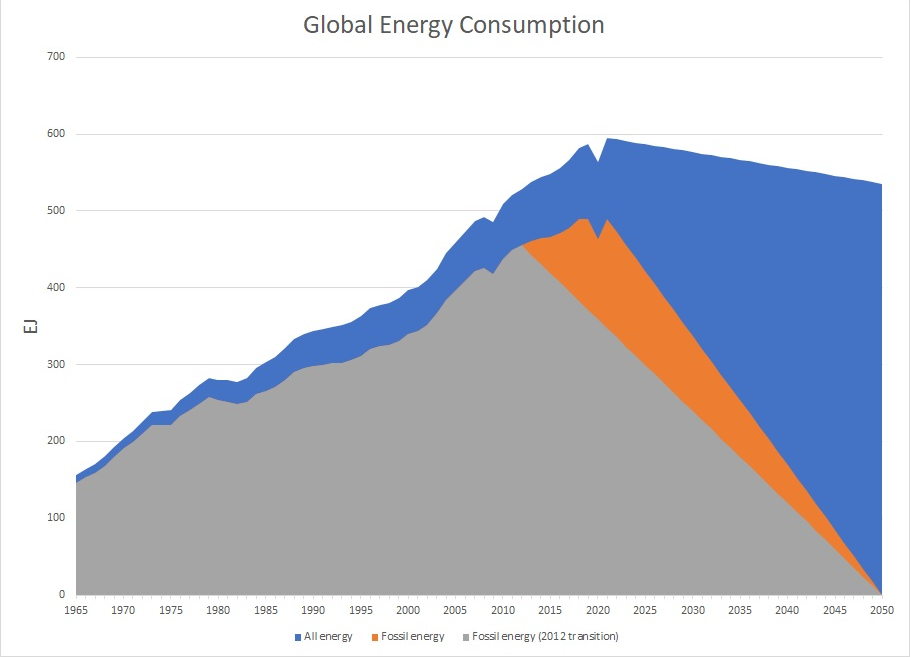
Let’s look at those grosser human realities. In the graph below I indicate total global energy consumption from 1965 to 2021, split between fossil and non-fossil energy sources, and then project that forward to 2050 on the (generous, I think) assumption that by 2050 we’ll need only 91% of current global energy consumption to keep us happily ticking along, but we’ll need to transition completely to non-fossils between now and then.
Source: BP Statistical Review of World Energy
The graph suggests that to achieve a 100% renewables transition by 2050 we’ll need to lose on average 16.9 exajoules of fossil energy consumption from the global energy mix each and every year between now and then. That’s more than the entire fossil energy consumption of the fifth largest energy-using country globally, Japan (15.5 EJ).
Let’s play that out in an imaginary scenario on a country by country basis. The 2022 energy figures haven’t been released yet, but if the graph is going to fit that orange downslope we have to hope that something like 16.9 EJ of fossil fuel consumption will have been swiped out last year. We can start the game gently by taking out the entire fossil fuel consumption of Japan in 2022, although that already puts us a little bit behind the curve.
Next let’s send a delegation to Moscow and ask Mr Putin to eliminate his country’s entire fossil energy use within a period of about 18 months. They’ll need good negotiating skills, but anyway.
Then let’s hop over to the USA and ask the new president, now they’ve bedded in for a bit, to cut 16.9 EJ of fossil energy consumption in their country every year for the rest of their presidential term, with another year on top so their successor can take a bit of the heat (or, in fact, remove it).
After that, India – we’ll give Mr Modi or his successor just over 18 months to cut out all the fossil fuels.
Then the big one. China gets nearly eight years to cut all its fossil energy. Good thing Mr Xi is president for life.
So now it’s 2037, we’ve taken out just the top five fossil fuel using countries and we’re about halfway there. Next year we need to take out another 16.9 EJ of fossil energy – let’s target the entire African continent, giving its governments one year to cut their collective 18 EJ of fossil fuel use, which will help us catch up with what we lost by swiping only Japan in 2022.
After that, we can aggregate various random countries to lose 16.9 EJ each year, every year, for the run up to 2050 by swiping their entire fossil energy consumption. Maybe Canada and Indonesia in 2039. The UK, Turkey and Italy in 2040. And so on until we’ve rounded up the last few stragglers. Job done.
When you frame energy transition technically in terms of things like bringing sodium-ion batteries to commercial scale or optimising inverter-based resources, it all sounds vaguely feasible. When you frame it in terms of taking out roughly the equivalent of the entire fossil energy consumption of the world’s fifth biggest energy consumer every single year for the next thirty years it all sounds vaguely impossible.
And while we’re knocking out all that fossil consumption, we’d have to be building up the renewables consumption – that big area of blue opening up on the right of the graph. Currently renewables account for 7% of total energy consumption and 38% of non-fossil fuel energy consumption, amounting to about 40 EJ of consumption annually. To make the 100% renewables transition, globally we’d have to add the equivalent of nearly half the world’s existing renewables consumption every year from now until 2050. Bear in mind, incidentally, that all this is just to keep global energy use roughly where it is at the moment. Not to transition low-energy and low-income countries to high-energy and high-income ones. And not to find a whole load of extra capacity with which to energise microbial food manufacturing.
You’ll see another downslope in grey on the graph starting in 2012. I picked that year because it was when I started this blog. Back then a few people told me that I was being over-dramatic about a small farm future, because the world would soon be transitioning to clean energy. Sometimes I’ve almost believed that myself. The graph gives a sense of how much that hasn’t happened in the intervening years. Still, that transition, the one that was around the corner in 2012 is now just past history. Or rather past non-history. All that matters now is the transition that’s just around the corner in 2023. Is it possible that will happen, by 2050? Well, we’re taught never to say some future eventuality is impossible. I’m not sure it’s always great advice, but anyway I would say that the transition is all but impossible, yes. And I think it would be better if collectively humanity acknowledged it. Because then all the smart people who are devoting themselves to modelling a 100% transition to renewables and scorning those who say otherwise could redeploy their technical skills towards making the soft path towards a small farm future as soft as it can possibly be.
My fear is that our societies aren’t going to give up on the hope of a 100% renewable transition, meaning – unfortunately – that the likeliest future we face is the hard path to agrarian localism.