

(Conversation Recorded on October 6, 2022.)
On this episode, Nate is joined by Sustainability Science and Policy Professor Jon Erickson. He and Nate dive into Jon’s new book The Progress Illusion: Reclaiming our Future from the Fairytale of Economics, which covers the economic myths that have shaped our modern reality. How can we reshape the narrative and shift the paradigm towards different economic systems that promote human and ecological well-being over material consumption?
About Jon Erickson
Jon Erickson is the David Blittersdorf Professor of Sustainability Science & Policy at the University of Vermont. He has published widely on energy & climate change policy, land conservation, watershed planning, environmental public health, and the theory and practice of ecological economics. He advised presidential candidate Bernie Sanders on economics and energy issues.
Show Notes & Links to Learn More
00:38 – Jon Erickson Works, Info + Newest Book – The Progress Illusion: Reclaiming our Future from the Fairytale of Economics
05:12 – Isolationism and Reductionism
07:17 – University trends towards more progressive ideas
08:16 – E.O. Wilson – Consilience
11:57 – Evolutionary biology
13:44 – Neoclassical economics – utility
15:35 – Heterodox Economics, Orthodox Economics
16:02 – Ecological Economics
17:38 – Economics attempts to become Newtonian
18:32 – John Kenneth Galbraith
19:10 – Carbon Pulse
19:29 – Deep Time Graphic
21:45 – Michael Douglas speech in the movie “Wall Street”
23:05 –Economics, Ecology, Ethics – Herman Daly
24:11 – The Progress Illusion: Reclaiming our Future from the Fairytale of Economics
24:35 – The field of Ecological Economics is very young
30:45 – Nate’s Superorganism paper
32:20 – Donella Meadows Shifting the Paradigm
35:38 – Conservative movement funded the academy starting in the 50s
36:40 – Josh Farley – Circular Firing Squad
36:48 – Bernie Sanders
37:14 – Bernie Sanders record for amendments on bills
39:10 – The US Economy is built on the tradition of democratic socialism
39:17 – Gar Alperovitz, democratization of wealth
40:40 – Autocratic Socialism
40:45 – Martin Luther King – Socialism for the rich, capitalism for the poor
42:40 – Henry George, Karl Polanyi, The Great Transformation
43:06 – The Econocene, Richard Norgaard
44:08 – Occupy Wall Street, Walk out of Gregory Mankiw’s class at Harvard
46:23 – Alfred Kahn – Tyranny of Small Decisions
47:14 – Shifting Baselines
49:16 – Stages of growth in a forest
52:09 – Nordhaus – Nobel Prize in Economics Winner
54:01: Cambridge economist Ha-Joon Chang
59:25 – People were drawn to both Sanders and Trump because of anti-establishmentarianism
1:00:57 – Timothée Parrique + TGS Podcast
1:04:40 – Seeing someone else do altruistic things makes us 300% more likely to be altruistic
1:05:08 – Josh Farley (TGS Episode)
1:08:01 – Frankly Series
1:09:20 – David Christian, Big History
1:11:35 – Dan Kahan study at Yale University (climate science acceptability)
1:14:58 – The Invisible Gorilla Video
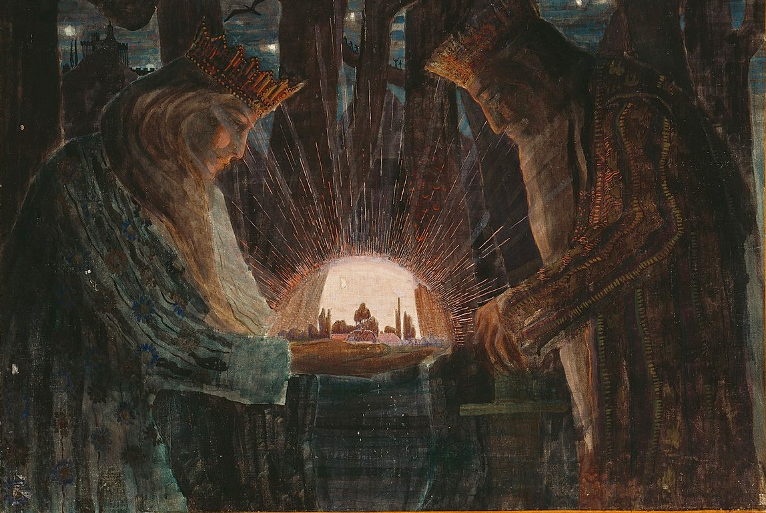
Teaser photo credit: Kings’ Fairy Tale, 1909, by Mikalojus Konstantinas Čiurlionis By Mikalojus Konstantinas Čiurlionis – ciurlionis.eu, Public Domain, https://commons.wikimedia.org/w/index.php?curid=18576612






Comments
We changed commenting systems on September 10, 2026 as part of a site-wide functionality and security upgrade. Your past comments have not disappeared, and you can still log in with your old Disqus account credentials if you wish. Contact us with any questions.