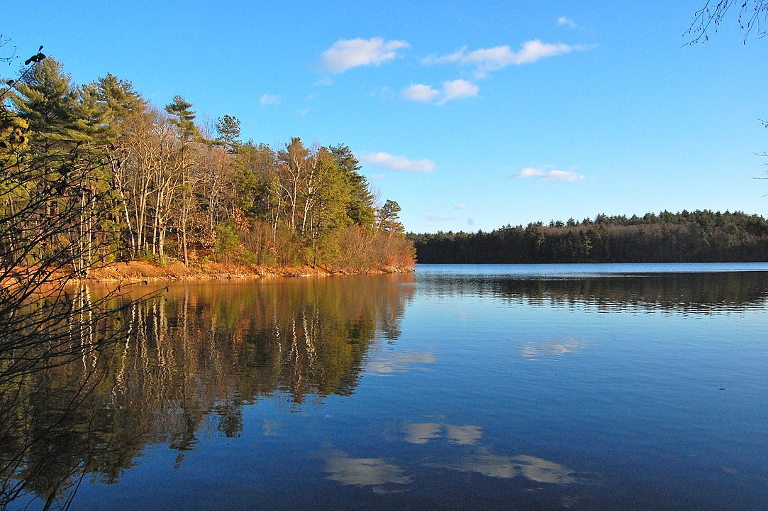
Economy

Thoreau’s Philosophy of Sufficiency Economy at Walden Pond (Part II of Ecological Civilisation)

March 3, 2022

This presentation gives an overview of Henry David Thoreau’s philosophy of sufficiency, which he developed and practised during his famous simple living experiment at Walden Pond (1845-47). Dr Alexander uses Thoreau’s life story to explore the question: How much is enough?

This is Part II of the Ecological Civilisation series, written and presented by Samuel Alexander, co-director of the Simplicity Institute.

The introduction is available here: https://www.youtube.com/watch?v=WxC-r…

This series will be grappling with the problems of consumerism and the growth economy; envisioning alternative, post-carbon ways of life; and considering what action can be taken, both personally and politically, to help build an ecological civilisation.

New presentations will be added to this playlist over time: https://www.youtube.com/playlist?list…

You can support this channel by purchasing an e-book from the Simplicity Institute, available on a ‘pay what you can’ basis (edit the price as you choose for a donation): https://249897.e-junkie.com

Paperbacks are available here: https://au.permacultureprinciples.com…

Samuel Alexander’s work is available here: http://samuelalexander.info

The Simplicity Institute website is here: https://simplicityinstitute.org

We’d like to thank Andrew Doodson, Jordan Osmond, and Antoinette Wilson for offering invaluable production advice.

The opening image is kindly provided by Melissa Davis.

Other image references are available here: http://samuelalexander.info/image-ref…

The music is provided by Mortimer’s Method: https://mortimersmethod.bandcamp.com


Teaser photo credit: By ptwo from Allahabad, India – 985Uploaded by Ekabhishek, CC BY 2.0, https://commons.wikimedia.org/w/index.php?curid=16428533


Samuel Alexander

Dr. Samuel Alexander, co-director of the Simplicity Institute, is a lecturer at the Office for Environmental Programs, University of Melbourne, Australia, teaching a course called ‘Consumerism and the Growth Economy: Critical Interdisciplinary Perspectives’ into the Master of Environment. He is also a Research Fellow with the Melbourne Sustainable Society Institute. He is author of eighteen books, including Degrowth in the Suburbs: A Radical Urban Imaginary (2018), Art Against Empire: Toward an Aesthetics of Degrowth (2017), Just Enough is Plenty: Thoreau’s Alternative Economics (2016), Prosperous Descent: Crisis as Opportunity in an Age of Limits (2015), Sufficiency Economy: Enough, for Everyone, Forever (2015), and Entropia: Life Beyond Industrial Civilisation (2013), and he is editor of Voluntary Simplicity: The Poetic Alternative to Consumer Culture (2009) and co-editor of Simple Living in History: Pioneers of the Deep Future (2014). A full publication list is available here.

As well as his academic work, in recent years Sam has been working on a ‘simpler way’ demonstration project which became the subject of a documentary, ‘A Simpler Way: Crisis as Opportunity‘. He is also founder of the Simplicity Collective, a website and social network dedicated to exploring the relationships between voluntary simplicity, energy descent, and post-growth / degrowth economics.  Dr. Alexander’s PhD thesis, conducted through Melbourne Law School, is entitled “Property beyond Growth: Toward a Politics of Voluntary Simplicity”.


Tags: Simplicity, sufficiency economy

Comments

Welcome to the new Resillience commenting system!

We have moved from the former Disqus commenting system to a new system as of September 10, 2026.

  • Your past comments have not disappeared.
  • You can log in with your old Disqus credentials, as well as Gmail credentials or a Resilience account (formerly Resilience+). Login with Facebook and other credentials is coming soon.

We made this change because of privacy concerns regarding Disqus. It's also part of a set of changes to bring more services to the Resilience community under a single login: commenting, (coming September 2026), and online courses (coming 2027). Unfortunately, your old Disqus comments may not reliably link to your account in this new system. Please contact us if you have any questions or concerns.

Subscribe
Notify of
0 Comments
Oldest
Newest Most Voted