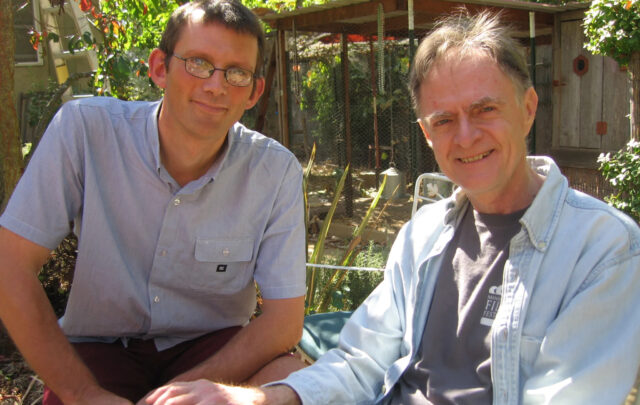
Normally I think it is interesting and exciting to travel to different places for conferences and presentations. But it is with a heavy heart that I made the journey to Houston and Texas. My mission was to celebrate Matt Simmons’ life in remembrance ceremony. It is still difficult to accept that Matt will no longer be with us “Peakists”.
I came to Houston late in the afternoon, collected my hire car and began to drive to the centre of the city and my motel. When I booked the room it had seemed to be quite centrally located but reality showed it to be a motel outside the Interstate 610 “loop” around Houston. The five-lane highway with its amazing multi-level intersections indicates that thoughts of peak oil were far away when it was designed. My two days in the heart of the oil state Texas gave me time for a little reflection in a way that I had not planned but that I found quite interesting.
My conviction that one cannot survive here without a car has been strengthened. While driving around I discovered that, certainly, there is a tram line that runs from north to south through Downtown but the number of passengers that waited at the stations was usually fewer than the fingers on one hand. It might look different at rush hour but around lunch time there was hardly any activity.
On the way to the Museum of Fine Arts where the remembrance ceremony was to take place I passed the eastern part of Houston and, when I arrived, there was time to stroll around the area in which the Museum is situated. It will surprise no one if I mention that I was the only one actually walking around. What I saw was an area that had definitely seen busier days. There were empty shops and a number of large open areas that looked abandoned. There was no sign of any new construction even though this should be an area attractive for development. As an example I can mention that there was a gigantic facility for “drive through banking” with 12 lanes and the capacity for at least 10 cars to queue in each. It now seemed that only one lane remained open and there was only one customer doing their banking with one car waiting its turn. Of course, the internet has taken over some of this activity but the scene set the tone. The fact that one cannot see construction cranes anywhere to indicate building activity – that there is no investment in new infrastructure – is a sign of stagnation.
After the remembrance ceremony (my blog about the ceremony: http://aleklett.wordpress.com/2010/10/05/matt-simmons-remembered-in-hous…) I travelled around a little in Downtown and while there was clearly activity behind the glass facades of the buildings, there was no new construction there either. Once again there were empty shops and a noticeable feeling that the city was falling into a long slumber.
On my list of things to do was to travel to Texas City and look at all the oil refineries to be found there. There was no opportunity to enter the harbour area but the funnel on what was presumably a supertanker indicated that there was activity behind all the tanks. The USA’s dependence on imported oil is so great they must receive a new supertanker every 5 hours. The fact that Texas City is the USA’s sixth largest harbour indicates that shiploads of oil must arrive there every day. What will happen to Texas City when we have passed peak oil and more and more tankers voyage to China rather than the USA? Just as in Houston there was nothing in Texas City to indicate any investment in new construction. Instead, much of the installation seemed old and a little rusty.
Finally, I travelled to the coast and Galveston. The picture was the same there as in Houston and Texas City but in the centre of town they had renovated some of the old locales and there were activities typical of a tourist city. At a bar over a glass of beer one of the few customers described how Galveston had once been the capital city of Texas and how they were the first to get electricity etc. The opera house built in 1894 was mentioned with pride and many of the houses in the centre of the city seemed to date from Galveston’s golden age at the start of the 20th century. There is a wonderful beach at Galveston and the city will certainly survive as a tourist destination but the question is whether there will be sufficient gasoline for all the cars that need to travel there.
In California and Nevada many new cities sprang up in the wake of the gold rush and today some of those places are either ghost towns or tourist towns. The oil in Texas and off its coast has been the foundation for Texas’ greatness but a conclusion that I could draw from what I saw was that, for Texas, peak oil may have begun. What is needed now is for Texas’ leadership to immediately begin to plan for the period “past peak oil”. We needed Matt so that Houston and Texas could come up with alternative ideas for its future.
(If you have different views from what I have presented above then I hope that you will leave a comment on my blog; http://aleklett.wordpress.com/2010/10/05/has-texas-pased-the-peak/)
Comments:
Ed says:
October 6, 2010 at 9:22 pm (Edit)
Jim Rogers has left the U.S. and predicts extremely hard times to come for people in the U.S.. He is teaching his children Chinese. The U.S. federal government deficit is 1750 billion dollars this year. Almost 15% of the gross product of the country. The 4000 billion dollars owned to the social security trust fund to pay for food and housing for the old is unlikely ever to be honored. It is far more than Texas that is going down.
JVP says:
October 7, 2010 at 6:47 pm (Edit)
I live in NYC but was raised in Arizona.
I see similar scenes when I return home to visit family.
The amount of energy peopel consume to complete the simplest of tasks is staggering when you consider shrinking oil supplies.
ALL activity, from going to the post office, or buying a gallon of milk,requires the assistance of a 2 ton vehicle.
After 20 years of city living, and the conveniences of walking to my needs,I am not sure most people can contemplate the disruption to their lives that is coming ( or has arrived).
tejanojim says:
October 7, 2010 at 10:20 pm (Edit)
I live and work in Houston, and my commute takes me up I45 from near downtown to near Bush Airport. What I see is businesses failing one by one, and once they shut down nothing takes their place. The most dramatic is a huge car lot, now abandoned to plywood and grafitti. Downtown, through which I commute by bus once a week, is the same as ever, devoted to the suit and BMW class and the workers that tend to them.
The city is actually in the process of building two more light rail lines and extending the existing one further north. None of the new lines, as far as I can tell, connect to major destinations or go to places I visit regularly.
My one nitpick with your post is Galveston – even by car, it takes much less liquid fuel to get there than to go to Aspen or Costa Rica. Also, since they have a working port, their rail connection to Houston is functional. Getting passenger service restarted shouldn’t be a major challenge.
In terms of attitude, climate change has more visibility than peak oil, and is itself vehemently denied by most residents. The mood I detect is resignation that the brightest days of the American Empire are behind us. Worries about federal debt and the rise of China, like Ed mentions above, are common. Thanks for a good post, and thanks for visiting my town. Matt Simmons will be missed.